Giving a mobile detailer access to your parking is the single most important step toward a successful on-site car detailing service. Without the right space, permissions, and preparation, even the best detailer cannot deliver a quality result. Urban car owners face unique challenges here: gated lots, underground garages, HOA rules, and tight street parking all create friction that a traditional shop visit never would. This guide covers exactly what you need to know about space requirements, legal permissions, equipment self-sufficiency, and how to prepare your spot before the detailer arrives.
What parking space requirements do mobile detailers need?
The industry standard space for mobile detailing is a flat area roughly 12 feet by 20 feet. That footprint gives the detailer room to open all four doors, move freely around the vehicle, and position equipment without blocking traffic or neighboring cars.
Surface grade matters just as much as size. Slopes steeper than 8–10% make water collection unreliable and create stability risks for equipment carts and pressure washers. A gently sloped driveway is usually fine. A steep parking deck ramp is not.
Location type changes the equation entirely. A private driveway is the easiest scenario: open access, no gate codes, and no neighbors to disturb. Street-side parking works in most residential areas, but public street regulations in some cities restrict or prohibit commercial service vehicles on narrow roads. Underground and covered garages introduce a separate problem: vehicle height clearance for the detailer's cargo van. Standard mobile detailing vans often exceed 7 feet in height, which rules out many urban parking structures.
Pro Tip: Before booking, measure or confirm the clearance height of your garage entrance. Most parking structures post the limit near the entry gate. Share that number with your detailer when you schedule.
Weather is the final physical factor. Exterior detailing pauses in rain or when temperatures drop below 40°F or climb above 95°F in direct sun. Products like wax, ceramic coatings, and paint sealants cure poorly outside those ranges. If your parking spot sits in full afternoon sun with no shade, mention it when booking so the detailer can plan an early morning slot.
How do you secure permission for mobile detailing in urban parking?
Operating on private property without explicit permission is legally considered trespass. That rule applies whether the property is a corporate parking lot, an apartment complex, or a gated community. Permission is not a formality. It is a legal requirement.
The type of permission you need depends on where your car lives:
- Private driveway (owned home): No third-party approval needed. You are the property owner. Just confirm the space meets the physical requirements above.
- Apartment complex or condo: Contact building management or your HOA before booking. Apartment and gated community lots often require prior approval, and some buildings ban commercial service vehicles outright due to liability and noise concerns.
- Commercial parking lot: Get written approval from the property manager. Many managers will ask about the detailer's insurance and environmental practices before granting access.
- Public street: Check local ordinances. Some cities require permits for commercial vehicles parked on residential streets during service hours.
Property managers respond well to two things: proof of insurance and confirmation of zero-discharge detailing methods. Property managers prioritize environmental protections and frequently require that detailers use wastewater containment systems before granting access. A reputable detailer will have this documentation ready.
Pro Tip: When you contact your building manager, frame the request around the detailer's eco-friendly practices and self-contained equipment. Managers who hear "no runoff, no noise beyond a vacuum" approve requests far more often than those who hear "a commercial van will be parked here for three hours."
When you book, pass along every access detail: gate codes, visitor parking instructions, security desk contact names, and elevator restrictions. Clear communication at the booking stage prevents the most common urban detailing failure, which is the detailer arriving and being unable to enter.
What equipment do self-contained mobile detailers carry?
Modern professional mobile detailers operate as fully self-contained units. Most carry 30–50 gallon onboard water tanks and use generators or battery inverters for power. That setup means 90% of services require no connection to your property's water supply or electrical outlets.
The table below shows how equipment needs shift based on service type and parking location.
| Service type | Water needed | Power source | Hookup required? |
|---|---|---|---|
| Express interior detail | Minimal (spray bottles) | Battery inverter | No |
| Full exterior wash and wax | 20–40 gallons | Generator or inverter | Rarely |
| Paint correction or ceramic coating | 30–50 gallons | Generator | Occasionally |
| Engine bay cleaning | 10–20 gallons | Generator | No |
When a hookup is requested, it is almost always for a full-day paint correction job that exceeds the onboard tank capacity. For standard detailing appointments, your water and power stay untouched.
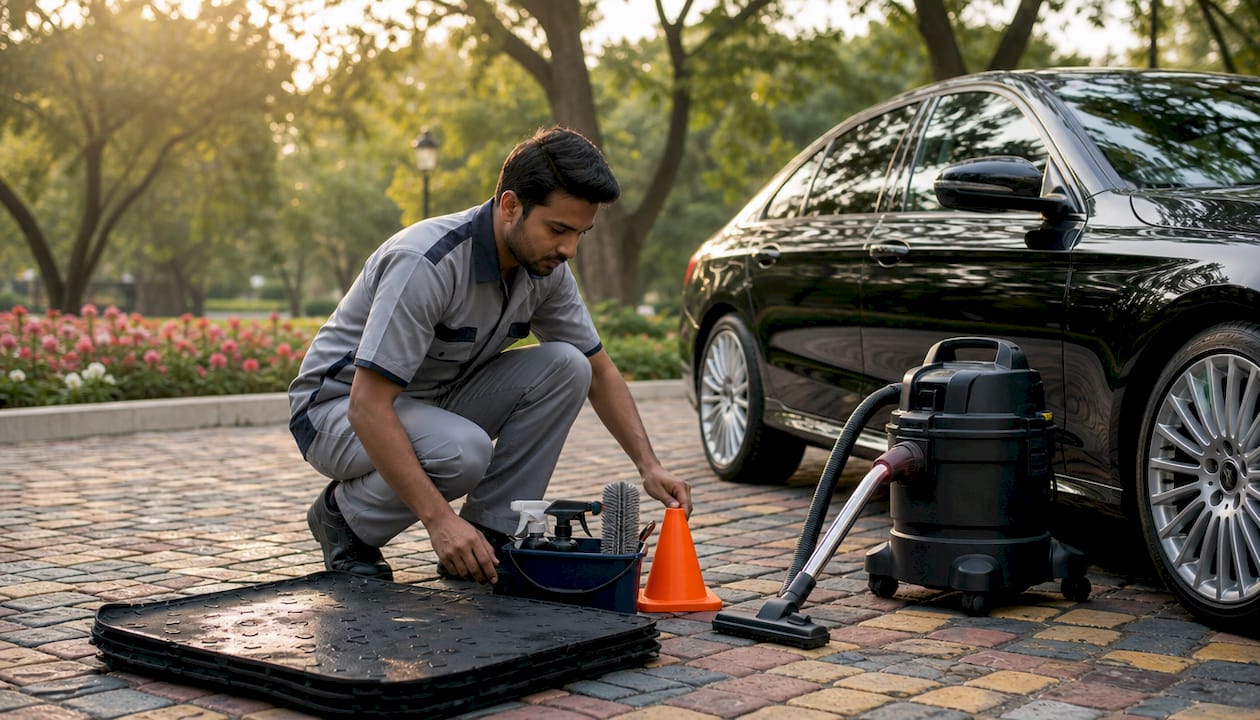
Wastewater containment is the other side of the equation. Responsible detailers use containment mats and wet vacuums to capture runoff rather than letting it flow into storm drains. This practice satisfies most property manager requirements and aligns with environmental standards that are increasingly enforced at the municipal level in 2026. Living Waters Auto Wash LLC operates without requiring electricity or water hookups from customers, which removes the most common friction point in urban detailing access.
How should you prepare your parking spot before the detailer arrives?
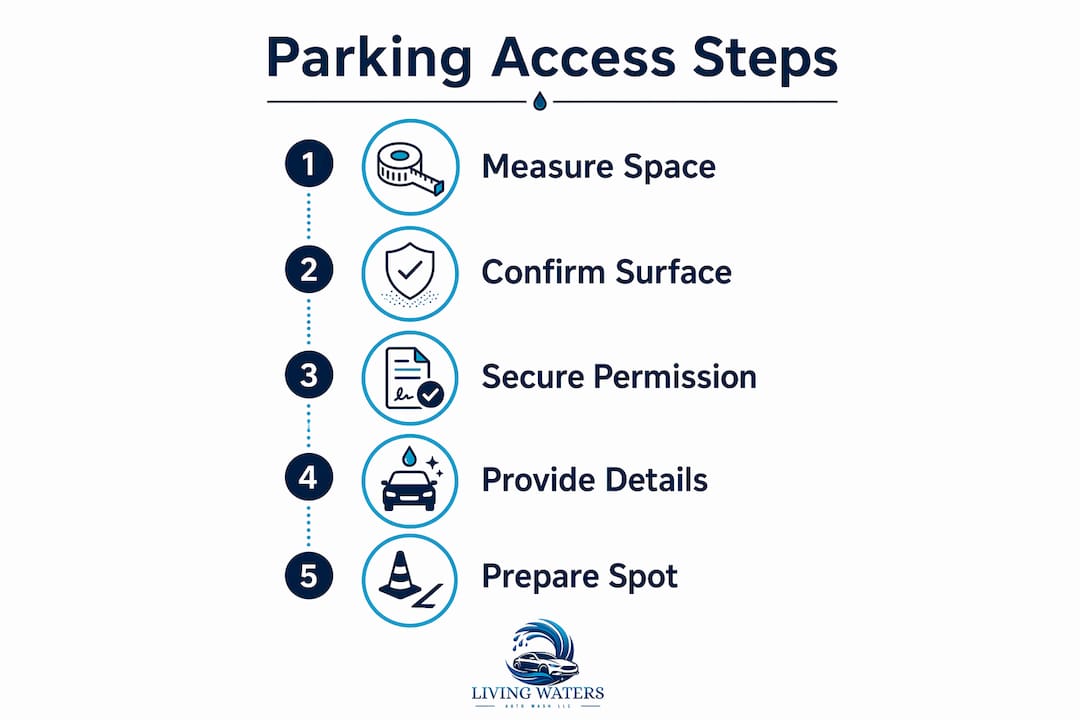
Preparation takes about ten minutes and prevents delays that can cost you an hour. Follow these steps before your appointment:
- Describe your parking accurately when booking. Tell the detailer whether your space is an underground garage, an open lot, a street spot, or a private driveway. Accurate parking descriptions let the detailer bring the right equipment and plan the right access route.
- Clear adjacent spaces. Move any other vehicles or large objects from the spots directly beside yours. The detailer needs that buffer to work around the car safely.
- Send access details in advance. Share gate codes, visitor pass instructions, and the security desk contact at least 24 hours before the appointment. Do not wait until the morning of service.
- Park in the best available spot. Choose a flat, well-lit area over a dark corner or sloped section, even if it means walking a little farther from the entrance.
- Remove personal items from the interior. Clear the seats, floor mats, and trunk of anything you do not want moved. This speeds up interior work and protects your belongings.
- Plan for the car to stay parked. A standard detail runs 1.5–4 hours depending on service level. Do not schedule the appointment on a day when you need the car mid-service.
- Check the weather and reschedule if needed. If rain or extreme heat is forecast, contact the detailer the day before. Most reputable services reschedule without penalty for weather.
Pro Tip: Many detailers now offer contactless service where you leave keys with a concierge or use a lockbox. If your schedule is tight, ask about this option when booking. It is one of the biggest time-saving advantages of mobile detailing for busy urban car owners.
For a full checklist on getting your vehicle and space ready, the mobile detailing appointment prep guide from Living Waters Auto Wash LLC covers every step in detail.
Key Takeaways
Giving a mobile detailer proper parking access requires the right space dimensions, explicit permissions, and clear communication before the appointment.
| Point | Details |
|---|---|
| Space size and grade | A flat area of roughly 12'x20' with a slope under 8–10% is the minimum workable setup. |
| Permissions are required | Always get explicit approval from building management or HOAs before booking in shared lots. |
| Self-contained equipment | Most detailers carry onboard water and power, so no property hookups are needed for standard services. |
| Clearance height matters | Confirm your garage entrance height before booking to avoid last-minute cancellations. |
| Preparation prevents delays | Share gate codes, clear adjacent spots, and remove interior items at least 24 hours before service. |
What urban parking access has taught me about mobile detailing
The most common reason a mobile detailing appointment fails in an urban setting is not the detailer's skill. It is a parking problem that nobody thought to solve in advance. I have seen appointments fall apart because a cargo van could not clear a 6-foot garage entrance, because a building manager turned away a service vehicle with no prior notice, and because a customer parked on a slope steep enough to make water collection impossible.
The fix is always the same: communicate early and communicate specifically. Telling a detailer "I live in an apartment" is not enough. Telling them "I have a visitor parking spot on level B2, clearance is 7.5 feet, gate code is 1234, and the security desk needs 24-hour notice for commercial vehicles" is what actually gets the job done.
Self-contained equipment has changed what is possible in urban detailing. The fact that mobile detailing for busy drivers no longer requires access to your building's water or power is a genuine shift. It removes the biggest objection property managers used to raise. But equipment alone does not solve the access problem. The car owner still has to do the groundwork on permissions and logistics.
My honest advice: treat the parking access conversation the same way you treat the service itself. Give it real attention before the appointment, and the detailing experience becomes exactly what it promises to be.
— Living
Living Waters Auto Wash LLC comes to your parking, ready to work
Urban car owners in Boca Raton, Pompano Beach, Coral Springs, and Parkland no longer need to drive to a shop or fight for a service bay appointment. Living Waters Auto Wash LLC brings professional detailing directly to your location, fully equipped with onboard water and power so your building's resources stay untouched.

The team handles the access logistics with you at booking, from gate codes to clearance checks, so there are no surprises on service day. Whether you need a quick express interior clean or a full exterior treatment, Living Waters Auto Wash LLC arrives prepared for your specific parking setup. Book your appointment at Living Waters Auto Wash and get a 5-star detail without leaving your parking spot.
FAQ
What size parking space does a mobile detailer need?
A minimum flat space of roughly 12 feet by 20 feet is the industry standard for mobile detailing. The surface should have a slope of less than 8–10% for safe equipment use.
Do I need to provide water or power for the detailer?
Most professional mobile detailers carry 30–50 gallon onboard tanks and generators or battery inverters, so the vast majority of standard services require no hookup to your property.
Can a mobile detailer work in my apartment complex parking lot?
Yes, but you must get prior approval from building management or your HOA first. Some buildings prohibit commercial service vehicles due to liability or noise policies, so confirm before booking.
What should I tell the detailer when I book?
Provide your exact parking type (underground garage, open lot, street, or driveway), clearance height if applicable, gate codes, and any building security requirements. Clear intake information prevents equipment mismatches and access delays.
Can mobile detailing happen if it rains?
Exterior services are typically paused or rescheduled during rain or when temperatures fall below 40°F or exceed 95°F. Contact your detailer the day before if severe weather is forecast to arrange a reschedule without penalty.