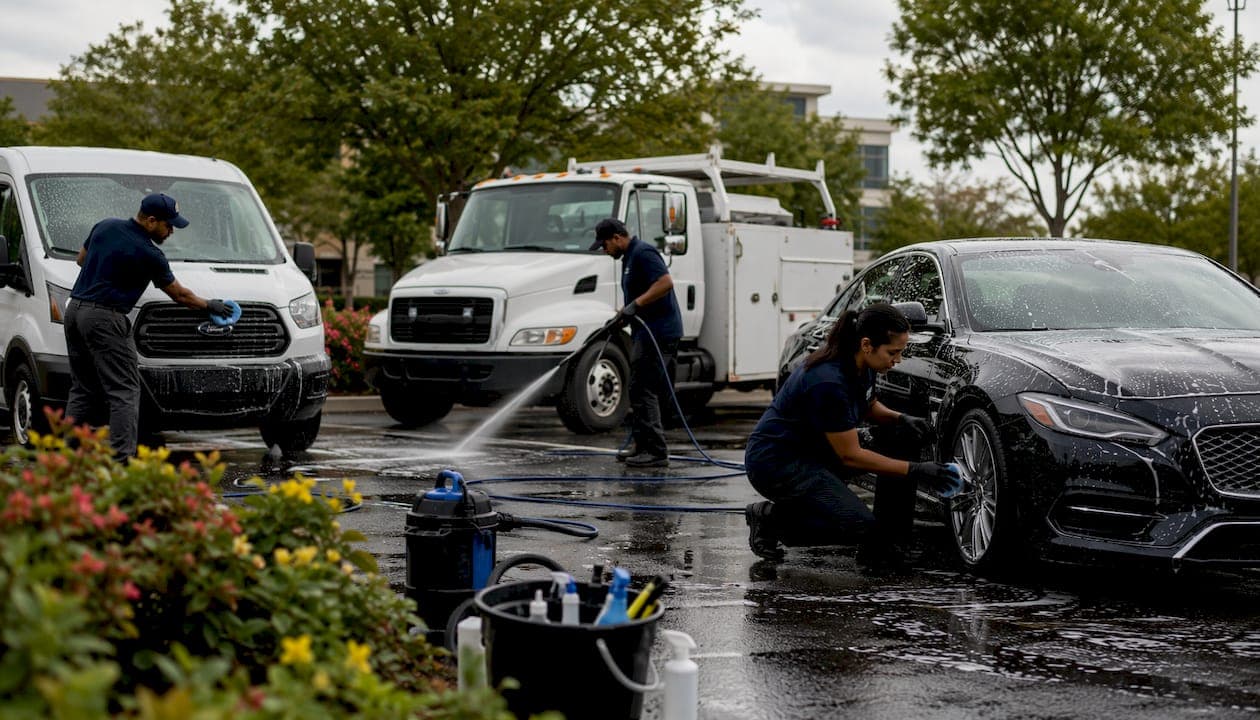
Mobile detailing keeps fleets operational and presentable by delivering cleaning and protective services directly on-site, eliminating shop transport time and compressing per-vehicle downtime to near zero. For fleet managers, the role of mobile detailing for fleets goes well beyond clean paint: it's a scheduling lever, a maintenance tool, and a brand asset rolled into one recurring program.
Here's what that looks like in practice:
- Uptime: A medium-route vehicle typically wastes 30–60 minutes per off-site wash visit. Mobile service collapses that dead time entirely.
- Brand image: Every vehicle on the road is a moving advertisement. A dirty van signals neglect; a clean one signals competence.
- Maintenance cost savings: Ceramic coatings cut subsequent wash times significantly according to operator reports, and headlight restoration directly improves nighttime visibility.
- Protective services: Sealants, paint protection film (PPF), and coatings extend vehicle life and preserve resale value.
- Scheduling flexibility: Off-hours and weekend programs mean vehicles are detailed while drivers sleep, not while they should be working.
Living Waters Auto Wash LLC, serving Boca Raton, Pompano Beach, Coral Springs, and Parkland, is a working example of how a U.S. mobile provider structures recurring fleet programs without requiring a fixed facility.
Table of Contents
- What fleet mobile detailing is and how it differs from single-vehicle work
- Core services mobile detailers bring to your fleet
- Why mobile detailing pays off operationally and financially
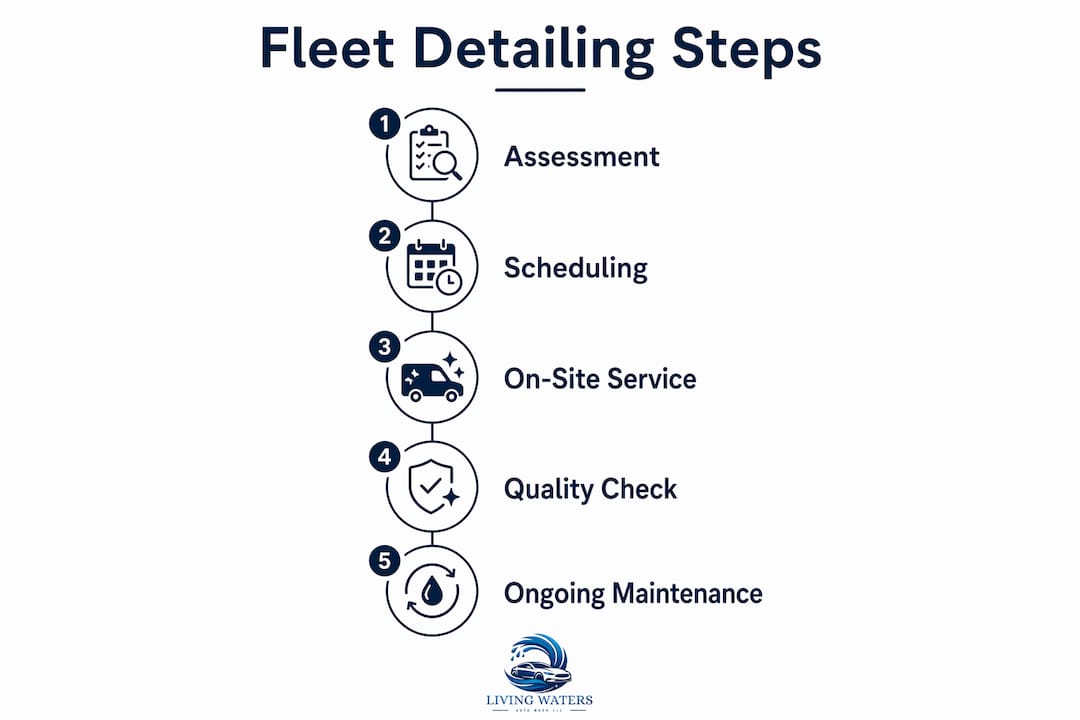
- How a mobile fleet detailing program is scheduled and run
- Typical costs, time estimates, and how often each vehicle type needs service
- How to evaluate and choose a mobile fleet detailer
- How Living Waters Auto Wash LLC supports fleet accounts
- Key Takeaways
- The case for treating detailing as an operations decision, not a cleaning budget line
- Living Waters Auto Wash LLC fleet programs: get a quote for your vehicles
- Recommended sources and further reading
What fleet mobile detailing is and how it differs from single-vehicle work
Mobile fleet detailing means a fully equipped team comes to your yard, lot, or office parking structure and services multiple vehicles on a recurring schedule. The detailer brings everything: water, power, extraction equipment, and products. No hookups required at your facility.
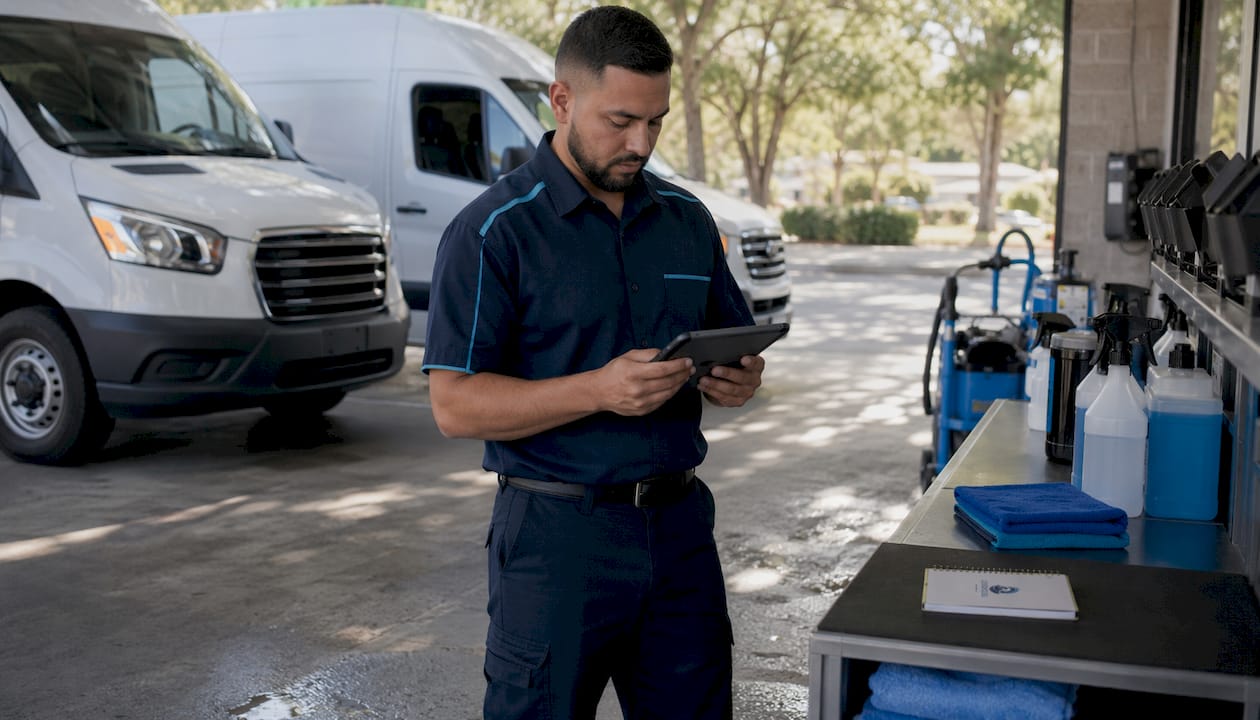
The difference from single-vehicle mobile detailing is scale and structure. A one-car appointment is transactional. A fleet program is a managed service with route planning, recurring billing, certificates of insurance (COI), and documented service scopes. The detailer sequences vehicles to minimize blocking dispatch lanes, tracks which units received which services, and invoices on a Net-15 or monthly cycle.
Fleet use cases span a wide range of vehicle types: delivery vans, service trucks, box trucks, pickup fleets, and executive sedans. Each class has different duty cycles, different contamination profiles, and different service priorities. A delivery van accumulates road grime and interior debris daily. An executive vehicle needs a lighter touch more frequently. A box truck may need undercarriage attention after highway miles. A well-structured fleet program accounts for all of it, rather than applying one-size-fits-all pricing and service depth.
Core services mobile detailers bring to your fleet
Fleet programs typically bundle services across three tiers: routine maintenance, full detail, and protective treatments. Here's what each covers:
Exterior services:
- Express wash (rinse, soap, hand wash, dry)
- Full exterior detail (clay bar, polish, wax or sealant)
- Wheel and tire cleaning, brake dust removal
- Undercarriage rinse for road salt and debris
- Wrap-safe washing protocols for vinyl-wrapped fleet vehicles
Interior services:
- Vacuum and surface wipe-down (express)
- Deep interior: upholstery extraction, odor treatment, leather conditioning
- Dashboard, console, and vent cleaning
- Sensor and backup camera lens cleaning (increasingly critical for telematics-equipped fleets)
- Cargo area sanitization for food-service or medical transport vehicles
Protective and restorative services:
- Paint sealants and ceramic coatings for high-mileage units
- Headlight restoration for aging lenses
- PPF applications on high-wear zones (front bumpers, mirror caps, door edges)
- Forced-air drying and de-icing prep for cold-weather operations
Pro Tip: For wrapped fleet vehicles, always confirm the detailer uses wrap-safe, pH-neutral products. Aggressive degreasers lift vinyl edges at seams, which turns a $4,000 wrap into a rework job.
Why mobile detailing pays off operationally and financially
The clearest ROI argument is time. When a driver has to leave a route to visit a wash facility, that round trip typically burns 30–60 minutes per visit. Multiply that across a 20-vehicle fleet on a weekly wash cycle and you're looking at 40–120 driver-hours lost per month to a task that mobile service handles during off-hours. That's labor you get back without changing anything else about your operation.
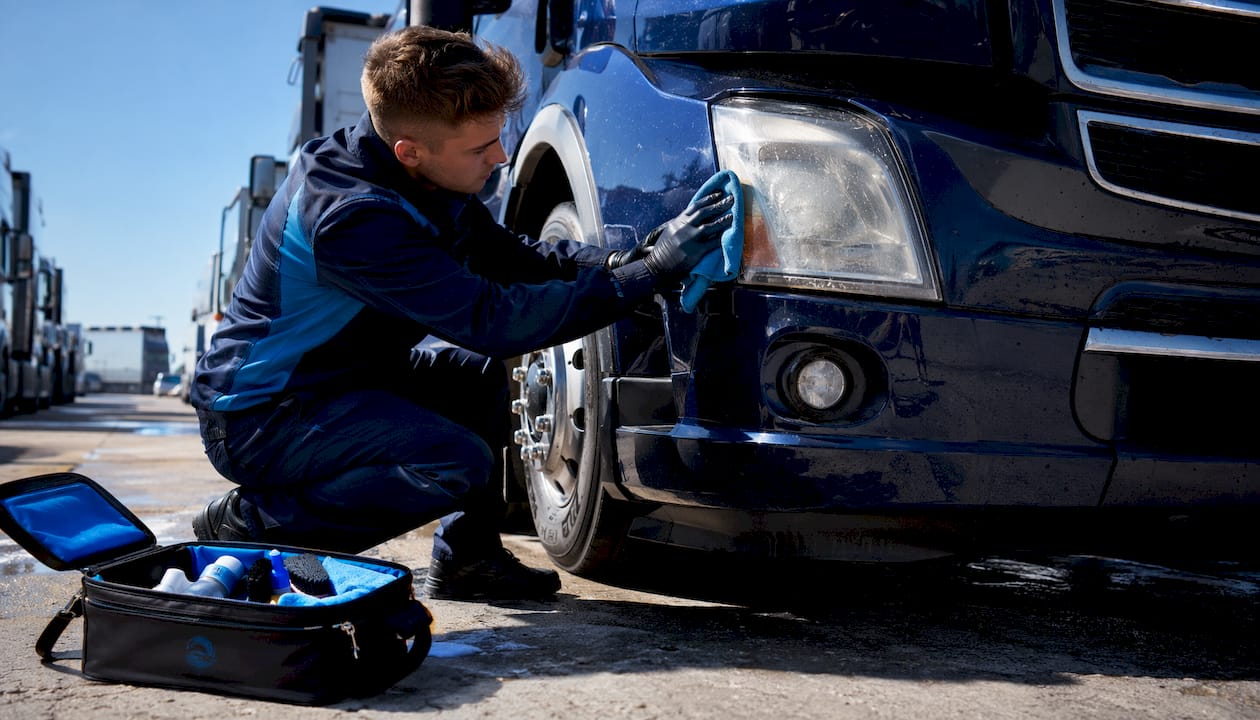
Cost benefits compound over time. Protective coatings reduce the effort and product needed for each subsequent wash, and ceramic coatings can cut wash time by 20–30% per vehicle once applied. Paint and interior preservation also protect resale value, which matters when you're cycling vehicles every three to five years. A fleet that arrives at auction clean, with no oxidized paint or cracked dashboards, commands meaningfully better trade-in numbers.
Safety is an underappreciated line item. Clouded headlights reduce nighttime visibility, and dirty backup camera lenses create blind spots in vehicles that drivers rely on for safety compliance. Regular detailing addresses both. Clean cab interiors also reduce slip hazards from debris accumulation on floor mats, particularly in service trucks where technicians climb in and out repeatedly.
Pro Tip: When building the internal business case, tie detailing costs to driver hours and preventive maintenance schedules rather than presenting it as a cleaning expense. A $120/vehicle/month retainer looks very different when it's framed as "we recovered 6 driver-hours and extended paint life by two years" versus "we spent $1,440 on washing."
How a mobile fleet detailing program is scheduled and run
A well-run fleet program follows a consistent choreography. The detailer arrives before dispatch, stages equipment away from traffic lanes, and works through a pre-agreed vehicle sequence. Exterior work comes first while interior products dwell. Final inspection closes each unit before the next one opens.
Logistics checklist for your site:
- Confirm water access or verify the detailer's tank capacity (sufficient for a properly equipped van)
- Identify power access or confirm the detailer carries a generator or inverter
- Mark drainage paths to avoid runoff compliance issues
- Designate a staging area that doesn't block dispatch or loading docks
- Establish a VIN/key control process so vehicles are ready and accessible
- Verify COI before the first service date
High-performing programs also account for lighting (critical for off-hour shifts), low-noise equipment for early-morning starts, and forced-air drying in cold or humid conditions. These aren't nice-to-haves; they're the difference between a smooth weekly route and a program that falls apart after two months.
| Service | Sedan | Van/Pickup | Box Truck | Turnaround |
|---|---|---|---|---|
| Express wash | 45–60 min | 60–90 min | 60–90 min | Same shift |
| Exterior detail | 1.5–3 hr | 2–4 hr | 2–4 hr (+45–60 min for larger vehicles) | Same day |
| Interior detail | 2–4 hr | 2–4 hr (+45–60 min for larger vehicles) | 2–4 hr (+45–60 min for larger vehicles) | Same day |
| Full detail | 4–5 hr | 5–6 hr | 5–6 hr (+45–60 min for larger vehicles) | Scheduled off-day |
| Ceramic coating | multi-day process per vehicle class | Weekend or rotation |
Time ranges based on industry-reported job durations; larger vehicles require additional time compared to sedans.
Typical costs, time estimates, and how often each vehicle type needs service
Pricing for fleet mobile detailing follows a tiered structure based on account size and service depth. Small-business fleets generally pay monthly retainers per vehicle, and corporate accounts with larger fleets pay proportionally more for bundled programs. Dealership lot preparation rates vary and typically reflect operational scale efficiencies.
Per-vehicle time estimates from industry data indicate express washes typically take 45–90 minutes, exterior details last 1.5–3 hours, interior details require 2–4 hours, and full details on sedans take 4–5 hours, with SUVs/trucks needing 45–60 minutes additional time.
| Vehicle class | Typical time (express) | Typical time (full detail) | Recommended cadence | Sample monthly range |
|---|---|---|---|---|
| Delivery van | 45–90 min | 4–5 hr (+45–60 min for larger vehicles) | Weekly express, monthly full | — |
| Service truck | 45–90 min | 4–5 hr (+45–60 min for larger vehicles) | Biweekly express, quarterly full | — |
| Executive sedan | 45–60 min | 4–5 hr | Weekly or biweekly | — |
| Box truck | 45–90 min | 4–5 hr (+45–60 min for larger vehicles) | Biweekly express, semiannual full | — |
For recommended detailing frequency by vehicle type, high-contact delivery vehicles generally need weekly express washes and a monthly full interior. Executive vehicles benefit from more frequent light service to maintain presentation. Service trucks can often run biweekly on express with quarterly deep cleans, depending on duty cycle and geographic conditions.
How to evaluate and choose a mobile fleet detailer
Vetting checklist:
- Proof of commercial general liability insurance with an additional-insured endorsement, not just a certificate-holder listing. The distinction matters: as an additional insured, your fleet is directly covered under the detailer's policy.
- Garage-keepers coverage for vehicles in their care, custody, and control
- Documented recurring program with written service scope, not verbal agreements
- References from at least two fleet accounts of similar size
- Confirmed product compatibility with wrapped or vinyl-graphic vehicles
- Route reliability record: ask how they handle weather delays and technician absences
Sample procurement questions to ask on the first call:
- What's your turnaround SLA per vehicle class, and how do you handle rework if a unit doesn't pass inspection?
- How do you handle COI requests, and can you add us as additional insured within 48 hours?
- What's your invoicing cadence, and do you offer Net-15 terms for fleet accounts?
- How do you sequence vehicles to avoid blocking our dispatch lanes?
- What products do you use on wrapped vehicles, and can you provide the product data sheets?
Red flags to walk away from:
- Vague or missing COI documentation
- No written route plan or service schedule
- Pricing pitched below $90/vehicle for full-detail work on a solo-operator model (margin math doesn't work, and service quality suffers)
- No fleet references, or references they can't provide in writing
- Resistance to a pilot run before a long-term contract
Contracting tips: Start with a 2–3 vehicle pilot at a discounted or complimentary rate. Establish Net-15 billing from day one. Require a one-page scope of work that defines service inclusions, exclusions, and rework policy before signing anything longer than a month-to-month agreement. Corporate fleet contracts often take 60–120 days to close from first contact to signed agreement; small-business fleets typically move in 1–4 weeks.
How Living Waters Auto Wash LLC supports fleet accounts
Living Waters Auto Wash LLC operates as a fully mobile, eco-conscious detailing company serving Boca Raton, Pompano Beach, Coral Springs, and Parkland. The company requires no water or power hookups at the client's location, which removes one of the most common logistical barriers for fleet managers evaluating on-site programs.
Their fleet services are structured around recurring programs rather than one-off appointments. A typical fleet arrangement might pair weekly express exterior washes with a monthly full interior and exterior detail, plus ceramic coating applications on flagship or high-visibility units on a quarterly or annual rotation. Scheduling and billing are handled on a recurring basis, which means fleet managers aren't chasing invoices or rebooking after every service cycle.
Trust signals matter when you're handing over keys to a fleet. Living Waters Auto Wash LLC carries 5-star local reviews, employs a trained detailing team, and operates with the COI documentation fleet procurement teams require. For managers in South Florida evaluating a mobile car wash for fleets, that combination of local coverage, eco-conscious practices, and documented quality is a practical starting point for a pilot program.
Key Takeaways
Mobile fleet detailing is a measurable operational investment: it recovers driver hours, protects vehicle assets, and keeps brand presentation consistent without pulling vehicles off route.
| Point | Details |
|---|---|
| Time savings are immediate | Off-site wash visits waste 30–60 minutes per vehicle; mobile service eliminates that loss entirely. |
| Protective coatings compound ROI | Ceramic coatings reduce subsequent wash time by 20–30%, lowering long-term labor and product costs. |
| Insurance terms matter | Always require an additional-insured endorsement, not just a certificate-holder listing, before signing any fleet contract. |
| Frequency drives results | Delivery vans need weekly express service; service trucks can run biweekly; executive vehicles benefit from consistent light-touch care. |
| Living Waters Auto Wash LLC | Offers recurring mobile fleet programs across Boca Raton, Pompano Beach, Coral Springs, and Parkland with no hookup requirements. |
The case for treating detailing as an operations decision, not a cleaning budget line
The conventional framing for fleet detailing is cosmetic: clean vehicles look professional. That's true, but it undersells the actual leverage. The more useful frame is operational: detailing is a scheduled maintenance task that happens to produce a clean vehicle as a byproduct.
When you treat it that way, the procurement conversation changes. You're not approving a cleaning expense; you're scheduling a recurring service that recovers driver hours, extends asset life, and reduces the frequency of reactive maintenance on paint, sensors, and interiors. The managers who get the most out of mobile fleet programs are the ones who tie detailing metrics to their preventive maintenance schedules and driver time logs, not the ones who approve it because the vehicles "look bad."
The pilot approach is the right first move. Run 2–3 vehicles for 30–60 days. Track time per vehicle, rework rate, and driver feedback. If the numbers hold, scale the contract. If they don't, you've spent very little to find out. Month-to-month terms protect you during that evaluation window; don't let a provider push you into a six-month minimum before you've seen a single service cycle.
Living Waters Auto Wash LLC fleet programs: get a quote for your vehicles
Fleet managers in South Florida have a straightforward option for on-site vehicle detailing that doesn't require facility upgrades or driver downtime. Living Waters Auto Wash LLC brings a fully equipped mobile team to your location across Boca Raton, Pompano Beach, Coral Springs, and Parkland, with no water or power hookups needed on your end.
Pilot programs are the standard starting point: bring 2–3 vehicles into a first-service cycle at a reduced rate, confirm the workflow fits your dispatch schedule, and scale from there. Recurring retainer options cover everything from weekly express washes to full detail and ceramic coating rotations for high-visibility units. The team is trained, insured, and built around recurring fleet relationships rather than one-off residential work.
Ready to see what a clean fleet actually costs in time and money? Claim the $30 exterior wash offer for your first vehicle and use it as the starting point for a fleet pilot conversation.
Recommended sources and further reading
These sources cover the operational, financial, and insurance dimensions of mobile fleet detailing in more depth:
- Living Waters Auto Wash LLC fleet services: The company's fleet page covering service packages, service area, and recurring program structure for South Florida fleets.
- How mobile car detailing works (neardetailer.com): Practical breakdown of job durations, equipment requirements, and on-site workflow expectations. Useful for benchmarking turnaround times.
- Mobile detailing time-saving benefits: Covers how mobile service reclaims driver hours across multi-vehicle operations.
- Commercial and fleet mobile detailing economics (30DayPivot): Covers pricing tiers, retainer structures, dealership lot economics, and sales cycle timelines for corporate fleet accounts.
- Certificate holder vs. additional insured (SmartInsured): Explains the critical insurance distinction fleet managers must understand before signing any detailing contract.
- Mobile detailing for fleet vehicles: save time and money: Covers operational time savings, headlight restoration benefits, and coating ROI data points.
- Car detailing frequency recommendations: Guidance on recommended service cadences by vehicle type, useful for building a recurring program schedule.
- Eco-friendly mobile car wash practices: Covers water-saving techniques and environmental compliance considerations for fleet programs operating in regulated areas.