Choosing an eco-friendly car wash can cut freshwater use significantly compared to unregulated home washing and keeps oil, detergent, and heavy metals out of storm drains that flow straight into local waterways. The mechanisms behind that number are specific: water-reclamation loops that reuse rinse water, wastewater routed to sewer treatment instead of a storm drain, and biodegradable soaps that break down before they reach a stream. The EPA's WaterSense program and the International Carwash Association (ICA) have both documented these savings in the field, and mobile operators like Living Waters Auto Wash LLC apply the same low-water, no-runoff principles at a driveway or office parking lot instead of a fixed facility.
The practical upside matters as much as the environmental one:
- Less water on the paint means less chance of swirl marks from gritty runoff sitting in a driveway puddle.
- Biodegradable, pH-neutral products tend to be gentler on wax and ceramic coatings.
- Mobile and reclamation-equipped services save owners a trip and often a chunk of water utility cost over a year.
If you're picking a provider, look for one that either runs a certified water-reclamation system or, if mobile, uses closed-loop equipment and eco-rated chemicals with no wastewater discharge at all.
Key Takeaways
Eco-friendly car washing works because it controls where wastewater goes and how much fresh water each vehicle uses, cutting both pollution and consumption at the same time.
| Point | Details |
|---|---|
| Reclamation cuts water use | Fresh-water use drops 50% to 83% at facilities with well-designed reclamation systems. |
| Runoff routing matters most | Sewer-routed wastewater gets treated; driveway runoff goes untreated straight to storm drains. |
| Match method to soil level | Waterless and rinseless work for light dust only; heavy dirt or salt needs real water. |
| Check the chemistry | Biodegradable, phosphate-free, pH-neutral products cut aquatic toxicity substantially. |
| Mobile service delivers the same wins | Living Waters Auto Wash LLC uses biodegradable products and minimal water with no customer hookups needed. |
Table of Contents
- The Environmental and Practical Case for Eco-Friendly Car Washing
- Why Professional Eco Washes Beat Driveway Washing
- Waterless, Rinseless, Steam, or Reclaimed Water: Which Method Fits?
- What Makes a Cleaning Product Actually Eco-Friendly
- What Water Use Actually Costs, and What Reclamation Saves
- How to Choose an Eco-Friendly Car Wash
- A Mobile Eco Wash in Practice
- Book a Low-Water, No-Runoff Wash at Your Door
- Sources
The Environmental and Practical Case for Eco-Friendly Car Washing
The core benefit is simple math: washing a car at home with a running hose can use 80 to 140 gallons of water, while a self-serve bay uses closer to 15 gallons and a well-run in-bay automatic with reclamation can push fresh-water use down toward the 35 to 40 gallon range the EPA recommends as a design target for new conveyor and in-bay systems. That gap compounds fast. A household washing weekly saves thousands of gallons a year just by switching to a facility with reclaimed water, and a fleet manager washing dozens of vehicles saves far more.
Water reclamation systems can cut fresh-water use by 50% to 83%, depending on how many wash cycles pull from reclaimed water versus a fresh line, according to EPA field data.
Pollution prevention is the other half of the equation. Wastewater from a certified facility gets routed to a sanitary sewer, where treatment plants remove oils, phosphates, and heavy metals before the water re-enters the environment. Home washing sends that same cocktail straight into a storm drain, untreated.
Owners get real, tangible upside too: less abrasive grit dragged across the clear coat, gentler chemistry that protects wax layers, and for mobile services, zero travel time.
Pro Tip: If a wash operator can't tell you where their wastewater goes, assume it's going to a storm drain. That single answer tells you almost everything about how "eco" the operation really is.
Why Professional Eco Washes Beat Driveway Washing
A garden hose has no meter, no shutoff, and no idea how much soap just ran into the gutter. That's the entire problem with home washing: it's an uncontrolled system. King County's public health guidance puts it plainly. Driveway runoff, loaded with oil, grease, and detergent, flows into storm drains that discharge to creeks and rivers without any treatment step in between. Commercial facilities route that same wastewater to a sanitary sewer, where a treatment plant handles it before it goes anywhere near a waterway.
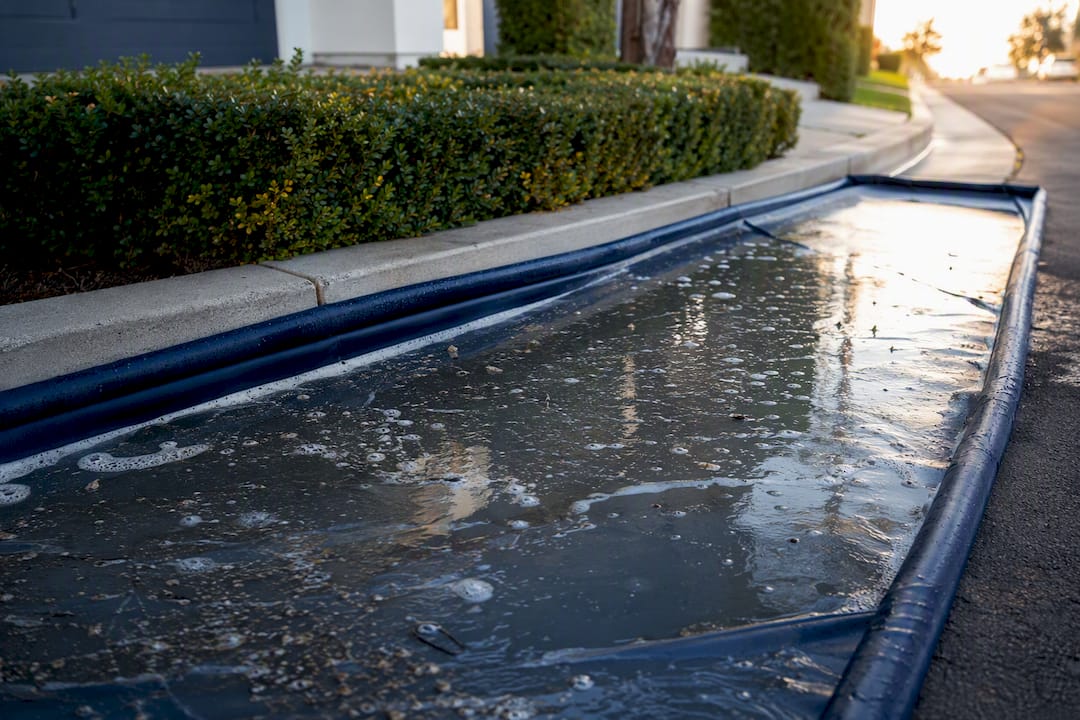
The technology gap reinforces the behavior gap. Commercial equipment meters exactly how much water each cycle uses, and a growing share of facilities recycle that water through filtration and reclamation loops. Home washing relies on whatever the hose puts out and however long the washer feels like spraying.
| Factor | Home/driveway washing | Professional eco-aware wash |
|---|---|---|
| Wastewater destination | Storm drain (untreated) | Sewer (treated) or reclaimed on-site |
| Water metering | None | Automated, metered cycles |
| Typical water use | 80–140 gallons | 15–40 gallons depending on method |
| Oil/grease handling | Untreated runoff | Separators and reclamation filtration |
A few behavioral differences show up again and again in the ICA's industry review:
- Staff trained on chemical dosing use less product per vehicle than an untrained homeowner eyeballing a bottle.
- Automated sprays apply a set volume; a hose doesn't self-limit.
- Facilities with oil-water separators keep petroleum residue out of the discharge stream entirely.
Waterless, Rinseless, Steam, or Reclaimed Water: Which Method Fits?
"Eco-friendly car wash" isn't one method. It's a category that includes several distinct techniques, each suited to a different level of dirt.
Waterless wash uses a spray loaded with lubricating polymers that encapsulate light dust so a microfiber towel can lift it off without dragging grit across the paint. Rinseless wash (the ONR-style bucket method) works similarly but uses a diluted solution and a wash mitt, rinsed in a separate bucket, using a gallon or two of water total instead of dozens. Steam cleaning uses high-temperature vapor to loosen grime and sanitize surfaces with almost no liquid runoff. In-bay automatics and conveyor systems with reclamation filter and reuse rinse water across cycles, which is where the biggest fresh-water savings actually happen.
| Method | Best for | Typical water use |
|---|---|---|
| Waterless spray | Light dust, weekly maintenance | Under 1 gallon |
| Rinseless bucket | Regular maintenance, no hose access | 1–2 gallons |
| Steam cleaning | Interior detail, sanitizing | Near zero liquid |
| In-bay auto w/ reclamation | Regular commercial washing | 35–40 gallons fresh |
| Conveyor w/ closed loop | Fleet and high-volume | Varies, reclaimed |
Waterless and rinseless washing is not a universal fix. Detailer testing shows these methods are safe for lightly soiled cars but unsuitable for heavy dirt, mud, or road salt, where trapped grit can scratch the clear coat even with a quality lubricant.
Pro Tip: Save waterless products for cars that see light dust and pollen. Once winter road salt or a muddy trail gets involved, you need actual water and, ideally, a two-bucket or pressure-rinse step first.
Reclaimed-water systems carry their own trade-off: they need solid filtration to keep the reused water from carrying grit or soap residue into later cycles, which is why facility maintenance matters as much as the equipment itself.
What Makes a Cleaning Product Actually Eco-Friendly
Look for biodegradable formulas, phosphate-free labeling, and pH-neutral chemistry. Studies on alkyl polyglucosides and sodium citrate, both common in newer formulations, show they break down faster and carry lower aquatic toxicity than older detergent chemistries, with some life-cycle assessments showing roughly 50% reductions in toxicity and eutrophication impact when facilities pair these products with advanced wastewater treatment.
Skip anything with phosphates, high surfactant concentrations, petroleum distillates, or chlorine bleach. These persist in waterways and disrupt aquatic ecosystems long after they leave your driveway.
Pro Tip: A supplier's safety data sheet (SDS) lists exact ingredient categories and hazard ratings. If a company won't share one, that's a red flag no marketing label can fix.
A "green" or "eco" sticker on a bottle means nothing on its own. Real certification comes from a named standard with published criteria, not a self-applied badge.
What Water Use Actually Costs, and What Reclamation Saves
Here's the range that matters when you're comparing options: self-serve bays run about 15 gallons per vehicle, in-bay automatics without reclamation average around 44 gallons, and conveyor systems can run higher still, according to the ICA's water-use review. Waterless and rinseless methods sit near the bottom, at a gallon or two.
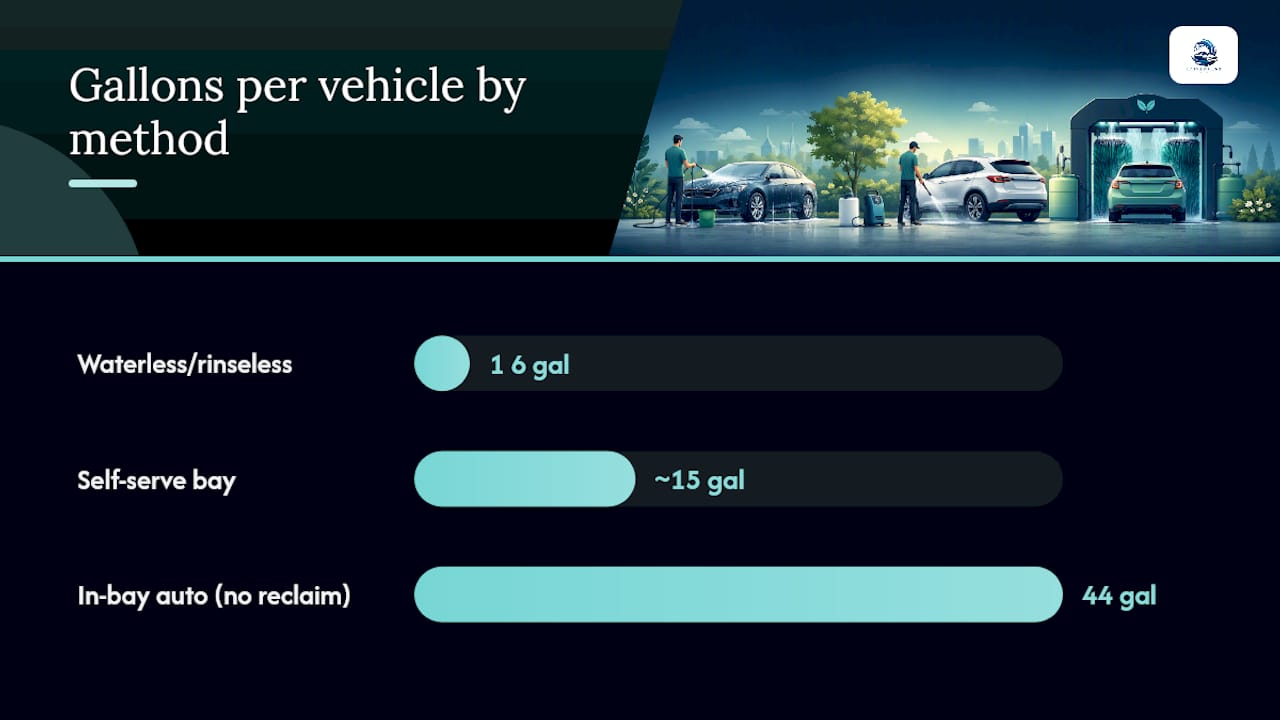
| Method | Gallons per vehicle |
|---|---|
| Self-serve bay | ~15 |
| In-bay automatic (no reclaim) | ~44 |
| Conveyor system | Higher, varies by design |
| Waterless/rinseless | 1–2 |
Reclamation changes that math fast. One documented multi-site upgrade program saved more than 24 million gallons a year after installing reverse-osmosis and reclaim systems, with some locations saving up to 34 gallons per car. That's the kind of payback that makes equipment upgrades worth the upfront cost within a few years.
- Municipal programs like the SAWS WaterSaver Car Wash Program offer rebates that shorten payback periods for facilities installing reclaim systems.
- For an individual owner, the simplest math is this: a weekly driveway wash at 100 gallons versus a monthly reclaimed-water professional wash saves both water and time.
- Small household changes, like fixing leaks and using shutoff nozzles, stack on top of those savings if you do wash at home occasionally.
How to Choose an Eco-Friendly Car Wash
Ask these questions before you book:
- Where does your wastewater go, sewer, reclamation system, or storm drain?
- Do you use oil-water separators and biodegradable, phosphate-free products?
- Can I see a safety data sheet for your cleaning chemicals?
- Are you enrolled in a municipal WaterSaver, rebate, or certification program?
Watch for these red flags:
- Vague claims like "all-natural" or "green clean" with no ingredient list.
- No answer, or a dodge, when you ask about wastewater routing.
- No sampling or monitoring data available on request.
Municipal water authorities and ICA guidance usually keep lists of certified or rebate-eligible operators in your area. A mobile service is a strong fit when you want zero runoff and zero travel, but confirm upfront that they use closed-loop equipment and biodegradable products, not just a bucket and a garden hose.
A Mobile Eco Wash in Practice
Picture a typical Living Waters Auto Wash LLC appointment: the crew arrives with their own water supply and power, sets up in a driveway or office lot, and washes the vehicle using biodegradable, pH-neutral products and minimal-water technique, no hose running for twenty minutes into the gutter.
Because the job uses so little water and no customer hookups, there's no puddle of soapy runoff heading for a storm drain. The owner gets a clean car without driving anywhere, and the paint gets handled with lower-abrasion methods than a self-service wand bay.
Mobile detailing fits best for individual owners and small fleets who want convenience with minimal environmental footprint. A reclamation-equipped commercial facility still makes more sense for high-volume operations washing dozens of vehicles daily, where a fixed water-reclamation loop outperforms a mobile unit on sheer throughput.
Choosing green care for your car isn't complicated
Ask providers exactly where their wastewater goes and what's in their soap. Living Waters Auto Wash LLC's mobile, low-water approach is one verifiable answer worth checking against that shortlist.
Book a Low-Water, No-Runoff Wash at Your Door
Living Waters Auto Wash LLC delivers the same eco-friendly wins this article just walked through, minimal water use, biodegradable products, zero runoff to a storm drain, without you driving anywhere or hooking up a hose. The crew brings its own water and power, so nothing from your driveway ends up in a local creek.

Every job uses trained technicians who know how to apply low-water technique without dragging grit across your clear coat, which matters more on a driveway than in a bay with a pressure rinse. If you want to see the savings for yourself, the $30 mobile exterior wash promo is a low-commitment way to try it, and fleet managers can check the fleet wash services page for recurring maintenance plans across multiple vehicles. Book a slot and see what a genuinely low-water wash looks like at your own curb.
Sources
- WaterSense at Work Section 5.4: Vehicle Washes November 2023
- Putting WaterSense® to Work, Car Wash Chain Drives Down Water Use With Efficiency Upgrades
- How to make sure your car wash is eco-friendly - King County, Washington