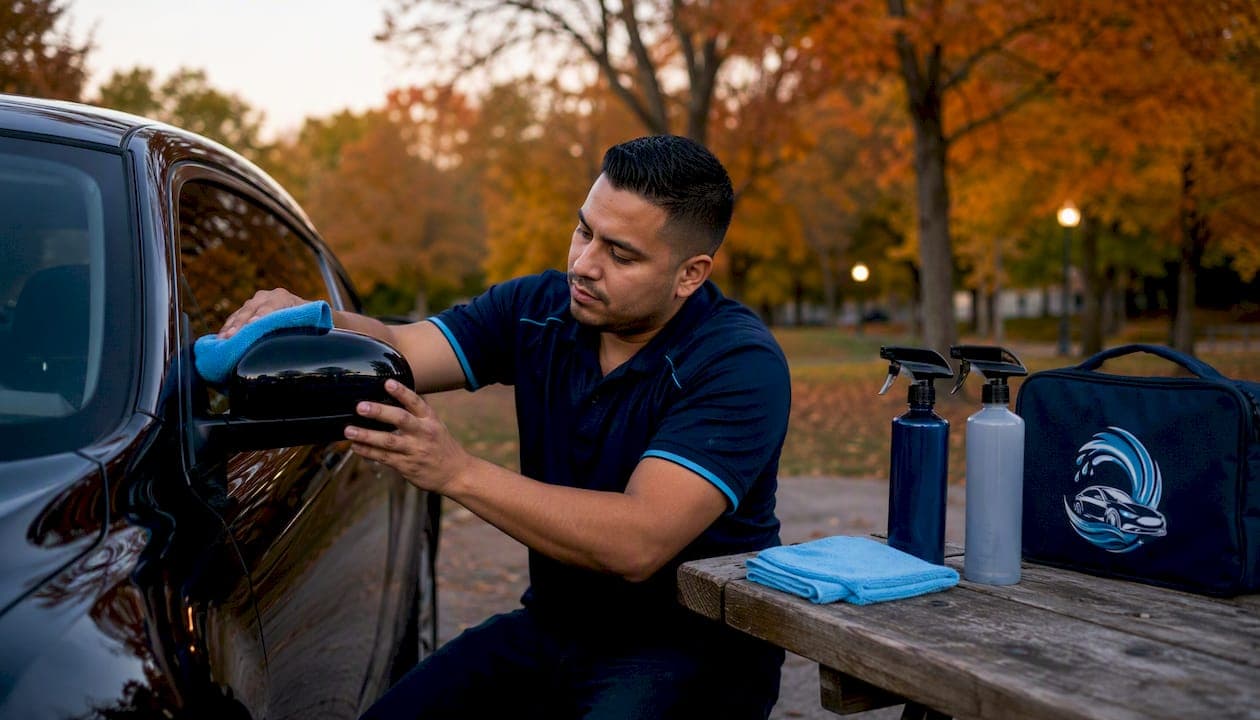
Eco-conscious detailing means cleaning and maintaining your vehicle using methods that conserve water, rely on biodegradable and low-VOC chemistry, and contain waste so it never reaches storm drains or local waterways. It is not a single product or a label on a bottle. It is a complete approach to vehicle care that considers what goes on your car, how much water is used, and where the runoff ends up.
The short version:
- Water conservation: Waterless, rinseless, or controlled low-volume rinse methods replace the open hose
- Safer chemistry: Biodegradable, pH-neutral, phosphate-free formulas with accessible MSDS documentation
- Waste containment: Runoff is captured or controlled on-site, not allowed to flow into gutters or storm drains
- Reuse practices: Microfiber towels, refillable packaging, and minimal single-use materials
- Who benefits: Your car's finish, your family's air quality, and the waterways in your community
The EPA's guidance on greener cleaning products sets criteria including low VOCs, biodegradability, and low aquatic toxicity, and these same standards apply directly to what a credible eco-conscious detailer should be using. Living Waters Auto Wash LLC, a fully mobile detailing service operating across Boca Raton, Pompano Beach, Coral Springs, Parkland, and Palm Beach County, is one example of a provider that brings these practices directly to your driveway without requiring you to supply water or power.
Table of Contents
- What does eco-conscious detailing actually cover?
- Which sustainable techniques do professionals actually use?
- How do you read eco product labels and certifications?
- What are the real benefits of eco-conscious detailing?
- When eco-conscious detailing has real limits
- How do you evaluate an eco-conscious detailer before you book?
- What does eco-conscious detailing typically cost and how long does it take?
- Living Waters Auto Wash LLC: eco-conscious mobile detailing in practice
- Key Takeaways
- Why eco-conscious detailing matters more than most car owners realize
- Living Waters Auto Wash LLC brings eco-conscious detailing to your door
- Useful sources and further reading
What does eco-conscious detailing actually cover?
The phrase gets used loosely, so it helps to know what the real pillars are. Eco-conscious detailing ties product chemistry, process, and packaging to measurable criteria rather than vague "green" marketing.

Water conservation is the most visible pillar. Traditional driveway washing can use a large amount of water per session with a standard garden hose. Rinseless and waterless methods bring that figure down to a fraction of that, and professional mobile detailers using controlled workflows can operate with very low water usage per vehicle for certain services.
Safer chemistry means more than a plant-based label. Look for:
- Biodegradable surfactants that break down in the environment without leaving persistent residues
- pH-neutral to mildly alkaline formulas (roughly pH 6–9 for most surfaces) that clean without stripping protective coatings
- Phosphate-free ingredients, since phosphates accelerate algae growth in waterways
- Low or zero VOC content, which matters both outdoors and inside your car's cabin
Waste minimization covers the full loop. Reusable microfiber towels replace disposable wipes. Refillable concentrate packaging cuts plastic. On-site containment, whether through absorbent mats, berms, or vacuum recovery, keeps wash water from entering storm drains.
Process is what separates real eco-conscious detailing from a green-labeled product. A skilled technician who uses proper encapsulation technique, matches the method to the contamination level, and manages towel rotation is doing more for the environment than someone who grabs a "natural" spray and wipes carelessly.
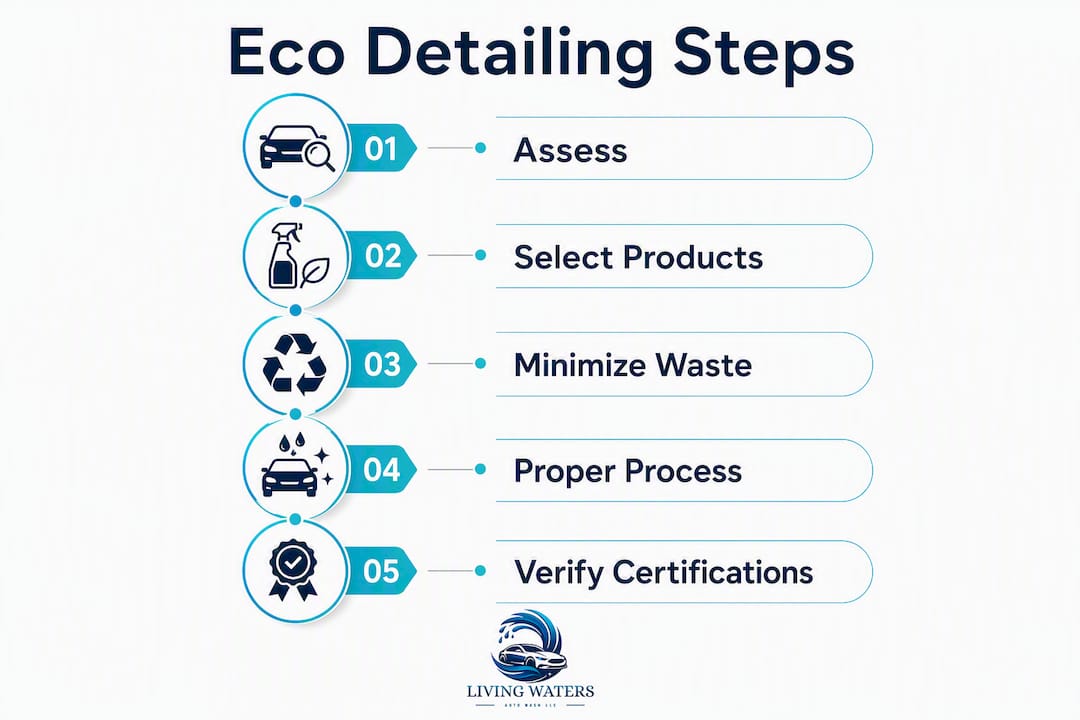
Certifications and label cues that signal credibility include the EPA Safer Choice mark, third-party biodegradability certifications, and clear MSDS (Material Safety Data Sheet) access. If a detailer or product can't produce an MSDS on request, that's a gap worth noting.
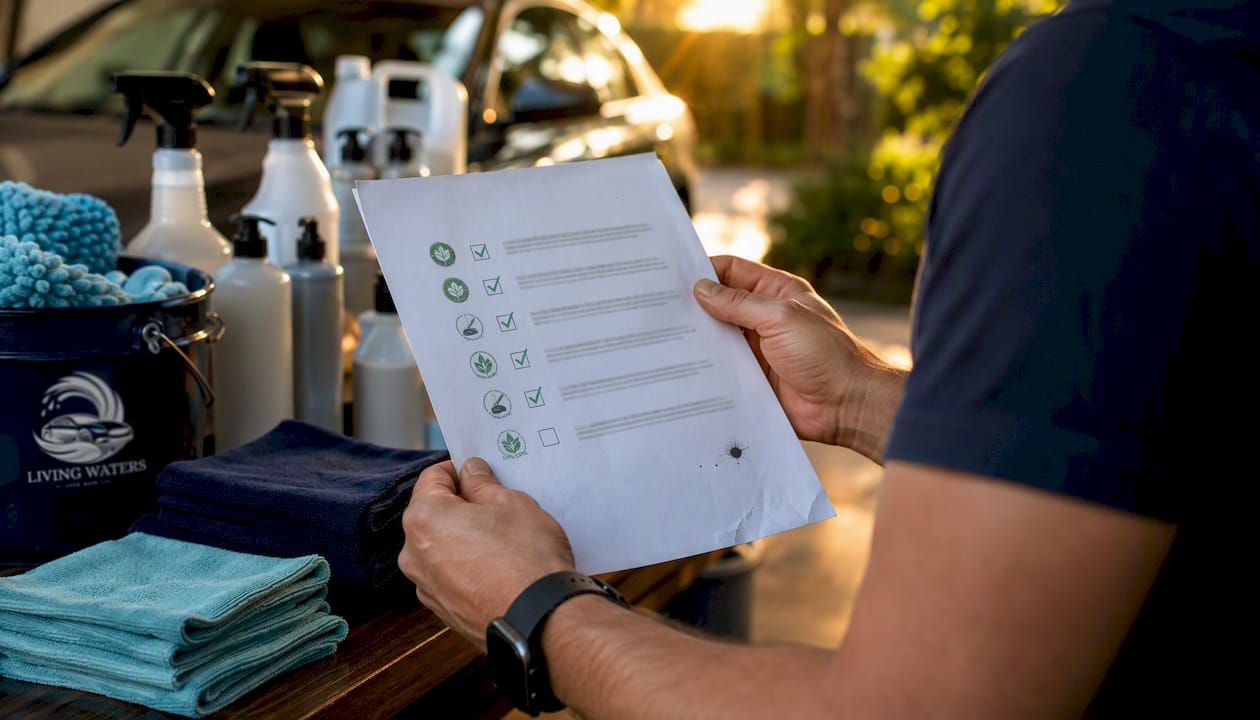
Pro Tip: Ask any detailer to name the specific product line they use and confirm MSDS availability before booking. A professional who knows their chemistry will answer without hesitation.
Which sustainable techniques do professionals actually use?
Green vehicle detailing is not one method. It is a toolkit, and the right choice depends on how dirty the car is and where it's being serviced.
The four main methods
- Waterless wash: A high-lubricity spray encapsulates dirt particles, lifting them off the surface so a microfiber towel can remove them without scratching. Best for lightly soiled vehicles maintained on a regular schedule. Not appropriate for heavily contaminated surfaces.
- Rinseless wash: A small amount of water (typically 1–2 gallons) is mixed with a concentrated rinseless product. Applied panel by panel, wiped with microfiber, and never hosed off. Handles moderate contamination better than a pure waterless approach.
- High-heat steam cleaning: Steam at high temperature breaks down grease, kills bacteria, and sanitizes upholstery, vents, and door jambs using only water vapor. No harsh chemical degreasers needed. Particularly effective for interiors, pet hair removal, and odor elimination.
- Touchless exterior options: Pressure-controlled, low-volume rinse systems with pH-neutral chemistry that minimize physical contact and reduce the risk of swirl marks.
When to use each method
- Light dust or fingerprints between washes: Waterless wash is the right call. Quick, effective, zero runoff.
- Regular maintenance wash (every 2–4 weeks): Rinseless wash handles the job with minimal water and no drain concerns, making it ideal for apartment and condo residents who lack outdoor hose access.
- Interior sanitization, odor, or pet hair: Steam cleaning delivers results without loading the cabin with chemical residue. Families with young children and pet owners see a real difference in air quality.
- Winter-salted or road-grime-heavy vehicles: Pre-treat with a targeted, low-VOC degreaser on the heaviest areas first, then transition to rinseless for the full wash. Skipping pre-treatment and going straight to waterless on a salt-crusted car risks scratching the paint.
Pro Tip: Microfiber towel management is where most DIY eco washes go wrong. Use a dedicated "dirty side" folding method: fold each towel into quarters, use one panel per face, and never reload a towel that has already picked up grit. One contaminated towel can undo careful chemistry.
For step-by-step guidance on doing this at home, the waterless interior cleaning guide from Living Waters Auto Wash LLC walks through the full process.
How do you read eco product labels and certifications?
Marketing copy on a bottle is not evidence. Here is what actually matters.
Label claims worth trusting (with caveats):
- "Biodegradable" is only meaningful when it specifies the standard (OECD 301B or equivalent) and the timeframe. "Biodegradable" with no further detail is a marketing claim, not a verified fact.
- "Low VOC" should reference a measurable threshold. The EPA Safer Choice program sets specific VOC criteria; a product that simply says "low VOC" without citing a standard is self-reported.
- "Phosphate-free" is straightforward and verifiable on the MSDS.
- "pH-neutral" should come with an actual pH range, not just the phrase.
Certifications to trust:
The EPA Safer Choice label is the most credible U.S. standard for cleaning products. It evaluates every ingredient for human health and environmental impact, including aquatic toxicity, biodegradability, and VOC content. Third-party biodegradability certifications from recognized testing labs add another layer of verification.
Your label checklist:
- MSDS or Safety Data Sheet available online or on request
- Specific biodegradability standard cited (not just the word "biodegradable")
- pH range stated numerically
- Phosphate-free confirmed on the ingredient list
- VOC content referenced against a standard
- Packaging: concentrate format or refillable container preferred
Red flag language to distrust: Phrases like "all-natural," "earth-friendly," or "green formula" with no supporting data are the detailing equivalent of greenwashing. If the label can't tell you the pH, the VOC level, or the biodegradability standard, it is not making a verifiable eco claim. Vague language without specs is a signal to look for a different product.
As The Mobile Buff's guide to eco-friendly detailing products notes, genuine eco-friendly detailing ties product chemistry to measurable criteria including low VOCs, biodegradability, and pH range, and references EPA guidance for greener cleaning products.
What are the real benefits of eco-conscious detailing?
The case for switching is stronger than most people expect, and it runs in two directions: what it does for the environment and what it does for your car.
Environmental wins:
Conventional driveway washing sends a mix of soap, road grime, heavy metals, and petroleum residue directly into storm drains, which in most U.S. municipalities flow untreated into local waterways. Eco-friendly car wash methods that route wastewater to sanitary sewers or use containment systems prevent that pollution entirely. Some professional mobile detailers using water-efficient methods operate with very low water usage per vehicle, compared with the much larger volume a standard garden hose delivers.
Vehicle care benefits:
Gentler chemistry preserves what protects your paint. Harsh alkaline or acidic cleaners strip wax, degrade ceramic coatings, and accelerate clear coat oxidation over time. Switching to eco-friendly products and regular low-impact maintenance can preserve wax and sealants, reduce paint degradation, and lower VOC exposure inside the vehicle.
Health and air quality:
High-VOC products off-gas inside the cabin long after the detail is done. Steam cleaning and low-VOC interior products reduce that load, which matters most for families with young children, people with respiratory sensitivities, and pet owners.
The four benefits that matter most to you:
- Cleaner local waterways with no polluted runoff from your driveway
- Preserved paint, clear coat, and interior materials over the vehicle's lifetime
- Lower chemical exposure for everyone who rides in the car
- Reduced water consumption per wash, which adds up significantly over a year of regular maintenance
When eco-conscious detailing has real limits
Eco methods are not always the right first step, and pretending otherwise sets up disappointing results.
Where limitations show up:
- Heavy winter salt and road grime: A vehicle that has accumulated thick salt deposits, caked mud, or tar spots needs a targeted pre-treatment before a rinseless or waterless approach. Attempting waterless on a heavily contaminated surface drags abrasive particles across the paint, which defeats the purpose entirely.
- Overloaded towels: The most common eco-wash mistake. When a microfiber towel is saturated with grit and reused, it scratches. Proper towel rotation is non-negotiable.
- Incomplete residue removal: Some waterless products leave a light residue if not buffed properly, particularly in direct sunlight or on hot panels. This is a technique issue, not a chemistry failure, but it requires trained hands.
- Very heavy oxidation or paint correction: Eco chemistry is not formulated for aggressive paint correction. Compound polishing to remove deep scratches or heavy oxidation requires more aggressive products and a different workflow.
How to sequence it correctly:
Use a low-VOC, targeted pre-treatment on the worst contamination first. Once the heavy material is lifted, transition to rinseless or waterless for the full wash. Finish with eco-friendly sealants or waxes. The goal is to use the most aggressive step only where it is genuinely needed, then return to low-impact methods for everything else.
For a clear breakdown of detailing types and when each is appropriate, matching the service level to the contamination level is the core skill.
How do you evaluate an eco-conscious detailer before you book?
The right questions take two minutes and tell you everything.
Your buyer's checklist:
- Can they provide MSDS or Safety Data Sheets for the products they use?
- What is their stated water use per vehicle?
- How do they handle wastewater on-site (containment mats, vacuum recovery, or drain routing)?
- Do they use reusable microfiber or disposable wipes?
- Are their products EPA Safer Choice certified or third-party biodegradability verified?
Interview questions to ask directly:
- "What product line do you use, and can you share the MSDS?"
- "How many gallons of water does a standard exterior wash use?"
- "Where does the wash water go when you're working in a parking lot or driveway?"
- "How do you handle a vehicle that comes in heavily contaminated?"
- "What training do your technicians have in low-water detailing techniques?"
Red flags that should make you pause:
- Vague answers to the water-use question ("we use very little" without a number)
- Refusal to share product names or MSDS
- Insisting waterless is fine for a visibly salt-crusted or mud-covered vehicle without inspecting it first
- No mention of wastewater containment when working on a hard surface near a drain
A simple script for booking:
"Before I confirm, can you tell me what products you use and whether you have MSDS available? And how do you handle wastewater when you're working on-site?" A detailer who takes eco-conscious practices seriously will answer both questions specifically and without hesitation.
What does eco-conscious detailing typically cost and how long does it take?
Pricing varies by service type, vehicle size, and contamination level. Here is a realistic range for common eco-conscious services:
- Mobile exterior waterless or rinseless wash: Living Waters Auto Wash LLC offers a $30 mobile exterior wash for a standard passenger vehicle as an entry-level option.
- Steam interior cleaning: Pricing for a full interior varies, with rates higher for heavily soiled vehicles or those with significant pet hair or odor.
- Combined exterior and interior eco package: Pricing varies by vehicle type and condition, generally higher for SUVs and trucks.
- Recurring maintenance plans: Reduce per-visit cost compared with one-time bookings, keeping vehicles in condition for water-efficient methods.
Time on-site:
A waterless or rinseless exterior wash on a maintained standard vehicle typically takes 45–75 minutes. Steam interior work adds 60–90 minutes. The panel-by-panel microfiber workflow requires more skilled labor time than a pressure-wash-and-blow-dry approach, which is reflected in pricing.
The long-term math:
Regular light maintenance every 3–4 weeks costs less over a year than two or three aggressive deep-cleaning sessions that require paint correction to undo the damage from neglect. Keeping the vehicle clean with low-impact methods also means the chemistry never has to work as hard.
Living Waters Auto Wash LLC: eco-conscious mobile detailing in practice
Living Waters Auto Wash LLC operates entirely without customer-supplied water or power, which makes their workflow a practical demonstration of what mobile eco-conscious detailing looks like in the field.
What the process looks like on-site: A Living Waters technician arrives with all equipment, products, and containment materials. The vehicle is inspected before any product is applied. Heavily contaminated areas receive targeted pre-treatment. The exterior is worked panel by panel using a rinseless or waterless encapsulation method with fresh microfiber at each stage. The interior is sanitized with high-heat steam, eliminating bacteria and odors without chemical residue. Wash water and runoff are managed on-site so nothing enters the surrounding pavement or storm drain.
The process steps a customer can observe and verify:
- Pre-service inspection to assess contamination level and select the appropriate method
- Technician explains the products being used and can provide MSDS on request
- Panel-by-panel exterior work with visible microfiber rotation
- Steam application to interior surfaces, vents, and upholstery
- Final inspection before the technician packs up
Proof signals to request when booking:
- Ask for the average water use per vehicle for the service you're booking
- Check their Google reviews for mentions of on-site cleanliness and professionalism
- Ask whether they carry containment materials for hard-surface locations
Living Waters Auto Wash LLC serves Boca Raton, Pompano Beach, Coral Springs, Parkland, and Palm Beach County, and their mobile detailing approach is built around convenience for apartment residents, busy professionals, and fleet managers who need results without the logistics of a traditional shop visit.
Key Takeaways
Eco-conscious detailing is a process-driven approach combining water-efficient methods, biodegradable chemistry, and on-site waste containment, and verifying those three pillars before you book is the fastest way to separate real practice from green marketing.
| Point | Details |
|---|---|
| Verify before you book | Ask for MSDS access, stated water use per vehicle, and wastewater handling before confirming any service. |
| Match method to contamination | Waterless works for maintained vehicles; heavily salted or mud-caked cars need targeted pre-treatment first. |
| Certifications that count | The EPA Safer Choice label and third-party biodegradability standards are the most credible U.S. benchmarks for cleaning products. |
| Recurring maintenance saves money | Regular light-maintenance visits cost less annually than infrequent aggressive sessions and preserve paint longer. |
| Living Waters Auto Wash LLC | Offers fully mobile eco-conscious detailing across Boca Raton, Pompano Beach, Coral Springs, Parkland, and Palm Beach County with no customer water or power required. |
Why eco-conscious detailing matters more than most car owners realize
The conventional wisdom is that green detailing is a compromise: you accept slightly worse results in exchange for feeling better about the environment. That framing is wrong, and it has been wrong for years.
Modern encapsulation chemistry and high-heat steam are not weaker than their conventional counterparts. They are formulated differently, and for routine maintenance, they are often better for the finish precisely because they do not strip protective coatings every time you wash. The car owners who see the most paint degradation over time are not the ones who wash too often. They are the ones who wash infrequently with harsh chemistry and then wonder why the clear coat looks dull at year five.
The environmental argument is also more local than most people think. Storm drain runoff from residential driveways carries road grime, heavy metals, and petroleum residue directly into the nearest waterway, untreated. That is not an abstract global problem. In South Florida, it flows into the Intracoastal and eventually the Atlantic. Choosing a mobile detailer who contains their wash water is a direct, measurable action, not a symbolic one.
For busy owners, the practical case is just as strong. A recurring mobile maintenance plan keeps the vehicle in a condition where waterless methods always work, which means faster visits, lower costs per session, and no need for paint correction down the road. The eco-conscious choice and the financially sensible choice turn out to be the same one.
Living Waters Auto Wash LLC brings eco-conscious detailing to your door
Skipping the traditional car wash does not mean settling for less. Living Waters Auto Wash LLC delivers fully mobile, water-efficient detailing across Boca Raton, Pompano Beach, Coral Springs, Parkland, and Palm Beach County, with no customer water or power hookup needed. Every service uses eco-conscious chemistry, microfiber workflows, and on-site waste containment, whether you're booking a quick exterior refresh or a full steam interior clean.
For apartment residents, condo dwellers, and busy professionals who want a clean car without the trip, Living Waters Auto Wash LLC's $30 mobile exterior wash is the entry-level option for a standard passenger vehicle. When you book, ask the team about their product line and water use per vehicle. They will answer specifically, because that transparency is part of how they work.
Useful sources and further reading
These are the most authoritative sources for verifying eco-conscious detailing claims and digging deeper into standards:
- EPA: Identifying Greener Cleaning Products — the primary U.S. standard for low-VOC, biodegradable, and low-aquatic-toxicity criteria; look here for the Safer Choice program specifics
- The Mobile Buff: Eco-Friendly Car Detailing — practical explainer on techniques, product chemistry, and what eco-conscious detailing requires in practice
- The Mobile Buff: Eco-Friendly Detailing Products Guide — detailed breakdown of label claims, VOC standards, and how to evaluate product credibility
- Living Waters Auto Wash: Eco-Friendly Mobile Car Wash Guide — the company's own resource on mobile eco-conscious workflows and service details
- OTS Mobile: Types of Car Detailing — useful reference for matching detailing service level to contamination type
- Steve's Detailing: Eco-Friendly Detailing and Vehicle Protection — covers the vehicle-care case for gentler chemistry and regular maintenance