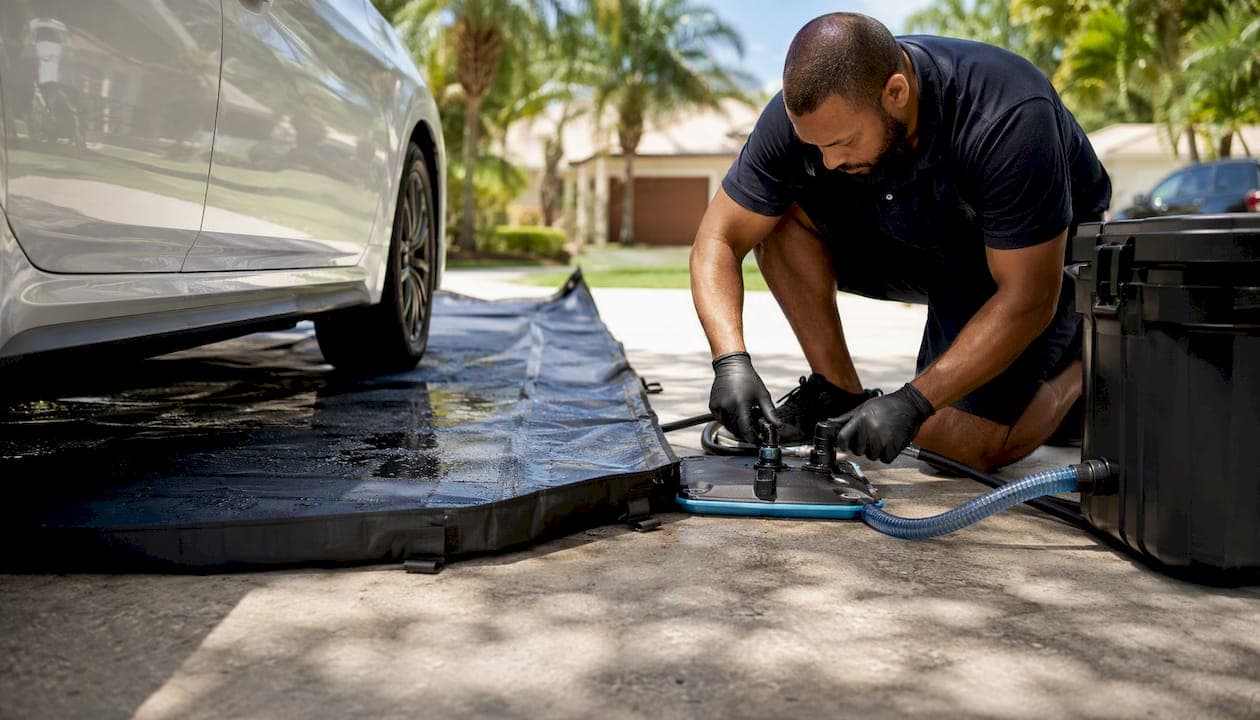
Mobile detailers manage wastewater by containing all runoff at the source, capturing it with a bermed mat and pump into a sealed tank, then disposing of it through a legal route — a permitted sanitary sewer, an approved car-wash facility, or a licensed liquid-waste hauler. Wash water never goes to a storm drain, regardless of what soap you used. That is the short version of how detailers manage water waste explained in practice, and the rest of this guide walks through every step in detail.
Three actions to take before your next job:
- Park the vehicle on a bermed reclamation mat, run a low-start flat pump into a sealed poly tank, and confirm the tank is secured before you move the vehicle.
- Dispose only to a permitted sanitary sewer connection (with written permission), an approved car-wash or wastewater facility, or a licensed hauler — never to a curb, lot drain, or storm inlet.
- Log the date, location, gallons recovered, disposal method, and receipt number after every job.
Living Waters Auto Wash LLC, the publisher of this guide, follows this exact workflow on every exterior and interior job across Palm Beach County.
Key Takeaways
Compliant mobile detailing requires containment at the source, legal disposal through a permitted route, and a written record of every disposal event.
| Point | Details |
|---|---|
| Contain all runoff | Use a bermed wash mat and sealed tank on every job; no wash water reaches a storm drain. |
| Dispose legally | Discharge only to a permitted sanitary sewer (with written permission), an approved facility, or a licensed hauler. |
| Minimum treatment for reuse | Separate grit, oil, and grease before reusing water; EPA guidance supports 50%–83% freshwater reduction with reclaim systems. |
| Document every disposal | Log job date, gallons recovered, disposal method, and receipt number after each job and retain records for at least three years. |
| Living Waters Auto Wash LLC | Follows this full workflow on every job in Palm Beach County, with disposal logs available for fleet clients on request. |
Table of Contents
- What detailing wastewater actually contains
- U.S. regulations every mobile detailer needs to know
- Containment, capture, and primary treatment options
- Legal routes for treating and disposing of recovered wastewater
- Choosing cleaners that work with your reclaim system
- A step-by-step day-of-job workflow for mobile detailers
- Who to contact and a permitting checklist before you discharge
- Records to keep and a simple log template
- How Living Waters Auto Wash LLC manages water waste on a typical job
- Typical costs, maintenance, and operational risks
- What to do in the next 24–72 hours
- Training and certification options for detailers on wastewater handling
- How often wastewater treatment steps happen in a typical detailing operation
- Environmental benefits of proper wastewater management
- Why this matters to us at Living Waters Auto Wash LLC
- Living Waters Auto Wash LLC brings compliant mobile detailing to your door
- Sources
What detailing wastewater actually contains
Wash water from a car detail is not just dirty water. A single vehicle generates a mix of soaps, surfactants, wax and polish residues, petroleum oils and grease, brake dust, heavy metals (cadmium, zinc, lead from brake and tire wear), road grit, microfibers from interior extraction, and solvents from engine or wheel cleaners. Interior jobs add extracted carpet and upholstery water, which carries biological material and cleaning-agent residue.
The numbers matter here. EPA WaterSense guidance documents that vehicle wash facilities using reclamation systems reduced freshwater consumption by roughly 50% to 83% in field studies — a range that shows how much water a single operation cycles through, and how much can be recovered with the right equipment.
That cocktail of contaminants is why storm drains are off-limits. Storm drain systems flow directly to local waterways — creeks, canals, bays, and coastal waters — with no treatment in between. A sanitary sewer, by contrast, routes water to a municipal wastewater treatment plant designed to handle these pollutants. The distinction is not a technicality; it is the core of every compliance rule mobile detailers face.
U.S. regulations every mobile detailer needs to know
The federal baseline comes from the Clean Water Act, which prohibits unpermitted discharge of pollutants to waters of the United States. The National Pollutant Discharge Elimination System (NPDES) program implements that prohibition, and authority flows down to state environmental agencies and then to city and county stormwater programs. For most mobile detailers, the rules you will actually deal with are local.
Who to contact before you start operating in a new area:
- Your city or county stormwater program (often under Public Works or Environmental Services)
- Your local wastewater utility or municipal sanitary sewer authority
- The property owner or facility manager at any site where you plan to discharge to a private sewer connection
Municipal BMP guidance from cities across the country consistently lists containment mats, capture equipment, and a strict prohibition on stormwater discharge as required practices for mobile vehicle washing. Enforcement is often complaint-driven, but inspectors can issue fines, stop-work orders, and hold property owners jointly liable for illegal discharges on their premises.
Pro Tip: Get written permission before discharging to any sanitary sewer connection — whether it belongs to a customer, a parking facility, or a commercial tenant. A signed disposal agreement protects you if a complaint is filed and is the first document an inspector will ask for.
Containment, capture, and primary treatment options
The practical answer for most mobile operations is a three-piece kit: a bermed wash mat, a low-start flat submersible pump, and a sealed poly storage tank. Industry guides confirm that this combination — mat, pump, discharge hose, and tank — is the standard portable reclaim setup. A wet vac with a puddle scoop works as a lower-cost alternative for very low-volume jobs, but it requires manual transfer and is slower.
Equipment and what each item does:
- Bermed wash mat: Creates a contained work zone; all runoff stays within the berm and drains to a low point where the pump sits.
- Low-start flat submersible pump: Activates at very shallow water depth (often under half an inch), so it empties the mat sump without manual intervention.
- Sealed poly storage tank: Holds recovered water for transport; sizes from 50 to 300 gallons depending on job volume and service frequency.
- Inlet screens and strainers: Catch large debris before it reaches the pump impeller.
- Sediment trap or settling chamber: Allows grit and particulates to drop out before water enters the tank or a filter stage.
- Portable oil/water separator: Removes free oil and grease; required if you plan to reuse water or discharge to a sewer that sets oil/grease limits.
- Cartridge filter: Polishes water after primary separation; necessary for reuse in rocker or undercarriage rinse stages.
For reuse, EPA guidance recommends that reclaim systems at minimum separate grit, oil, and grease. That level of treatment is sufficient for reuse in undercarriage and rocker-panel rinse stages. Broader reuse — such as pre-rinse or body wash — requires more advanced treatment.
| Equipment item | Typical capacity / spec | Primary function |
|---|---|---|
| Bermed wash mat | 10×20 ft to 20×30 ft | Contain all runoff in work zone |
| Flat submersible pump | 1/6–1/3 HP, activates at 1/4–1/2 in. depth | Transfer captured water to tank |
| Poly storage tank | 50–300 gal | Hold recovered water for transport |
| Portable oil/water separator | 5–50 gal/min rated flow | Remove free oil and grease |
| Cartridge filter | 5–50 micron | Remove fine sediment for reuse |
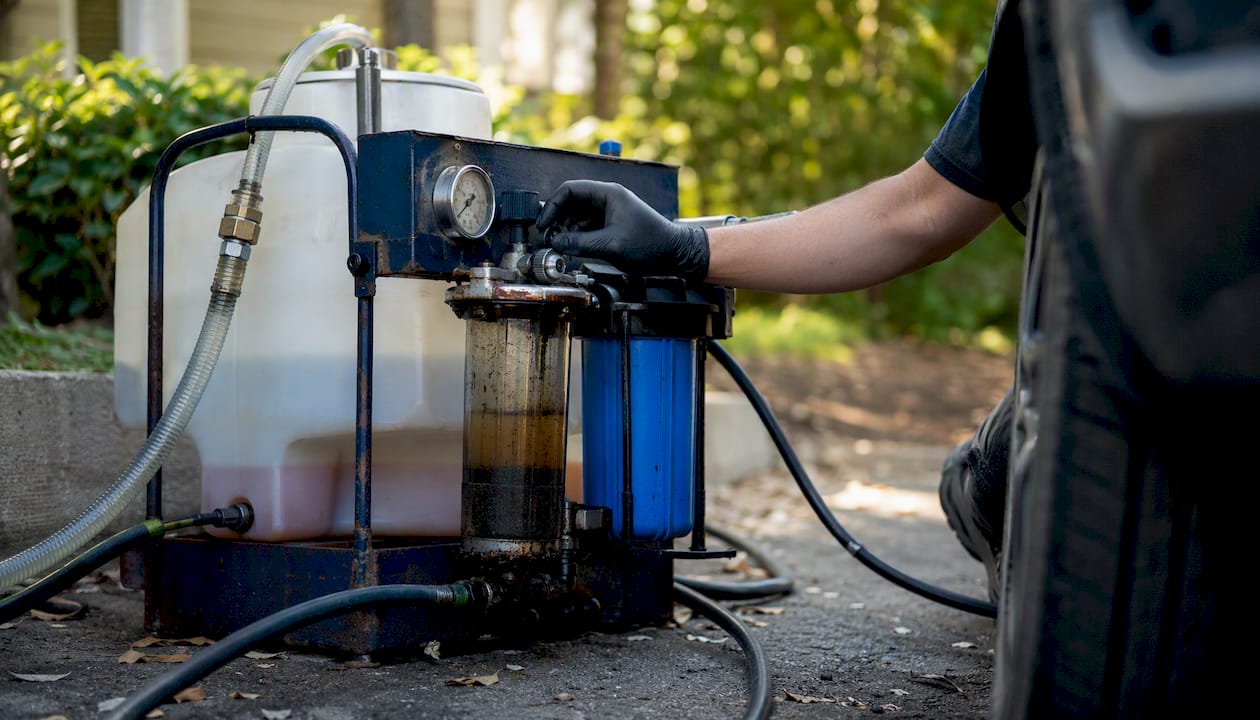
Pro Tip: Place the mat so the vehicle's lowest drain point (rocker seam or door sill) sits over the sump corner. A pump that requires two or more inches of standing water before it activates will leave a large puddle that can overflow the berm on a sloped surface — choose a pump rated to start at a quarter inch or less.
Legal routes for treating and disposing of recovered wastewater
Once the tank is full, you have three main options: discharge to a permitted sanitary sewer, consolidate and drop off at an approved car-wash or wastewater facility, or use a licensed liquid-waste hauler. City-level BMP guidance emphasizes capture of all wash water and disposal through one of these legal channels.
Choosing the right route:
- Check volume first. A single-vehicle exterior job generates roughly 15–30 gallons of recoverable water. A fleet day can push 200+ gallons. Volume determines whether a hauler is cost-effective or whether a nearby approved facility makes more sense.
- Confirm local sewer policy. Some municipalities allow mobile operators to discharge to a sanitary sewer with a written agreement; others require a permit or prohibit it entirely. Call your wastewater utility before assuming access.
- Locate an approved drop-off. Many full-service car washes accept recovered water from mobile operators for a per-gallon or per-load fee. Confirm they hold the appropriate discharge permit.
- Evaluate hauler cost vs. frequency. Licensed liquid-waste haulers provide manifests (which double as your disposal records), but per-gallon costs add up on high-volume operations. Scheduled weekly pickups often cost less than on-demand calls.
- Document every disposal event. Receipt, manifest number, facility name, date, and gallons — every time.
Pros and cons at a glance:
- Sanitary sewer discharge: Low per-gallon cost, convenient if access is available — but requires written permission and may require a permit or pretreatment.
- Approved facility drop-off: No permit needed on your end, straightforward — but adds drive time and a per-load fee.
- Licensed hauler: Provides manifests automatically, scales to any volume — highest per-gallon cost.
- On-site treatment and reuse: Reduces disposal frequency and freshwater use — requires capital investment in separators and filters, plus routine maintenance.
Pro Tip: If you plan to reuse water, avoid wax, polish, or silicone-based products in the wash stage. These compounds foul cartridge filters and membrane systems quickly, driving up replacement costs and reducing water quality. Check product compatibility before building a reuse loop.
Choosing cleaners that work with your reclaim system
Product selection directly affects how hard your filtration system has to work. The wrong cleaner can blind a cartridge filter in a single job or leave a visible oil sheen in your holding tank.
What to look for on labels and safety data sheets:
- pH: Neutral to mildly alkaline (pH 6–9) products are easier on cartridge media and O/W separators.
- Biodegradability rating: Look for products meeting OECD 301B or equivalent readily biodegradable standards.
- Surfactant type: Nonionic surfactants are generally more reclaim-compatible than anionic or cationic types, which can cause foaming in reclaim loops.
- Phosphate content: Low or zero phosphate reduces algae risk in holding tanks.
- Residual oil content: Avoid heavy petroleum-based degreasers when reuse is planned; they overwhelm primary O/W separators.
- "Reclaim-compatible" label: Some manufacturers test and certify products for use in reclaim systems — this label is worth seeking out.
One point that trips up even experienced operators: "biodegradable" on a label does not mean the product is safe to discharge to a storm drain. Guidance from compliance resources is explicit that biodegradable soaps remain pollutants until they fully degrade, and containment is still required because metals, oils, and grit travel with the wash water regardless of what soap carried them.
Train staff to read MSDS sheets before introducing any new product to a job that uses a reclaim loop. Incompatibilities with RO or membrane systems are usually flagged in the environmental or disposal section of the sheet.
Pro Tip: Run a new product through a small test loop — one vehicle, one filter pass — before deploying it fleet-wide. Check the filter after the job for loading rate and inspect the tank for sheen or foam. A product that loads a filter in one pass will cost you far more in replacements than the savings from buying it in bulk.
A step-by-step day-of-job workflow for mobile detailers
The workflow in one sentence: set up containment before water touches the vehicle, capture all runoff during the wash, secure the tank before moving, transport to a legal disposal point, and document before the end of the day.
Step-by-step:
- Pre-job check (10 minutes before arrival): Confirm mat, pump, hoses, and tank are in the vehicle. Verify tank has capacity for the job. Check that disposal route is confirmed for the day.
- Site assessment on arrival: Identify slope direction, nearby storm drain inlets, and whether a sanitary connection is available on-site. If the site drains directly to a storm inlet with no containment possible, stop and reschedule or switch to a waterless method.
- Mat deployment: Lay the bermed mat so the vehicle sits centered, with the sump at the downhill corner. Connect the pump and run the discharge hose to the tank.
- Dry prep first: Blow out wheel wells, brush loose grit from panels, and vacuum interior before any water is applied. This reduces the volume and contamination load of wastewater generated.
- Wash with low-pressure rinse: Use a trigger-controlled nozzle or low-flow wand. Avoid unnecessary soaking — municipal BMP guidance specifically recommends minimizing water use and sweeping before washing to cut wastewater volume.
- Monitor pump and tank during the job: Check tank level at the halfway point. If it is near capacity, pause and arrange interim disposal before continuing.
- Post-wash mat check: Inspect the berm for any overflow or seepage before breaking down. Photograph the mat and tank gauge.
- Secure the tank: Cap the tank outlet, secure the lid, and confirm no leaks before loading for transport.
- Dispose and log: Discharge to your approved route. Collect a receipt or manifest. Record job date, location, gallons recovered, disposal method, and staff initials on your log sheet.
For engine bays and heavy degreasing: These jobs generate high-oil-content wastewater that exceeds what a basic O/W separator handles. Either use a dry-cleaning method (degrease and wipe without rinsing), or refer the job to a facility with industrial pretreatment. Do not attempt to capture and haul engine-bay rinse water in a standard reclaim tank without confirming your hauler or disposal facility accepts it.
Pro Tip: Take a photo of the mat before the first rinse and after breakdown, plus a photo of the tank gauge at disposal. These three images, timestamped by your phone, are the fastest way to demonstrate compliance if a complaint is filed.
Who to contact and a permitting checklist before you discharge
Before you discharge a single gallon to any sanitary connection, contact two offices: your city or county stormwater program and your local wastewater utility. Ask specifically about mobile washing operations — the rules for a fixed car wash and a mobile operator are often different.
Documents and permissions to have in place:
- Written permission from the property owner for any discharge to a private sanitary connection on their premises
- Written acceptance letter or contract from the receiving facility (car wash, wastewater plant, or commercial sewer user)
- Hauler manifest forms if using a licensed liquid-waste hauler
- Copy of any municipal permit or written approval from the wastewater utility
- Signed disposal agreement on file, updated annually
Questions to ask when you call the stormwater or wastewater office:
- "Do you permit mobile car-wash operators to discharge to the municipal sanitary sewer?"
- "Do we need a permit, a written agreement, or both?"
- "Are there pretreatment requirements (oil/grease limits, pH limits) before we can discharge?"
- "Where can we legally dump recovered wash water in this jurisdiction?"
- "Is there a licensed hauler list or approved drop-off facility list you maintain?"
Getting these answers in writing — even a follow-up email from the office — gives you documentation that you acted in good faith if a compliance question arises later.
Records to keep and a simple log template
Keep a daily water-recovery log, all disposal receipts, maintenance records for O/W separators and filters, and signed disposal agreements. If an inspector asks, these four categories cover everything they typically request.
Minimum records to retain for each job:
- Job date and site address
- Vehicle count and type (car, SUV, fleet unit number)
- Estimated gallons of water used and gallons recovered
- Disposal method (sewer, facility, hauler)
- Disposal facility name or hauler company name
- Receipt or manifest number
- Staff initials
Mini log template (copy into your job sheet or digital form):
Store logs for a minimum of three years. Many states require two years; three gives you a buffer if a complaint surfaces after a long delay. Digital logs in a shared folder or fleet management app are easier to retrieve than paper sheets stored in a van.
How Living Waters Auto Wash LLC manages water waste on a typical job
On a standard exterior plus interior job in Palm Beach County, Living Waters Auto Wash LLC arrives with a bermed wash mat (typically 10×20 ft), a low-start flat submersible pump, a sealed 100-gallon poly tank, and a basic inlet strainer. The mat goes down before any water is applied. The pump runs continuously into the tank during the rinse stage.
Equipment used and why:
- Bermed mat: Contains all runoff from the vehicle footprint; chosen for portability and quick deployment on driveways, parking lots, and garage aprons.
- Low-start flat pump: Activates at minimal water depth, keeping the mat sump clear without manual monitoring.
- 100-gallon sealed tank: Sized for a full-day route of 4–6 vehicles before a disposal run; avoids mid-day interruptions on most residential jobs.
- Inlet strainer: Catches grit and debris before the pump, extending pump life and reducing sediment load in the tank.
A single exterior job takes roughly 15–25 minutes of active wash time. The pump runs throughout, and the tank is checked at the end of each vehicle. At the end of the route, recovered water is transported to an approved disposal facility or discharged to a permitted sanitary connection with a signed agreement on file. The disposal receipt is logged in the job sheet before the crew leaves the site.
For fleet accounts, Living Waters Auto Wash LLC schedules disposal runs on a fixed day each week, which lets fleet managers review disposal logs as part of their own compliance records. Fleet managers who require documented service find this scheduled approach easier to audit than on-demand disposal.
Pro Tip: Recurring fleet clients often want a monthly disposal summary they can attach to their own environmental compliance files. A one-page PDF with job dates, vehicle counts, gallons recovered, and disposal receipts takes five minutes to generate and builds significant trust with commercial accounts.
Typical costs, maintenance, and operational risks
Upfront equipment costs for a basic mobile reclaim kit run roughly $300–$800 for a mat, pump, and 100-gallon tank. Adding a portable oil/water separator pushes that to $800–$2,500 depending on flow-rate rating. Cartridge filter housings add another $100–$400.
Recurring costs to budget for:
- Hauler fees: typically $0.05–$0.25 per gallon depending on volume and region, or a flat per-pickup rate
- Approved facility drop-off fees: variable, often $15–$50 per load
- Cartridge filter replacements: every 20–50 jobs depending on contamination load and product compatibility
- O/W separator maintenance: inspect monthly, service quarterly
- Municipal permit or written agreement renewals: annual, often no fee but requires paperwork
Operational risks and mitigations:
- Mat berm failure: Inspect seams before every job; carry a repair kit or a backup mat section.
- Pump clogging: Clean the inlet strainer after each job; keep a spare impeller on the vehicle.
- Illegal discharge fines: Under the Clean Water Act, civil penalties can reach significant amounts per day of violation. Written agreements and disposal logs are your primary defense.
- Lost disposal agreements: Store signed agreements in a cloud folder, not just in the van. If the paper copy is lost, you need a backup.
Pro Tip: Set a filter replacement schedule based on job count, not calendar time. A detailer running 10 vehicles a day burns through a cartridge far faster than one running 3. Track job count in your log and replace filters at the interval your supplier recommends for your contamination profile.
What to do in the next 24–72 hours
The compliance gap for most mobile detailers is not knowledge — it is execution. Here are five actions, in priority order:
- Highest priority — confirm local rules today: Call your city stormwater program and wastewater utility. Ask the specific questions listed in the permitting section above. Get the answers in writing.
- Buy or confirm a bermed mat and pump: If you do not have a compliant containment setup, order one before your next job. This is the single item that stops an illegal discharge from happening.
- Plan your disposal route: Identify at least two legal disposal options in your service area — an approved facility and a licensed hauler as backup. Confirm both accept mobile-detailer wash water.
- Update your job sheets: Add disposal fields (gallons recovered, disposal method, receipt number, staff initials) to every job record, paper or digital, before your next shift.
- Schedule staff training: Walk every technician through the mat setup, pump operation, and log completion. A crew member who skips the mat because setup takes five minutes is your biggest compliance risk.
Training and certification options for detailers on wastewater handling
Formal training on wastewater compliance for mobile detailers is available through several channels. The International Detailing Association (IDA) offers a Certified Detailer program that covers environmental compliance as part of its curriculum, including stormwater rules and BMP implementation. The IDA's training is widely recognized by fleet managers and commercial clients as a baseline credential.
State-level environmental agencies sometimes offer free online modules on stormwater BMP compliance for small businesses. These are worth completing even if they are not mandatory, because they document that your team received instruction — useful if a complaint is ever investigated.
For wastewater-specific training, the Water Environment Federation (WEF) and local water utility educational programs occasionally run workshops on small-business discharge compliance. Check your local utility's website for scheduled sessions.
At the operational level, the most effective training is hands-on: run a new technician through a full mat-setup, pump-operation, and disposal-log cycle before their first solo job. Pair that with a written SOP they can reference in the field. Monitoring and maintenance are decisive factors in whether a reclaim system performs consistently — and that performance depends almost entirely on whether staff understand what they are maintaining and why.
How often wastewater treatment steps happen in a typical detailing operation
The frequency of each step depends on job volume, but a practical schedule for a mobile operation running 4–8 vehicles per day looks like this:
Per job: Mat deployment, pump operation, and tank monitoring happen on every vehicle. The disposal log entry is completed before leaving the site.
End of each workday: The tank is emptied at an approved disposal point. The pump inlet strainer is cleaned. The mat is rinsed (on a contained surface) and inspected for berm damage.
Weekly: Sediment trap or settling chamber is cleaned out. Cartridge filter is inspected and replaced if loading is visible. Disposal receipts are filed and the week's log is reviewed for completeness.
Monthly: O/W separator is inspected for oil accumulation and serviced if needed. Disposal agreements are confirmed as current. Equipment is checked for wear (pump seals, hose connections, tank lid gaskets).
Annually: Renew any municipal permits or written disposal agreements. Review product list for reclaim compatibility. Update staff SOPs if equipment or disposal routes have changed.
This cadence keeps the system running without requiring a dedicated maintenance day. The key is building the per-job and end-of-day steps into the standard workflow so they happen automatically, not as an afterthought.
Environmental benefits of proper wastewater management
The case for compliant wastewater handling is not only legal — it is genuinely environmental, and the numbers are large enough to matter at the community level.
Heavy metals from brake dust and tire wear, petroleum hydrocarbons from engine oil and grease, and surfactant residues from cleaning products are all toxic to aquatic life at low concentrations. When wash water reaches a storm drain, those contaminants travel untreated to local waterways. In South Florida, that means canals, the Intracoastal Waterway, and eventually coastal waters that support fisheries, recreation, and tourism.
Proper containment and disposal routes those contaminants to treatment facilities designed to handle them. And when reclamation is added, the water savings are substantial. EPA field studies found freshwater reductions of 50%–83% at vehicle wash facilities using reclaim systems. Research on decentralized reuse systems in other sectors reports savings of 30% or more in potable water demand. For a mobile operation running hundreds of vehicles per month, those percentages represent thousands of gallons.
Multi-criteria analyses using frameworks like TOPSIS consistently rank water recycling and reuse among the highest-performing strategies when balancing water efficiency, environmental impact, and operational feasibility. For mobile detailers evaluating long-term equipment investments, that ranking supports the case for adding a reclaim loop over simply hauling all recovered water indefinitely.
Beyond the numbers, compliant operations protect the detailer's own business. A single complaint-driven inspection that results in a fine or stop-work order costs far more than the equipment and disposal fees that would have prevented it.
Why this matters to us at Living Waters Auto Wash LLC
Every job we run in Boca Raton, Pompano Beach, Coral Springs, Parkland, and across Palm Beach County follows the workflow described in this guide. We built our containment and disposal process before we took on our first fleet account, because we knew that commercial clients and property managers would eventually ask for documentation. They do. And having that documentation ready is what separates a professional operation from one that is one complaint away from a problem.
We also believe that mobile detailing done right is genuinely better for the environment than a fixed car wash that sends water to a drain without reclaim. When you contain, capture, and dispose correctly, you are keeping real pollutants out of real waterways. That matters to us, and it matters to the communities we work in.
Living Waters Auto Wash LLC brings compliant mobile detailing to your door
Mobile detailing that handles wastewater correctly requires equipment, training, and a documented disposal process. Living Waters Auto Wash LLC brings all three to every job in Boca Raton, Pompano Beach, Coral Springs, Parkland, and Palm Beach County, with no water or power hookup required from the customer.

For individual vehicles, the express interior detailing service includes professional extraction with responsible wastewater handling built into the workflow. For businesses managing multiple vehicles, the fleet wash program includes scheduled service, disposal documentation, and monthly summaries that satisfy most commercial compliance requirements. Book a mobile wash or get a fleet quote at Lwautowash.
Sources
Verify your state and municipal rules directly with your local stormwater program and wastewater utility — enforcement standards and permit requirements vary significantly by jurisdiction.
- WaterSense at Work Section 5.4: Vehicle Washes November 2023
- Auto Detailers BMPs 12 page
- Compliance Best Management Practices for Mobile ...
- Car Wash Water Reclamation Systems: The Complete Guide for Auto Detailers
- Frontiers in Sustainability review on decentralized reuse and monitoring
This article is general information, not a substitute for advice from a qualified lawyer. Consult a qualified legal professional about your own circumstances before acting on anything here.