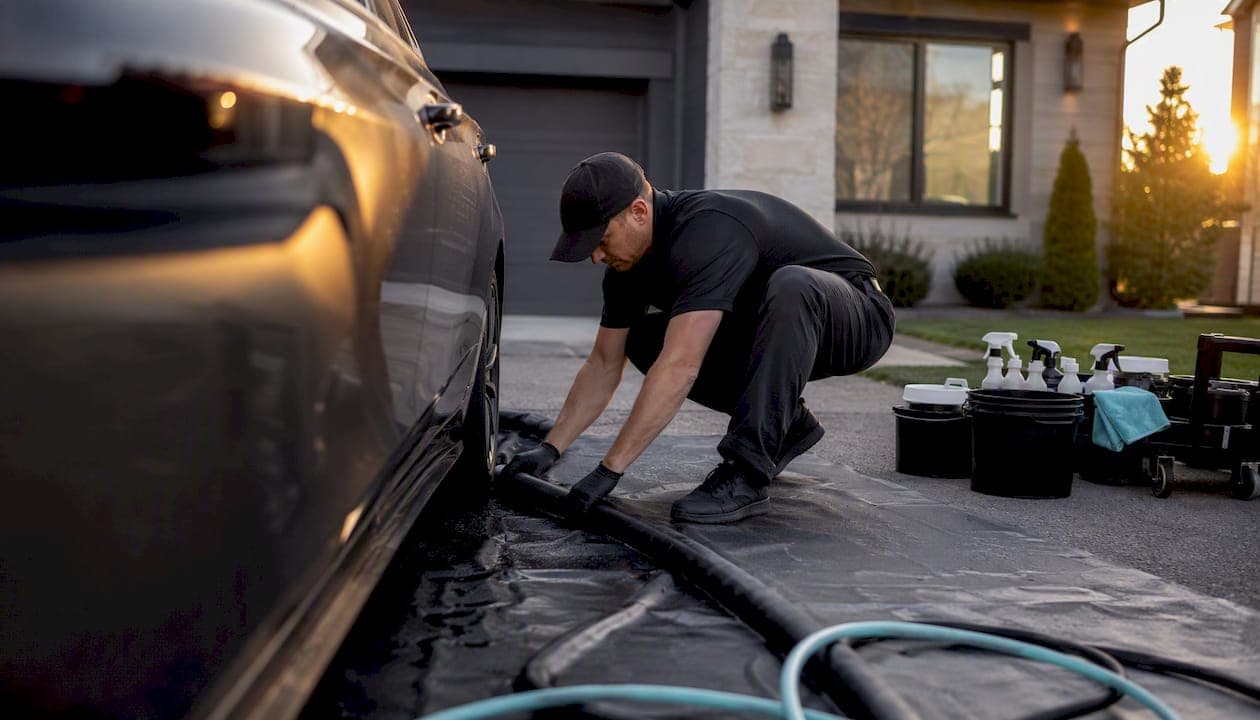
Mobile detailers can legally operate in HOA communities in most cases, but the answer depends on three things you verify before accepting the booking: what the CC&Rs say about commercial activity, what your city or county requires for stormwater containment, and whether you have written permission in hand. Skip any one of those, and you are one complaint away from a fine, a stop-work order, or a lost client relationship.
Here is the immediate action plan before you accept any HOA job:
- Check the CC&Rs and parking rules. Ask your client to pull the governing documents and search for "commercial activity," "service vehicles," and "vehicle washing." If the language is ambiguous, contact the management company directly before showing up.
- Confirm local stormwater rules. Call your city or county public works department and ask specifically about mobile vehicle washing. The Clean Water Act prohibits discharging wash water to storm drains, and most municipalities enforce this through local BMPs (best management practices) that require containment.
- Prepare your equipment and paperwork. Arrive with a wash mat or containment berm, a reclaim pump or wet-vac, your certificate of insurance, and a one-page BMP summary. These three items answer every question an HOA manager is likely to ask.
One-line documentation checklist to send the client before the job: CC&R confirmation, your COI, your BMP summary, and the agreed service date and location.
Pro Tip: Ask your client to forward the HOA permission email to you directly. A screenshot of "the HOA said it was fine" is not documentation. You want the management company's name, the approver's name, and the date in writing.
Key Takeaways
Mobile detailers can operate legally in HOA communities when they secure written permission, contain all wash water, carry proper insurance, and verify local permits before every new jurisdiction.
| Point | Details |
|---|---|
| Permission in writing first | Verbal HOA approval does not protect you; get the management company's written confirmation before the job date. |
| Contain and reclaim wash water | The Clean Water Act prohibits storm drain discharge; use a wash mat, berms, or waterless methods on every job. |
| Verify permits per jurisdiction | Local business licenses, itinerant-vendor permits, and stormwater rules vary by city and county; confirm each independently. |
| Document everything on-site | A timestamped photo log and disposal receipts are your best defense against HOA complaints or municipal inspections; retain for at least three years. |
| Living Waters Auto Wash LLC | Serves HOA communities across Boca Raton, Pompano Beach, Coral Springs, Parkland, and Palm Beach County with full compliance documentation provided on every job. |
Table of Contents
- How do you read CC&Rs and bylaws to find restrictions that matter?
- What permits and licenses do you need before operating in any jurisdiction?
- How do you contain, reclaim, and legally dispose of wash water on-site?
- How do you ask an HOA or property manager for permission?
- What contract clauses protect you from HOA fines and liability?
- What does a step-by-step compliance booking workflow look like?
- Where do you find BMPs, stormwater ordinances, and vendor permit rules?
- When should you decline an HOA job?
- What running a compliance-first mobile detailing route actually looks like
- Living Waters Auto Wash LLC brings compliance-first detailing to South Florida
- Sources
How do you read CC&Rs and bylaws to find restrictions that matter?
HOA governing documents are not written for service providers. They are written by developers and attorneys for homeowners, which means the language that affects your business is buried inside sections titled "Nuisance," "Parking," "Use Restrictions," or "Common Area Rules." You will not find a heading that says "Mobile Detailing."
Terms to search for in CC&Rs and bylaws:
- "Commercial activity" or "commercial services"
- "Service vehicles" or "contractor vehicles"
- "Vehicle washing," "car washing," or "vehicle maintenance"
- "Parking restrictions" or "guest parking"
- "Common area use" or "driveway restrictions"
Most HOA documents fall into two categories: developer-controlled (newer communities where the developer still holds the board) and resident-controlled (established communities where elected homeowners run the board). Developer-controlled boards tend to have stricter, more literal enforcement of commercial-activity clauses. Resident-controlled boards are more likely to make case-by-case decisions, especially if a neighbor has already used a mobile detailer without incident.
Practical checks before you commit to a booking:
- Call the management company and ask whether mobile detailing has been approved or denied for other residents. Past enforcement patterns tell you more than the written rule.
- Ask your client whether any neighbors use mobile detailers regularly. A neighbor who has been getting their car detailed on-site for two years is strong evidence the HOA is not actively enforcing a ban.
- Get the property manager's name and direct email so you can follow up in writing.
A verbal "yes" from a board member or a neighbor does not protect you. Written HOA rules override verbal approvals, and permissions typically last for a single service date unless the management company issues a standing approval. If you plan to serve multiple residents in the same community, ask for a blanket vendor approval in writing.
Pro Tip: When a CC&R clause is genuinely ambiguous, send a short written inquiry to the management company asking for clarification. Their written response is your documentation, even if the answer is "we have no policy on this."
| Document Type | Where to Find It | What to Look For |
|---|---|---|
| CC&Rs | County recorder's office or HOA portal | "Commercial activity," "vehicle washing," "service vehicles" |
| Bylaws | HOA management company or secretary | Board approval process, meeting notice requirements |
| Rules and Regulations | HOA website or management packet | Parking hours, contractor access, noise restrictions |
| Architectural Guidelines | HOA portal or request from manager | Driveway use, surface protection requirements |
For a detailed breakdown of how to navigate condo and HOA parking access, the condo parking lot guide covers document checklists and suggested attachments for permission requests.
What permits and licenses do you need before operating in any jurisdiction?
Mobile detailers operate inside a patchwork of overlapping rules: local business licenses, itinerant-vendor permits, municipal stormwater rules, and HOA covenants. Ignoring any one of these can lead to fines, stop-work orders, or lost clients. The offices to contact depend on where you operate, but the verification sequence is the same everywhere.
Offices to contact and what to ask:
- City Clerk: "Do I need a business license or home-occupation permit to operate a mobile detailing service in this city?" Also ask about itinerant or transient merchant permits, which apply when you conduct business at locations you do not own.
- Public Works or Stormwater Division: "Does the city have a BMP fact sheet for mobile vehicle washing?" Ask for the specific ordinance number and whether a permit is required to discharge reclaimed water to the sanitary sewer.
- County Health or Environmental Services: Some counties require a separate environmental compliance registration for businesses that handle wash water containing soaps, degreasers, or automotive fluids.
- State Environmental Agency: For operators in states with active NPDES (National Pollutant Discharge Elimination System) programs, confirm whether mobile detailing triggers any state-level permit requirement. In practice, capture-and-dispose is the compliant path for mobile operators because obtaining an NPDES permit is not practical at the individual-job level.
California is the clearest example of state-level complexity. The state requires car washing and polishing businesses with employees to register with the Division of Labor Standards Enforcement and carry a $150,000 surety bond for certain operations. Solo operators without employees are often exempt from the statewide license, but they still need local business licenses and may need additional bonds in specific cities. Santa Maria, for example, requires a separate $20,000 surety bond. Renewal fees run $300 per location. California also enforces recycled-water rules in drought-designated areas that directly affect how much fresh water a mobile operator can use per wash.
Itinerant or transient merchant permits are required in many cities when you conduct business at a customer's address rather than a fixed commercial location. These are typically low-cost and issued by the city clerk, but skipping them is a common reason mobile operators receive citations during routine code-enforcement sweeps.
| Office to Contact | What to Ask | Typical Documentation |
|---|---|---|
| City Clerk | Business license, itinerant-vendor permit | Application, proof of insurance, fee payment |
| Public Works / Stormwater | BMP fact sheet, discharge ordinance | Completed BMP form, equipment description |
| County Environmental Services | Wash-water handling requirements | Chemical inventory, disposal method description |
| State Environmental Agency | NPDES applicability, state-level exemptions | Business registration, containment plan |
How do you contain, reclaim, and legally dispose of wash water on-site?
The Clean Water Act prohibits discharging wash water containing soaps, oils, and automotive metals to storm drains. Municipal stormwater ordinances enforce this at the local level, and HOA boards increasingly ask for proof of containment before approving a vendor. There are three practical approaches, each with different tradeoffs.
Wash mat plus reclaim pump to holding tank
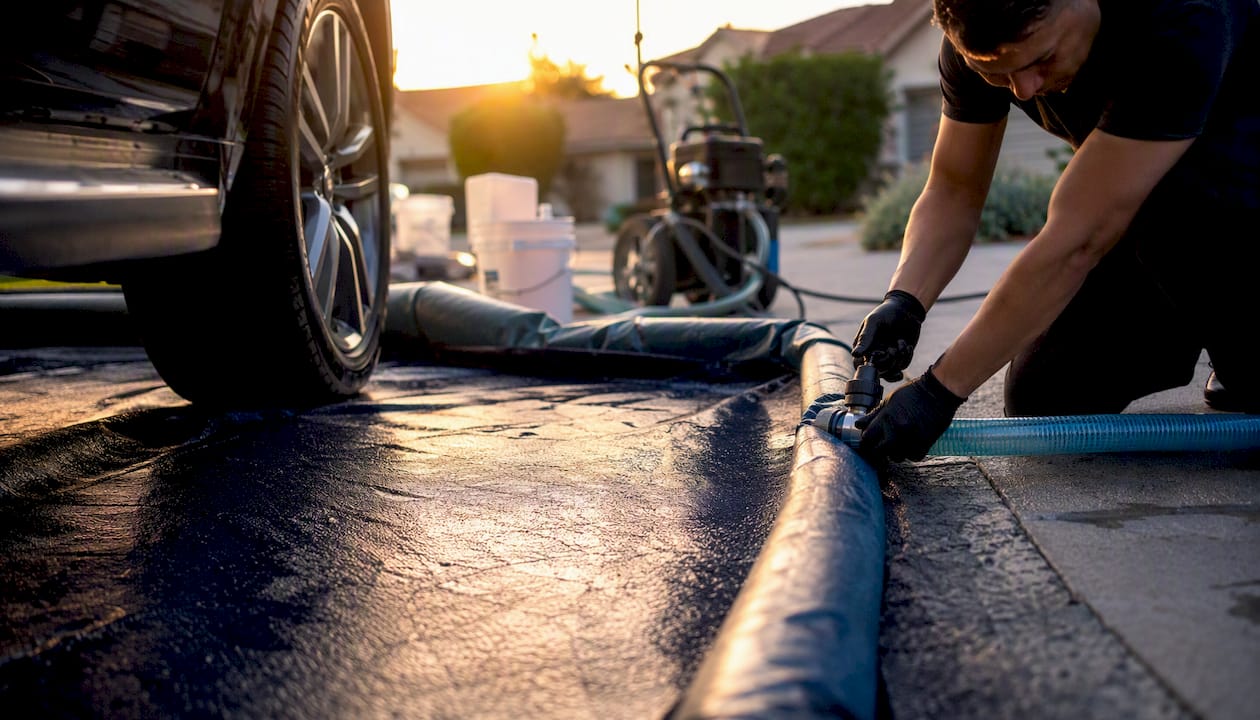
A containment mat (typically 10x20 feet or larger) with inflatable or foam berms channels runoff to a low point where a reclaim pump or wet-vac transfers it to a holding tank in your vehicle. This is the most visible and professional-looking setup. Property managers and HOA boards can see exactly how you are handling runoff, which makes it the strongest trust signal for winning fleet or multi-unit accounts. The tradeoff is an approximate setup time of several minutes and the cost of the mat, pump, and tank.
Berms plus vacuum-to-tank
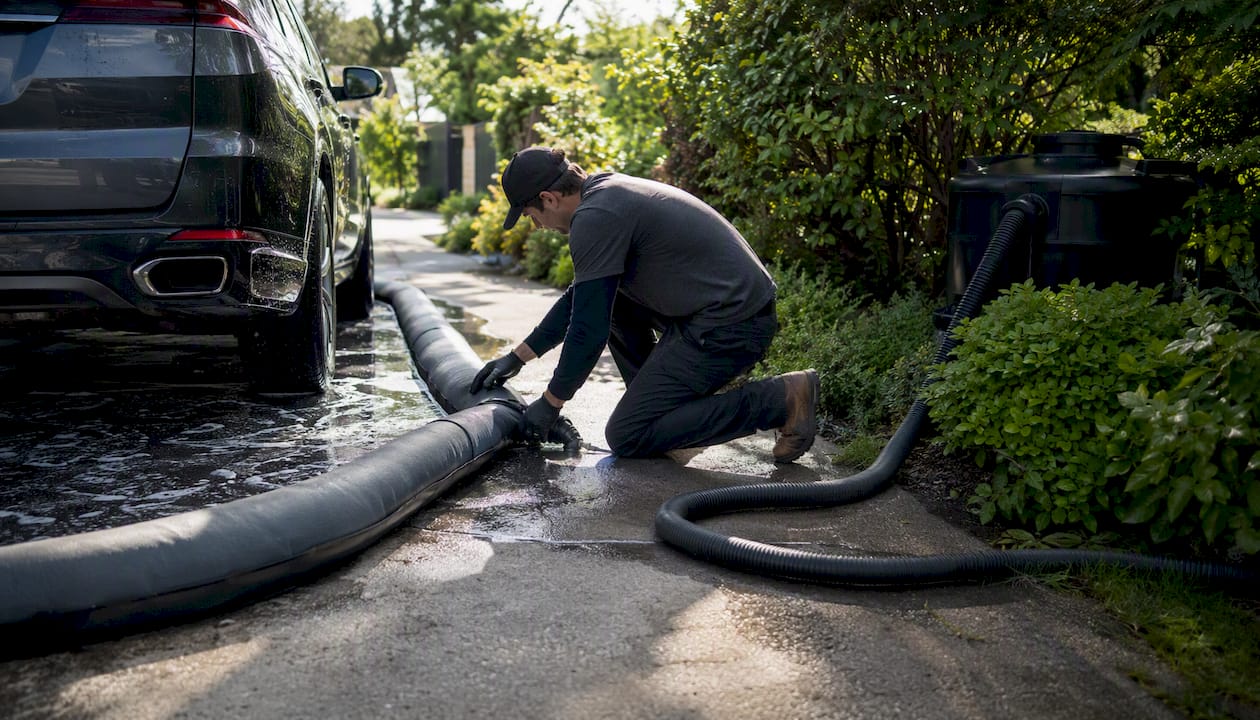
Portable foam or inflatable berms placed around the vehicle's perimeter contain runoff without a full mat. A wet-vac or reclaim pump pulls the water into a tank. This works well on flat driveways and in tight parking spaces where a full mat is difficult to deploy. Setup is faster, but the containment perimeter is less complete on sloped or uneven surfaces.
Fully waterless or rinseless detailing
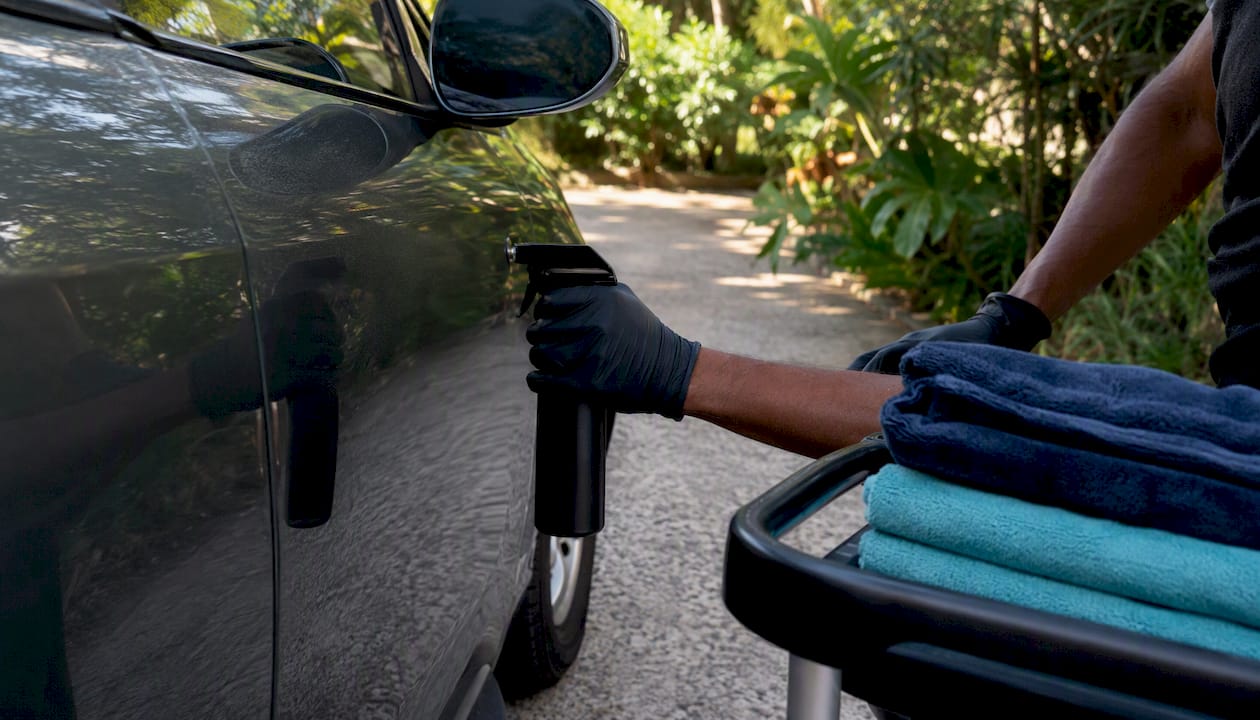
Waterless products (sprayed on and wiped off) and rinseless wash concentrates (used with a bucket and minimal water) eliminate runoff entirely. This is the quickest setup and typically the lowest equipment cost. It is also the right answer when a property denies sanitary sewer access for disposal. The limitation is that heavily soiled vehicles may need a traditional wash first, and some clients expect a full wet wash.
What inspectors and HOA managers ask to see:
- A photo of your containment setup before and during the job
- Safety Data Sheets (SDS, formerly MSDS) for your cleaning products
- Disposal receipts or a written statement of where reclaimed water is discharged
- Your certificate of insurance
Local car-care regulations also stress biodegradable cleaning products, proper chemical storage, and noise considerations. Using biodegradable, phosphate-free soaps is worth noting in your BMP summary because it directly addresses the most common HOA environmental objection.
Pro Tip: Reclaimed wash water should go to a sanitary sewer (with the property's permission) or to an approved disposal facility. Never pour it into a storm drain, a landscaped area, or a parking lot drain. Keep disposal receipts for at least three years.
| Method | Setup Time | Runoff Risk | Best Use Case |
|---|---|---|---|
| Wash mat + reclaim pump | 10–15 min | Very low | Fleet accounts, HOA approvals, full wet washes |
| Berms + wet-vac | 5 min | Low on flat surfaces | Residential driveways, tight parking spaces |
| Waterless / rinseless | 1–2 min | None | HOAs with no sewer access, lightly soiled vehicles |
For a deeper look at waterless methods and when they are the right call, the waterless detailing guide covers practical applications and how to present them to clients concerned about runoff.
How do you ask an HOA or property manager for permission?
The goal of a permission request is to make the manager's job easy. Give them everything they need to say yes in one email: what you are doing, how you are handling water, proof you are insured, and the specific date and time. A vague request forces them to ask follow-up questions, which adds days to the process.
What to include in a permission request:
- Service description (exterior wash, interior detail, or both) and estimated duration
- Containment method (mat and reclaim pump, waterless, or berms)
- Requested date, time, and parking location
- Your name, business name, phone, and email
- The resident's name and unit number
Attachments to include:
- Certificate of insurance (COI) showing general liability coverage
- One-page BMP summary describing your containment and disposal method
- A photo of your containment equipment
- Your business license or vendor registration
Sample permission email:
Subject: Mobile Detailing Vendor Approval Request — [Resident Name], Unit [#], [Date]
Dear [Property Manager Name],
I am writing to request approval to perform mobile auto detailing for [Resident Name] at [Community Name] on [Date] between [Time] and [Time]. I operate a licensed, insured mobile detailing service and use a containment mat with a reclaim pump to capture all wash water, which is then transported off-site for proper disposal. No wash water will enter storm drains or common-area landscaping.
Attached: Certificate of Insurance, BMP Summary, Equipment Photo, Business License.
Please let me know if you need any additional information or if the board requires a formal vendor application. I am happy to complete any required paperwork.
Thank you, [Your Name] [Business Name] | [Phone] | [Email]
Allow five to seven business days for a reply from a management company. Condo boards that require a formal vote may need 30 days or more. If the manager requests changes (a different parking area, a specific time window, or additional insurance coverage), respond in writing and confirm the revised terms before the job date.
Pro Tip: Send the permission email from your business email address, not a personal Gmail. It signals professionalism and makes it easier for the manager to file your request in their vendor system.
What contract clauses protect you from HOA fines and liability?
Your client agreement is the document that determines who pays when something goes wrong. Without the right clauses, you can be held responsible for fines your client caused by failing to get permission, or for damage claims that arise from a job you completed correctly.
Essential contract items:
- Client representation of HOA permission. A clause stating that the client warrants they have obtained all required HOA or property-management approvals before the service date. If they have not, the client bears responsibility for any resulting fines or removal costs.
- Indemnity for unlawful access. If the client misrepresents their HOA status and you are fined or asked to leave, the client indemnifies you for your time, travel, and any penalties assessed against your business.
- Fee and refund terms if asked to leave. Specify what happens if you arrive on-site and are turned away by management. A reasonable clause: the client pays a trip fee (typically the cost of one hour of labor) and you reschedule at no additional charge once written permission is confirmed.
- Insurance requirements. State your coverage minimums and confirm the client understands you carry general liability insurance. Some HOAs require vendors to be added as additional insureds on the policy. Know your insurer's process for issuing additional-insured endorsements before you need one.
Evidence to collect on-site:
- Pre-job photo log (vehicle condition, containment setup, drain covers in place)
- Signed client HOA-permission form (a one-page document the client signs confirming they have authorization)
- Post-job disposal receipts if you are returning reclaimed water to a sanitary sewer on-site
How to handle fines in contract language:
- State clearly that HOA fines resulting from the client's failure to obtain permission are the client's sole responsibility.
- State that fines resulting from your operational methods (e.g., a containment failure you caused) are your responsibility.
- Include a clause allowing you to decline or cancel a job if, upon arrival, you determine the site poses an unacceptable compliance risk.
California's licensing requirements illustrate why documentation matters at the state level too. The surety bond and recordkeeping requirements for California operators show how quickly operating costs and liability exposure can escalate when documentation is incomplete.
Pro Tip: Keep a signed copy of every client HOA-permission form and your pre-job photo log for at least three years. A timestamped photo of your containment setup has resolved more HOA disputes than any contract clause.
What does a step-by-step compliance booking workflow look like?
A repeatable workflow removes the guesswork from every HOA job. The steps below cover the full cycle from first contact to job close. Operators who follow this sequence consistently report fewer cancellations, faster repeat bookings, and stronger property-manager relationships, particularly in dense markets like South Florida where HOA and condo boards are strict gatekeepers.
Pre-booking verification (before confirming the appointment):
- Ask the client whether the property is HOA-governed or a condo association.
- Request a copy of the relevant CC&R section or confirm the management company's name and contact.
- Search the city or county public works website for a mobile vehicle washing BMP fact sheet.
- Confirm your business license is current for that jurisdiction and that your itinerant-vendor permit (if required) covers that address.
- Send the permission request email with all attachments and wait for written confirmation.
On-site procedure checklist:
- Deploy containment mat or berms before any water touches the vehicle.
- Verify that all nearby storm drains are covered or blocked from runoff path.
- Show your COI to the property manager or security desk if requested.
- Photograph the setup before starting work.
- Capture all wash water and transfer to holding tank.
- Photograph the post-job site (clean, no standing water, equipment removed).
Post-job steps:
- Dispose of reclaimed water at an approved sanitary sewer access point or licensed disposal facility.
- Retain disposal receipts.
- Email the client a brief job summary with two or three photos (before, during containment, after).
- Save all photos and receipts in a job folder labeled with the date, address, and client name. Retain for at least three years.
Templates to use:
- Booking intake form fields: client name, property address, HOA name and management company, permission status (confirmed/pending), service requested, preferred date and time, containment method to be used.
- Pre-job checklist: COI in vehicle, BMP summary printed, containment mat/berms loaded, reclaim pump charged, camera ready, client permission email saved to phone.
- Photo-log template: timestamp, address, photo type (pre-job vehicle, containment setup, drain cover, post-job site). Store in a cloud folder (Google Drive or Dropbox) organized by month and client name.
Pro Tip: Build the permission confirmation step into your booking software as a required field. If the field is blank, the job does not get scheduled. This single friction point prevents the majority of on-site surprises.
A compliance-first approach also speeds up future bookings. Once a management company has your COI and BMP summary on file, subsequent jobs at the same property often require only a date-and-time confirmation rather than a full vendor review. For more on how to present your operation to property managers, the parking access guide covers on-site setup and client access protocols in detail.
Where do you find BMPs, stormwater ordinances, and vendor permit rules?
Every city and county publishes this information, but it is rarely in one place. The fastest path is a direct phone call combined with a targeted web search.
Who to contact and what to search:
- City or county public works (stormwater division): Search "[city name] stormwater BMP vehicle washing" or "[city name] mobile detailing stormwater ordinance." Ask for the BMP fact sheet for mobile vehicle washing specifically. Many cities have a one-page document that lists exactly what containment equipment is required and where reclaimed water may be discharged.
- City clerk (vendor permits): Search "[city name] itinerant vendor permit" or "[city name] transient merchant license." Ask whether a permit is required for a mobile service business that operates at residential addresses.
- Sewer authority (disposal rules): Call the local utility and ask whether a mobile detailing operator may discharge reclaimed wash water to a sanitary sewer cleanout on a residential property. Some utilities require a pre-approval form; others allow it with the property owner's written consent.
- State environmental agency: Search "[state name] NPDES mobile vehicle washing exemption" to confirm whether your operation triggers any state-level permit requirement.
Documents to download and save:
- BMP fact sheet for mobile or on-site vehicle washing (from public works)
- Municipal code section on stormwater or illicit discharge (search the city's municipal code for "vehicle washing" or "wash water")
- Itinerant vendor permit application (from city clerk)
- State environmental agency guidance on mobile car washing (if available)
How to read a municipal ordinance for applicability: Look for the definitions section first. If "mobile vehicle washing" or "on-site vehicle washing" is defined, the ordinance applies to you directly. If it is not defined, look at the scope section to see whether the ordinance covers commercial activity at residential addresses. When in doubt, call the stormwater division and ask directly. A phone call takes five minutes and creates a contact you can reference later.
When should you decline an HOA job?
Not every HOA booking is worth taking. Some communities carry compliance risks that no amount of preparation can offset, and recognizing those situations early protects your time, your license, and your reputation.
Red flags that signal a job is too risky:
- The CC&Rs expressly prohibit commercial services or commercial vehicles on the property with no variance process.
- The condo board requires on-site staff approval with a lead time of 30 days or more and the client wants service next week.
- The HOA imposes per-day fines for violations (common in high-end communities) with no cap.
- There is no sanitary sewer access on the property and the client refuses a waterless service.
- The client cannot or will not provide written HOA permission and insists the job is "fine."
Decision rules:
- Written ban with no variance process: Decline. Offer to serve the client at a nearby non-HOA location, their workplace, or a commercial parking lot.
- Conditional approval requiring permanent changes (e.g., the HOA wants you to install a permanent wash pad): Decline or negotiate a significantly higher fee that accounts for the added cost and risk.
- Sanitary sewer disposal denied and client refuses waterless: Decline the wet wash. Offer a fully waterless interior and exterior service instead, which eliminates the disposal problem entirely.
- Client insists verbal permission is sufficient: Decline until written confirmation is in hand. This is not negotiable.
Alternatives to a declined site:
- Suggest the client's workplace parking lot (often no HOA restrictions).
- Offer a nearby commercial lot or shopping center where you have a standing vendor relationship.
- For fleet clients, route the job to a fleet yard or commercial property where access is unrestricted.
Declining a job is not a lost sale. It is a boundary that protects every other job on your route. Operators who take on high-risk HOA jobs without documentation tend to spend more time resolving complaints than they earn from the booking.
What running a compliance-first mobile detailing route actually looks like
The compliance-first approach sounds like more work until you see what it replaces: last-minute cancellations, on-site confrontations with property managers, and the slow erosion of client trust when a job goes sideways because no one checked the rules.
In practice, the pre-booking verification sequence takes about 15 minutes per new property. After the first job at a community, that time drops to near zero because the management company already has your COI and BMP summary on file. At that point, booking a repeat job is a two-line email: the date, the resident's name, and a confirmation that your insurance is current. That efficiency compounds fast when you are running a route through HOA-heavy neighborhoods in South Florida, where nearly every residential community has some form of governing association.
The compliance documentation also becomes a sales tool. When you pitch a property manager on a fleet or multi-unit contract, showing them your containment setup photo, your BMP summary, and your COI in the first meeting answers every objection before they raise it. Property managers who approve vendors are responsible for what those vendors do on their property. Giving them a clean paper trail makes their job easier, and that is exactly the kind of vendor they want to approve again.
Record retention is the part most operators skip until they need it. A timestamped photo log and disposal receipts have resolved HOA complaints that would otherwise have been a fine or a lost client. Keep job records for at least three years. The storage cost is negligible; the protection is not.
Living Waters Auto Wash LLC brings compliance-first detailing to South Florida

Living Waters Auto Wash LLC is the practical answer for property managers and residents in Boca Raton, Pompano Beach, Coral Springs, Parkland, and Palm Beach County who want a mobile detailer they can actually approve. Every job comes with a certificate of insurance, a BMP summary, and a containment setup that meets local stormwater requirements, which means the management company gets the documentation they need without chasing the vendor for it. No water or power hookups required from the property. No runoff risk. No paperwork headaches.
For fleet managers who need recurring service across multiple vehicles, Living Waters Auto Wash LLC offers fleet wash programs built around the same compliance documentation that HOA boards and property managers require. Individual clients can start with a full interior deep clean to see the service quality and compliance process firsthand. Reach out to book a job or get a quote for your property or fleet.
Sources
Regulatory and compliance references:
- Mobile Detailing Wastewater Regulations: What the EPA and Clean Water Act Require - Automotive Appearance Training and Equipment
- Suretybonds
- Mobile Detailing Legal Basics: Licensing, Water Runoff Rules & Local Permits
Internal resources from Living Waters Auto Wash LLC: