In Florida, plan to wash weekly to every three weeks, book a quick detail monthly, and schedule a full professional detail every two to four months, tightening all three if you park near the coast. That range comes straight from the CarCareTruth climate buckets, which sort vehicles by exposure rather than mileage. Four forces drive the shorter Florida timeline: relentless UV that fades and chalks paint, humidity that feeds mold and mildew, salt air that behaves like a slow-motion acid bath under ISO 9223's C5 corrosivity rating, and bird droppings that etch clear coat within hours on a sun-baked hood.
- Wash or rinse: every few weeks depending on coastal exposure
- Quick detail (interior wipe, spot treatment): every 3 to 4 weeks
- Professional full detail: every 2 to 4 months
- Wax or sealant reapplication: every 4 to 8 weeks for wax, 3 to 6 months for sealant
Living Waters Auto Wash LLC builds its recurring plans around exactly this logic, because a Florida car simply ages faster than one parked in Denver.
Key Takeaways
Florida's combined UV intensity, humidity, and airborne salt shorten detailing intervals to roughly one to three weeks for washes and two to four months for full professional details, with coastal vehicles needing the tighter end of every range.
| Point | Details |
|---|---|
| Match cadence to exposure | Coastal cars need washes every 1 to 2 weeks; inland cars can often stretch to 2 to 3 weeks. |
| Act fast on bird droppings | Remove within 2 to 4 hours on hot panels to avoid permanent clear coat etching. |
| Don't skip the undercarriage | Salt aerosol reaches inland vehicles too, so rinse the underbody at least quarterly near the coast. |
| Coatings reduce work, not washing | Ceramic coatings last years but still require regular washing and undercarriage care. |
| Use small habits between details | Sunshades and cracked windows on dry days slow interior heat and humidity damage at near-zero cost. |
Table of Contents
- Why Detailing Frequency in Florida Differs From the Rest of the Country
- What Counts as Detailing (and What Each Service Actually Protects)
- How Florida's Climate Actually Breaks Down a Car Faster
- Recommended Detailing Schedule by Florida Zone
- Personal Habits That Push Your Cadence Tighter or Looser
- Signs Your Car Needs Attention Right Now
- What Wax, Sealant, and Ceramic Coating Actually Buy You
- How a Mobile Workflow Keeps You on Schedule Without the Hassle
- Get Ahead of Florida's Climate With a Recurring Plan
- Why Florida's Cadence Advice Usually Undersells the Coast
- Sources
Why Detailing Frequency in Florida Differs From the Rest of the Country
A car in Ohio can coast on a monthly wash and an annual wax. A car in Boca Raton cannot, and the reason is chemistry, not habit. Florida stacks four accelerants on top of each other: intense UV radiation, near-constant humidity, airborne salt along the coast, and organic contaminants like pollen and bird droppings that show up almost daily during spring and summer. Each one attacks the vehicle differently, and together they compress a maintenance timeline that would stretch out for months anywhere else into a matter of weeks.
Most Florida drivers land somewhere between the Miami-area recommendation of washing every one to two weeks and the broader statewide guidance of detailing every two to three months. Where you fall in that range depends on how close you live to salt water and how much time your car spends parked outside.
What Counts as Detailing (and What Each Service Actually Protects)
A wash and a detail are not the same thing, and confusing them is why a lot of Florida cars look tired well before their time. A wash removes surface dirt. Detailing addresses what is bonded to or degrading the surface itself.
- Wash: removes loose dirt, pollen, and salt film from the exterior
- Quick detail: spot treatment, interior wipe down, tire shine, light vacuum
- Clay bar decontamination: pulls embedded contaminants (tree sap, industrial fallout, mineral deposits) off the paint before polishing
- Paint correction: removes oxidation, swirl marks, and light etching through machine polishing
- Interior deep clean: shampoos carpet and upholstery, treats leather, kills mold and odor sources
- Wax or sealant application: adds a sacrificial UV and contaminant barrier
- Ceramic coating: bonds a harder, longer-lasting protective layer to the clear coat
- Undercarriage rinse: flushes salt and road grime from the frame, wheel wells, and suspension components
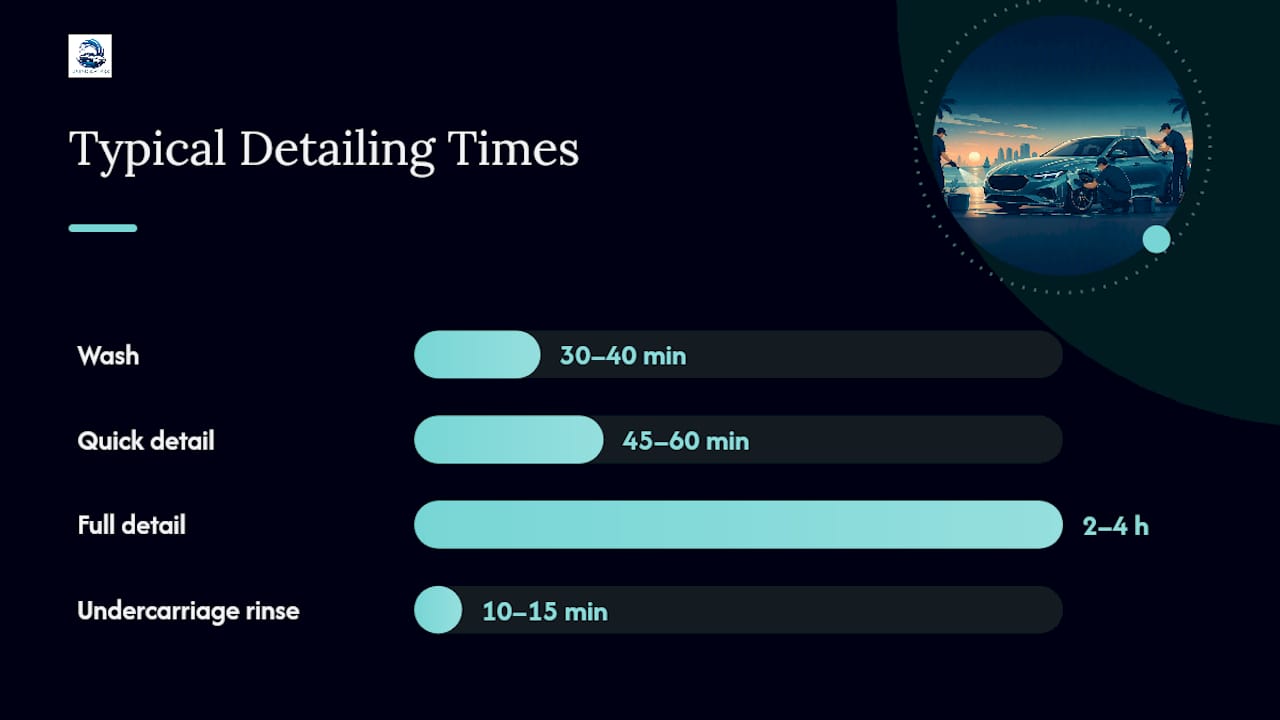
| Service | What it prevents | Typical time |
|---|---|---|
| Wash | Surface grime buildup, water spot etching | 30 to 40 minutes |
| Quick detail | Interior odor, minor stains, dulling | 45 to 60 minutes |
| Full detail | Oxidation, embedded contaminants, deep stains | 2 to 4 hours |
| Undercarriage rinse | Salt corrosion, suspension rust | 10 to 15 minutes add-on. |
Paint correction and ceramic coating cost more up front, but they exist specifically to slow the two things Florida accelerates most: UV fade and salt corrosion.
How Florida's Climate Actually Breaks Down a Car Faster
UV intensity is the first culprit, and it does more than fade paint. A dark-colored hood sitting in direct Florida sun can reach 140 to 180°F, and that heat matters because it turbocharges the enzymatic damage in bird droppings. On a cool panel, you might have 24 to 48 hours before droppings start etching clear coat. On a panel baking at midday, that window collapses to two to four hours before the acid and uric compounds start pitting the surface.
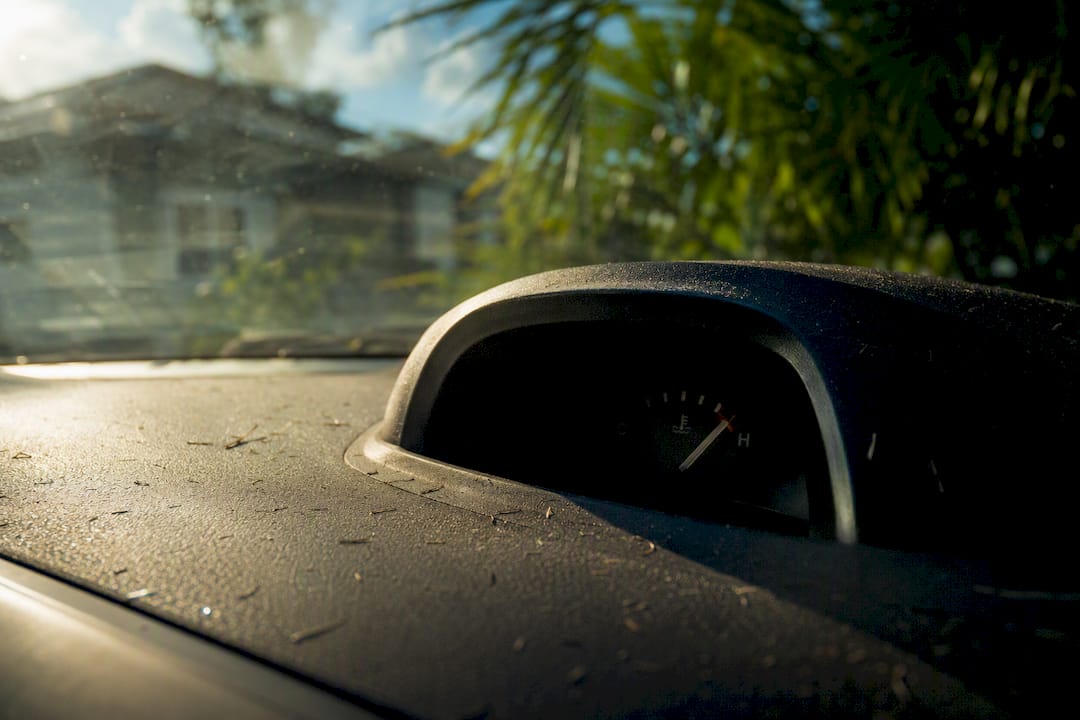
Humidity is the quieter threat. Florida's year-round moisture keeps interior surfaces damp enough that mold and mildew colonize carpet padding, seat foam, and HVAC systems faster than in drier climates, especially in cars that sit closed up in a parking lot all day.
Salt air is the one people underestimate most, because it does not require touching the ocean to do damage. Wind carries salt aerosol well inland, and coastal zones fall into ISO 9223's C5 corrosivity category, the same rating used for offshore industrial structures; for guidance on managing these seasonal environmental impacts, see the gutter cleaning frequency advice for Florida homes. That salt settles into wheel wells and undercarriage seams, where it works on metal quietly until rust shows up somewhere expensive.
- Hot panel bird dropping removal window: 2 to 4 hours
- Shaded panel removal window: up to a couple of days
- Coastal undercarriage rinse: at least every few months
- Interior mold risk: elevated year round due to ambient humidity
Recommended Detailing Schedule by Florida Zone
Where you park matters more than how far you drive. Coastal Florida (roughly within a few miles of open water), inland suburban Florida, and dense urban zones with heavy pollution and pollen each call for a different cadence.
| Service | Coastal (near shore) | Inland/suburban | Urban-exposed |
|---|---|---|---|
| Wash | 1 to 2 weeks | 2 to 3 weeks | 1 to 2 weeks |
| Quick detail | Every 2 to 3 weeks | Every 3 to 4 weeks | Every 2 to 3 weeks |
| Full professional detail | Every 2 to 3 months | Every 3 to 4 months | Every 2 to 3 months |
| Interior deep clean | Every 2 months | Every 3 months | Every 2 months |
| Wax reapplication | Every 4 to 6 weeks | Every 6 to 8 weeks | Every 4 to 6 weeks |
| Sealant reapplication | Every 3 to 4 months | Every 5 to 6 months | Every 3 to 4 months |
| Undercarriage rinse | Quarterly minimum | Twice yearly | Every 4 to 6 months |
The "hard floor" is the maximum interval you should let pass before real damage risk sets in. The "best-practice" range is where a car actually stays protected without wasted effort.
To pick your own cadence, ask yourself:
- Do I park outside more nights than not?
- Am I within a few miles of the coast or a major waterway?
- Do I drive on roads with heavy pollen, construction dust, or salted flooding runoff?
- Is my car dark colored or does it have leather seats?
Two or more "yes" answers means you belong on the tighter end of your zone's range, not the looser one.
Personal Habits That Push Your Cadence Tighter or Looser
Climate sets the baseline, but your own routine adjusts it up or down. Consider these factors in order of impact:
- Parking location. A covered garage cuts UV and dropping exposure dramatically; street parking under a ficus tree adds sap, pollen, and droppings daily.
- Daily driving distance and route. Highway driving through construction zones or agricultural areas adds grit and residue faster than short local trips.
- Vehicle age and paint condition. Older clear coat with existing micro-scratches oxidizes faster once UV finds an entry point.
- Color and interior material. Dark exteriors show fade and swirl marks sooner; leather interiors crack and fade faster than cloth under heat.
- Personal vs. fleet use. Fleet vehicles accumulate exposure faster simply from more hours parked outside and more drivers.
If you tick three or more of these toward the higher-risk side, move one full tier tighter than your zone's baseline schedule.
Pro Tip: A reflective sunshade can cut dashboard surface temperature by 40 to 50°F, and cracking a window slightly on dry days reduces the humidity buildup that feeds interior mold. Both cost almost nothing and buy you real time between details.
Signs Your Car Needs Attention Right Now
Some damage waits for your schedule. Some does not. Watch for these signals and act on the ones that mean escalating urgency:
- Fresh bird droppings on a hot panel: remove within hours, not days, to avoid permanent etching
- Water spots that don't wipe away: mineral deposits have started bonding to the clear coat
- Chalky or dull patches: early oxidation, often fixable with polish before it needs full correction
- Musty smell inside the cabin: early mold growth, usually traceable to a damp floor mat or clogged drain
- Persistent stains after a quick wipe: the contaminant has soaked past the surface fibers
Your triage order should be simple: spot remove immediately, reapply wax or sealant if the area is now bare, then schedule a full detail if oxidation or interior odor has already set in. Waiting past that point usually means paying for paint correction instead of a routine polish.
What Wax, Sealant, and Ceramic Coating Actually Buy You
Protective coatings change your cadence, but not as dramatically as marketing suggests. Carnauba wax in Florida's UV and salt combination typically lasts 4 to 8 weeks before it needs reapplication. Synthetic sealants stretch that out to 3 to 6 months. Ceramic coatings can protect for one to several years, but they still demand regular washing and undercarriage flushing, since coatings reduce how hard contaminants bond to paint, not whether salt reaches your suspension.
- Wax: cheapest, shortest lifespan, easiest DIY reapplication
- Sealant: mid-range cost, moderate lifespan, good balance for most inland drivers
- Ceramic coating: highest upfront cost, longest lifespan, best for coastal or high-mileage vehicles
- PPF (paint protection film): physical barrier against rock chips and etching, not a substitute for washing
A coating makes financial sense once you are paying for full paint correction more than once a year. If you are not there yet, a sealant plus a disciplined wash schedule usually covers it.
How a Mobile Workflow Keeps You on Schedule Without the Hassle
Sticking to a tighter cadence only works if booking a detail is not a chore. Living Waters Auto Wash LLC runs fully mobile service across Boca Raton, Pompano Beach, Coral Springs, Parkland, and Palm Beach County, arriving with everything needed and requiring no water or power hookup from the customer.
- Quarterly full detail paired with monthly quick details fits a typical coastal commuter well
- Fleet accounts often run weekly exterior washes with quarterly interior deep cleans
- Emergency cleanups (fresh droppings, spilled coffee, pet accidents) get handled the same week rather than waiting for a shop slot
Pro Tip: If you are unsure which tier fits your car, start with the recommended frequency schedule and adjust after one season based on how the paint and interior actually hold up. For interim upkeep between visits, the practical tips for keeping a car clean between details cover the small habits that matter most.
Get Ahead of Florida's Climate With a Recurring Plan
Booking one detail when the car already looks bad means paying for correction instead of maintenance. A recurring plan through Living Waters Auto Wash LLC keeps washes, quick details, and protective reapplications on the schedule your zone actually requires, whether that is a personal vehicle in Coral Springs or a business fleet running routes near the coast. Fleet managers can review fleet wash service options built around the same climate-bucket logic, while individual owners can book directly through the Living Waters Auto Wash service page and set a cadence that matches their exposure instead of guessing.
Why Florida's Cadence Advice Usually Undersells the Coast
The conventional advice treats Florida as one climate, when it is really several stacked risks that hit coastal drivers hardest and inland drivers gently. Most generic guides split the difference and land on a monthly wash recommendation that leaves coastal cars exposed to salt aerosol for weeks longer than they should be.
What gets underweighted almost everywhere is undercarriage care. Owners obsess over paint and ignore the frame and wheel wells, which is exactly where C5-level salt corrosivity does its quiet work. A car can look showroom clean on top and still be rusting from underneath.
If you take one thing from this: figure out your distance from salt water first, then build your schedule backward from that. Everything else, from wax choice to interior cleaning, follows naturally once you know which tier you actually live in.
Sources
- How Often to Actually Wash Your Car (by Climate) · CarCareTruth
- Car Detailing Tips for Miami Heat: Protect Your Paint & Interior | Motoro Cars