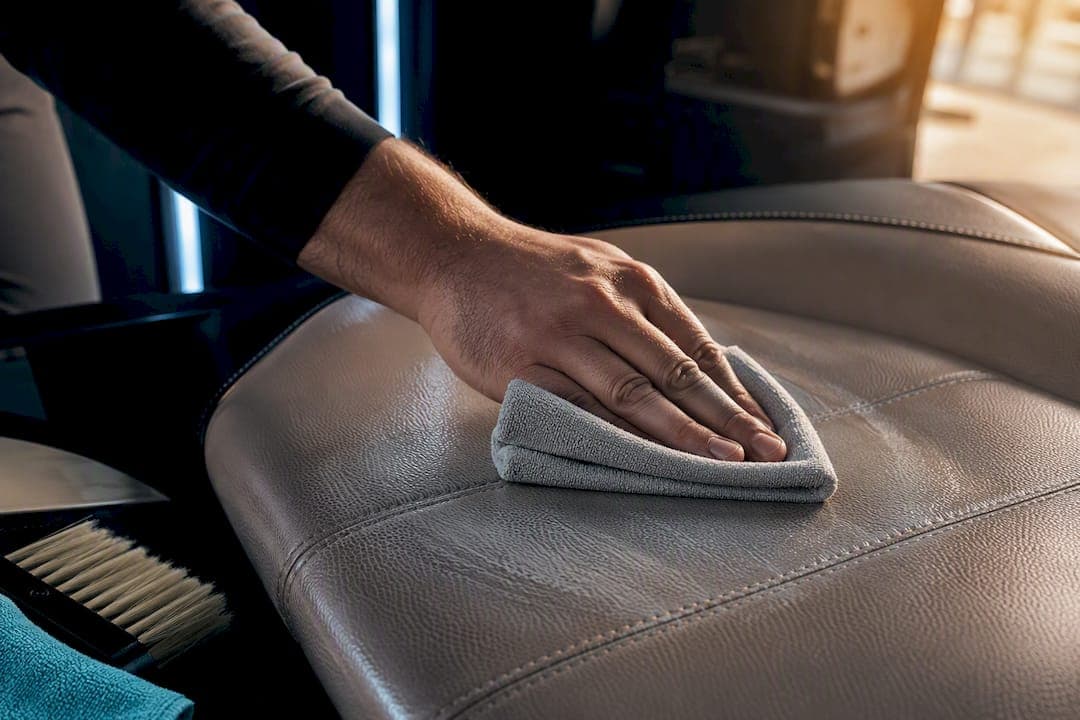
Most fresh sunscreen marks lift off leather seats without a trace, as long as you act before the sun bakes them in. The first move is simple: blot the excess, then cool the seat in shade or with the AC running before you touch a cleaner to it. From there, the reliable fix is a pH-neutral leather cleaner worked in with a soft brush, wiped away with fresh microfiber faces, and finished with a conditioner once the leather dries.
TL;DR:
- Applying a pH-neutral leather cleaner with gentle circular motions and minimal moisture is essential to remove sunscreen stains without damaging the finish.
- Mineral sunscreens like zinc oxide require mechanical lifting with brushes and fresh microfibers, as they sit in the leather grain and resist dissolving.
- Discoloration from chemical sunscreens such as avobenzone may progress into permanent yellow or orange stains if heat and time allow, often needing restoration rather than cleaning.
- Use a cooled, shaded surface and blot excess sunscreen immediately to prevent deeper migration into seams and perforations, increasing cleaning success.
- When in doubt or dealing with persistent or embedded stains, professional detailers can perform low-moisture, controlled methods to safely restore or address chemical-induced discoloration.
Table of Contents
- Sunscreen Stain Removal Checklist: What to Gather First
- How Do You Remove Sunscreen From Leather Seats Step by Step?
- Why Won't Some Sunscreen Stains Come Out?
- How Can You Prevent Sunscreen Stains on Leather Seats?
- When Should You Call a Professional Detailer?
- Do Different Leather Finishes Need Different Cleaning Methods?
- What Happens to Leather If Sunscreen Residue Is Left Untreated?
- Detailer's View: What Actually Separates a Clean Fix From a Ruined Seat
- Living Waters Auto Wash: The Fix When DIY Isn't Cutting It
- Sources
Sunscreen Stain Removal Checklist: What to Gather First
Before you touch the seat, get your supplies lined up. Rushing in with whatever's under the sink is how a small sunscreen smear turns into a bigger leather problem.
- pH-neutral leather cleaner, ideally an automotive-specific formula (roughly pH 4.5 to 5.0)
- A soft horsehair or nylon detailing brush
- 3 to 5 clean microfiber cloths, plus a spray bottle of distilled water
- Leather conditioner for after the cleaning is done
- Disposable gloves if you'd rather not handle cleaner directly
Park in shade or let the cabin cool down first, and always dab a hidden spot, like the underside of a seat edge, before working on the visible stain. Never spray cleaner straight onto the seat; load it onto your brush or towel instead. Skip Magic Erasers, acetone, full-strength degreasers, and repeated alcohol wipes. These strip the finish faster than sunscreen ever will.
Pro Tip: Fold your microfiber into quarters as you work. Each time a face picks up residue, flip to a clean section instead of grinding the same dirty patch back into the grain.
How Do You Remove Sunscreen From Leather Seats Step by Step?
This is the workflow professional detailers actually use, and the order matters as much as the products.
- Cool and blot. Get the seat out of direct sun, then lift excess sunscreen with a dry microfiber. Blot straight down. Don't rub, or you'll spread the oil into a wider stain before you've even started cleaning it.
- Load the cleaner onto your tool, not the seat. Apply a pH-neutral leather cleaner to your brush or a folded microfiber and work it into a light foam with gentle circular motions. Spraying directly onto the seat pushes moisture and residue into seams and perforations, which is exactly where sunscreen loves to hide.
- Agitate, then wipe, then repeat. Work the foam lightly into stitching and any perforated panels, then wipe away residue with a fresh microfiber face. Two to three light passes usually beats one aggressive one, since each pass lifts a little more without grinding sunscreen deeper into the hide.
- Rinse the residue. Wipe the area with a microfiber barely dampened with distilled water to pull off leftover cleaner, then let it dry fully before moving on.
- Condition once it's bone dry. Apply a thin coat of leather conditioner and buff it in. Conditioning too early, while the leather is still damp, traps moisture under the surface instead of restoring it.
The pattern that separates a clean result from a damaged seat is cooling the surface first, since heat thins the sunscreen's oils and lets them migrate deeper into the grain before you even get a cloth on it. Detailers typically run two to four short passes with foam rather than one long scrub, swapping to a clean microfiber face on every pass.
Keep moisture to a minimum throughout. Applying cleaner to the towel or brush instead of spraying it directly onto the leather is the single biggest factor in whether residue comes out clean or gets pushed into the seams.
Why Won't Some Sunscreen Stains Come Out?
Not all sunscreen behaves the same way on leather, and knowing which type you're dealing with saves you from wasting effort on the wrong fix.
- Mineral sunscreen (zinc oxide or titanium dioxide) leaves a chalky white residue that sits in the grain. No cleaner dissolves it because it's not really absorbed, it's just sitting there. Mechanical lifting with a brush and repeated fresh microfibers is what actually removes it.
- Chemical sunscreen leaves more of a greasy film, and if it bakes in the heat for a day or two, ingredients like avobenzone can react and leave a yellow or orange tint that cleaning alone won't reverse.
If a color shift lingers after proper cleaning, your options shift from cleaning to restoration: leather-specific stain removers made for coated hides, repigmentation kits, or a professional detailer. Stop the DIY approach if the finish looks duller after cleaning, the surface feels different under your hand, or residue keeps reappearing in the perforations no matter how many passes you run.
Pro Tip: A haze that returns a day after cleaning usually means residue is still trapped below the surface, not that your cleaner failed. Give it one more light pass with a fresh towel before assuming it's a permanent stain.
How Can You Prevent Sunscreen Stains on Leather Seats?
Prevention costs you almost nothing and saves you the whole cleanup process. A few small habits go a long way toward keeping leather looking new.
- Let sunscreen dry before sitting down whenever you can manage it.
- Keep a towel in the car and toss it over the seat after a beach or pool day.
- Use a removable seat cover on days you know you'll be in and out with sunscreen on.
- Wipe down high-contact areas, the seat bottom and lower backrest, every few trips if you're at the beach often.
Build a light maintenance rhythm around it: clean gently once a month or as needed, and condition sparingly after a full cleaning once the leather is dry. Lighter-colored interiors show sunscreen faster, so check those seats more often than you would a dark interior. A dilute dish soap solution can work in a pinch for a quick oil cut, but always follow it with a plain water wipe and a conditioning pass so the leather doesn't dry out. On a hot day, a two-minute wipedown before you park for the night stops residue from baking into the surface overnight.
When Should You Call a Professional Detailer?
DIY handles most fresh stains, but a few situations call for more than a brush and a bottle of cleaner. If residue is still visible after a proper cleaning attempt, if sunscreen worked its way into perforations or stitched seams, or if you're seeing that yellow-orange discoloration that won't budge, it's time to hand it off.
- Persistent residue after two or three careful cleaning attempts
- Sunscreen embedded in perforated leather or tight stitching
- Discoloration that suggests a chemical reaction rather than surface grime
Detailers who work with embedded or set-in stains routinely use controlled, low-moisture techniques and repigmentation skills that go beyond what a household cleaner can fix. Living Waters Auto Wash LLC's technicians bring leather-safe cleaning methods directly to your driveway, backed by a strong local reputation for 5-star reviews across the areas they serve.
Do Different Leather Finishes Need Different Cleaning Methods?
Not every leather seat responds the same way to the same cleaner, and treating a delicate finish like a rugged one is how good intentions turn into damage.
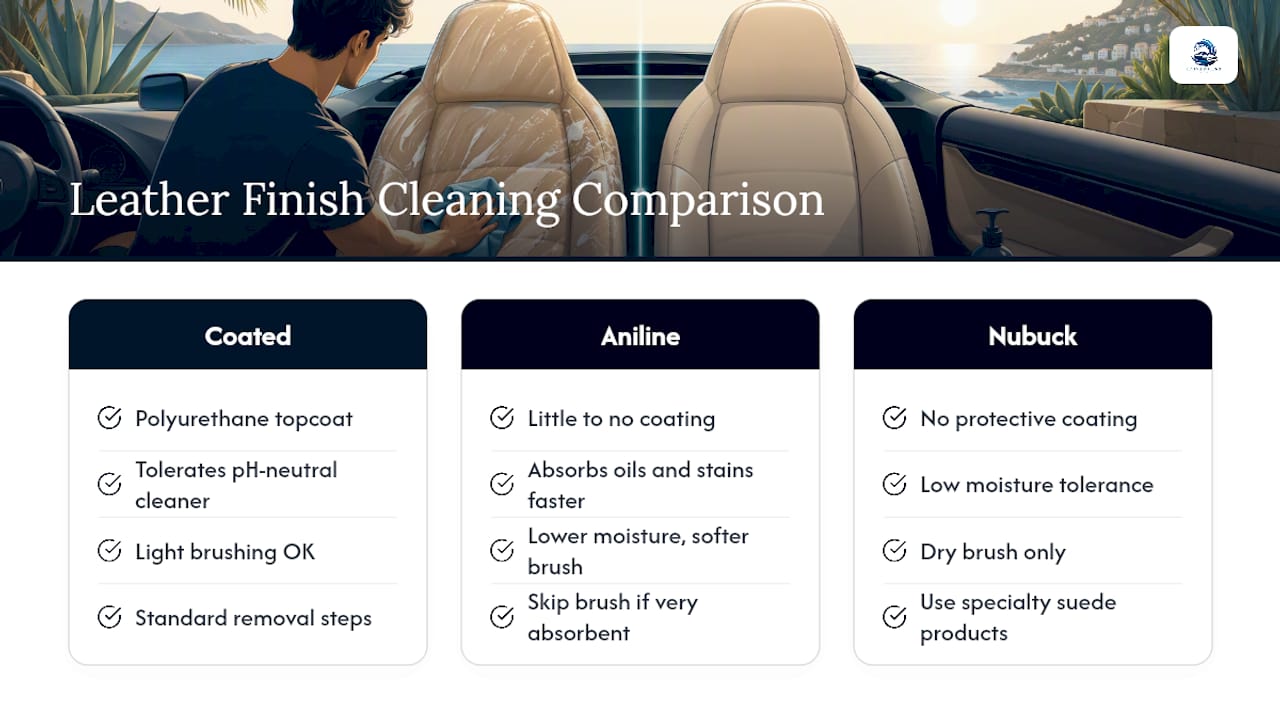
Coated or pigmented leather, the kind found in most modern vehicles, has a polyurethane topcoat that tolerates a pH-neutral cleaner and light brushing reasonably well. This is the finish most of the standard removal steps above are built around.
Aniline and semi-aniline leather has little to no protective coating, so it absorbs oils and stains faster and shows watermarks more easily. These seats need lower moisture, softer brushes, and a gentler touch. Skip the brush agitation altogether if the leather feels notably softer or more absorbent than a typical coated seat.
Nubuck or suede-style leather trim is rare in most vehicles but occasionally shows up in inserts or accent panels. Standard liquid cleaners can leave permanent water marks on this material, so it generally needs a dry brush and specialty suede products rather than anything in the wet-cleaning workflow above.
If you're not sure which finish you're working with, check your owner's manual or run the hidden-spot test described earlier before committing to a full cleaning pass on the whole seat.
What Happens to Leather If Sunscreen Residue Is Left Untreated?
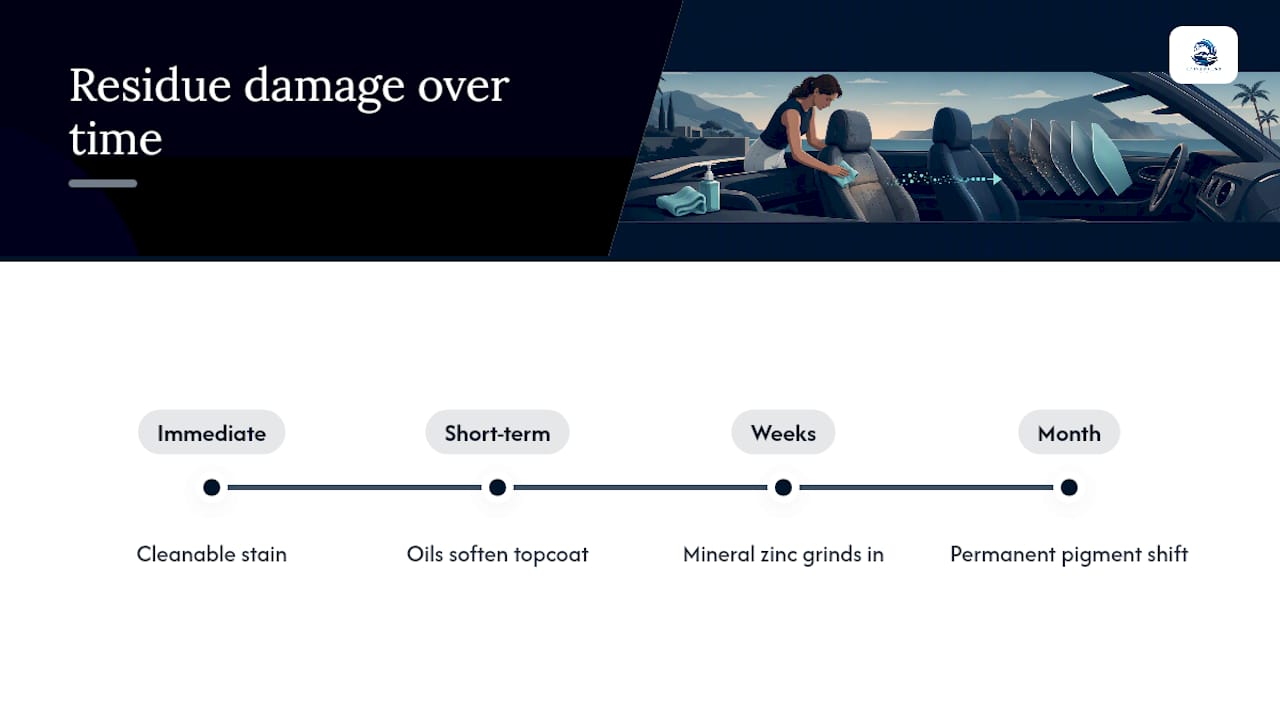
Sunscreen left on leather doesn't just sit there looking bad, it actively works against the material over time. The oils in most sunscreens are formulated to resist water, which means they also resist evaporating cleanly off a porous surface like leather.
Left for days or weeks, especially through repeated sun exposure, those oils can soften the topcoat's bond to the leather underneath, making the surface more prone to cracking down the road. Mineral sunscreen residue that never gets brushed out compounds the problem: each time you sit down, body heat and pressure grind more zinc oxide particles into the grain, making the eventual cleanup harder than if you'd handled it after the first exposure.
Chemical sunscreen carries a different long-term risk. The dye-shifting reaction that produces yellow or orange discoloration tends to get more pronounced the longer the sunscreen sits and the more heat it's exposed to, which is why a stain that looked manageable on day one can look permanent by day thirty. Once that shift sets into the leather's pigment layer, it typically requires repigmentation rather than cleaning to correct.
The takeaway is straightforward: time and heat are the enemy, not the sunscreen itself. A stain handled within a day or two is a cleaning job. The same stain ignored through a hot week can become a restoration job.
Detailer's View: What Actually Separates a Clean Fix From a Ruined Seat
Patience beats aggression every time. The detailers who get sunscreen out cleanly aren't the ones scrubbing hardest, they're the ones swapping to a clean towel face on nearly every pass and treating the job as several light rounds instead of one heavy one.
Most fresh stains come out. The honest failure mode isn't residue, it's color shift from chemical sunscreen that's already baked in, and that calls for repigmentation work most people can't do themselves. Prevention is still the cheapest fix on the list: a towel over the seat, fifteen minutes of drying time before you sit down, and a quick wipe at the end of a beach day handle more of this problem than any cleaner ever will.
— Living
Living Waters Auto Wash: The Fix When DIY Isn't Cutting It
If you've worked through the steps above and the stain, or the discoloration, is still staring back at you, Living Waters Auto Wash LLC gives you a way to skip the guesswork without hauling your car to a shop. Technicians come to you across Boca Raton, Pompano Beach, Coral Springs, Parkland, and Palm Beach County, with leather-safe cleaners and low-moisture techniques dialed in for exactly this kind of stubborn residue.
Every visit starts with an on-site inspection so the technician knows whether they're dealing with mineral buildup, chemical discoloration, or both, before touching your seats. From there they use the same pH-neutral, controlled-agitation approach covered above, condition the leather once it's dry, and flag anything that needs repigmentation rather than pushing a DIY-grade fix on a problem that needs more. No driveway hose, no dragging your car anywhere. If a quick DIY pass didn't fully clear a stain, book a mobile detailing visit and get a straight answer on what it'll take to bring your seats back.
Sources
- Sunscreen Off Leather Car Seats — Berry Finds
- Chemical Guys Facebook post: To remove sunscreen from leather consider using Chemical Guys leather cleaner
- How to remove sunscreen stains from car interior — Right Car Detailing