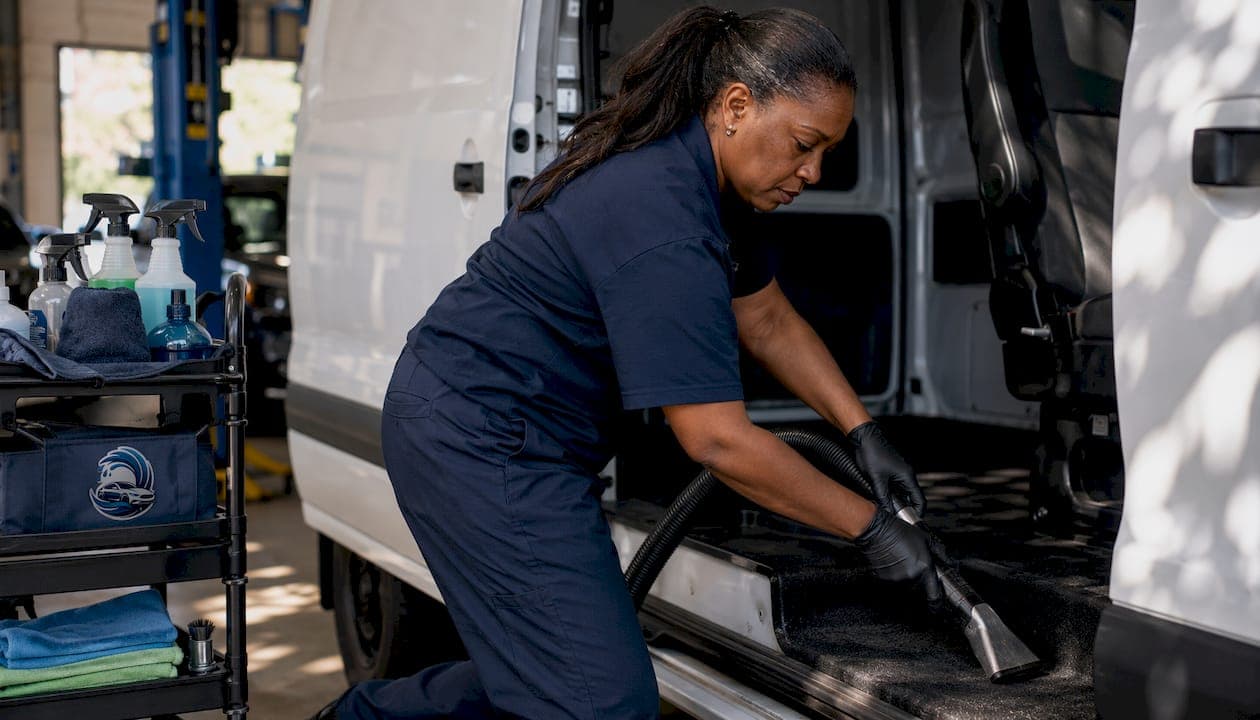
Van fleet interior detailing is a systematic, professional deep-cleaning and restoration process applied to the cabins of commercial vans, covering every surface from the cargo floor to the HVAC vents. It goes well beyond a routine wipe-down: technicians extract embedded contaminants, treat upholstery, condition leather, neutralize odors, and apply antimicrobial coatings to surfaces that drivers touch dozens of times a day.
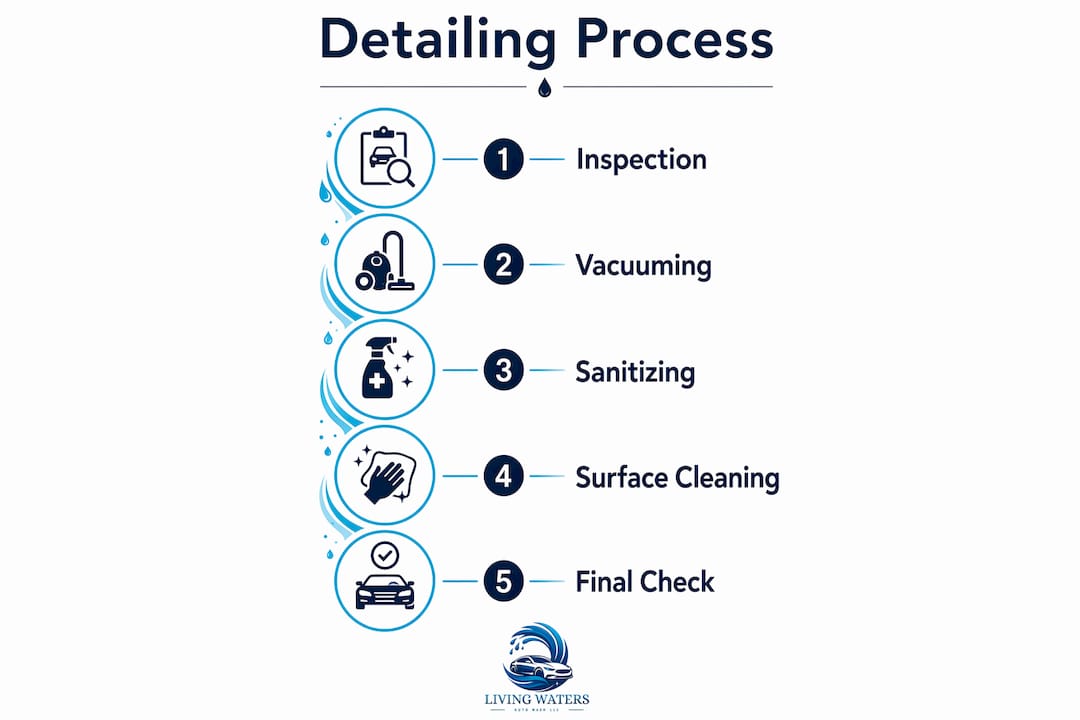
The business case is straightforward. Clean cabins reduce allergen exposure and improve cabin air quality for drivers who spend hours inside these vehicles. A well-maintained interior signals professionalism to every client who opens that van door. And protecting interior materials from early degradation directly preserves resale value when you cycle vehicles out of the fleet.
TL;DR: If your vans see daily use, routine cleaning alone won't cut it. Professional interior detailing, scheduled regularly depending on intensity, is the difference between a fleet that holds its value and one that racks up repair bills.
- Professional interior detailing removes allergens, bacteria, and mold that basic cleaning misses.
- A clean, odor-free cabin strengthens brand image with every client interaction.
- Protecting materials early reduces seat-repair, carpet-replacement, and odor-remediation costs over a vehicle's lifecycle.
For daily-use fleets, a recommended detailing schedule from professional providers is an exterior wash every 2–3 weeks, interior sanitation monthly, paint protection every 3–6 months, and a full deep detail once or twice per year.
Table of Contents
- What does van fleet interior detailing include?
- How does a van interior detail actually work?
- Why professional interior detailing pays off for fleets
- How often should fleet vans be detailed?
- What does van fleet interior detailing cost?
- How do you choose the right fleet detailing provider?
- Living Waters Auto Wash LLC: a mobile fleet detailing example
- What types of vans and fleet sizes does interior detailing cover?
- In-house vs. outsourced van fleet interior detailing
- Key Takeaways
- The case for treating detailing as fleet infrastructure
- Living Waters Auto Wash LLC serves fleets across South Florida
- Useful sources for fleet managers
What does van fleet interior detailing include?
Interior detailing goes well past a vacuum and a spray bottle. Here is what a complete service covers for commercial vans:
- Vacuuming — floors, mats, seat tracks, cargo rails, and storage cubbies; removes loose debris before wet processes begin.
- Upholstery shampooing and hot-water extraction — pulls soil from the base of fabric fibers, not just the surface.
- Carpet cleaning — targeted stain treatment followed by extraction; critical in cargo vans where floor contamination is heavy.
- Leather cleaning and conditioning — a pH-balanced cleaner followed by conditioner maintains suppleness and prevents cracking on driver and passenger seats.
- Dashboard and console degreasing — removes hand oils, food residue, and UV-accelerated grime from every touchpoint.
- Vent and HVAC cleaning — brushes and compressed air clear dust and mold spores from vents; a cabin filter check is standard.
- Odor elimination — ozone treatment or antimicrobial fogging neutralizes odors at the source rather than masking them.
- Window and mirror cleaning — streak-free glass improves visibility and looks sharp on customer-facing vehicles.
- Door jambs and crevice cleaning — often skipped in basic cleans; these areas accumulate grime that transfers to clothing.
- Seat-belt and anchor cleaning — high-touch, rarely cleaned, and a genuine hygiene concern in shared vehicles.
Add-on services for vans specifically: cargo-area sanitation with food-safe or industrial-grade cleaners, tool-compartment degreasing, marine-grade surface treatment for wet-work vans, smoke- or food-odor neutralization, and antimicrobial surface coating for client-facing vehicles.
Pro Tip: Before signing any quote, ask the provider to list the product names and dwell times for any disinfectant or antimicrobial treatment. A reputable provider will also confirm whether protective coatings carry a warranty and can show proof of technician training.
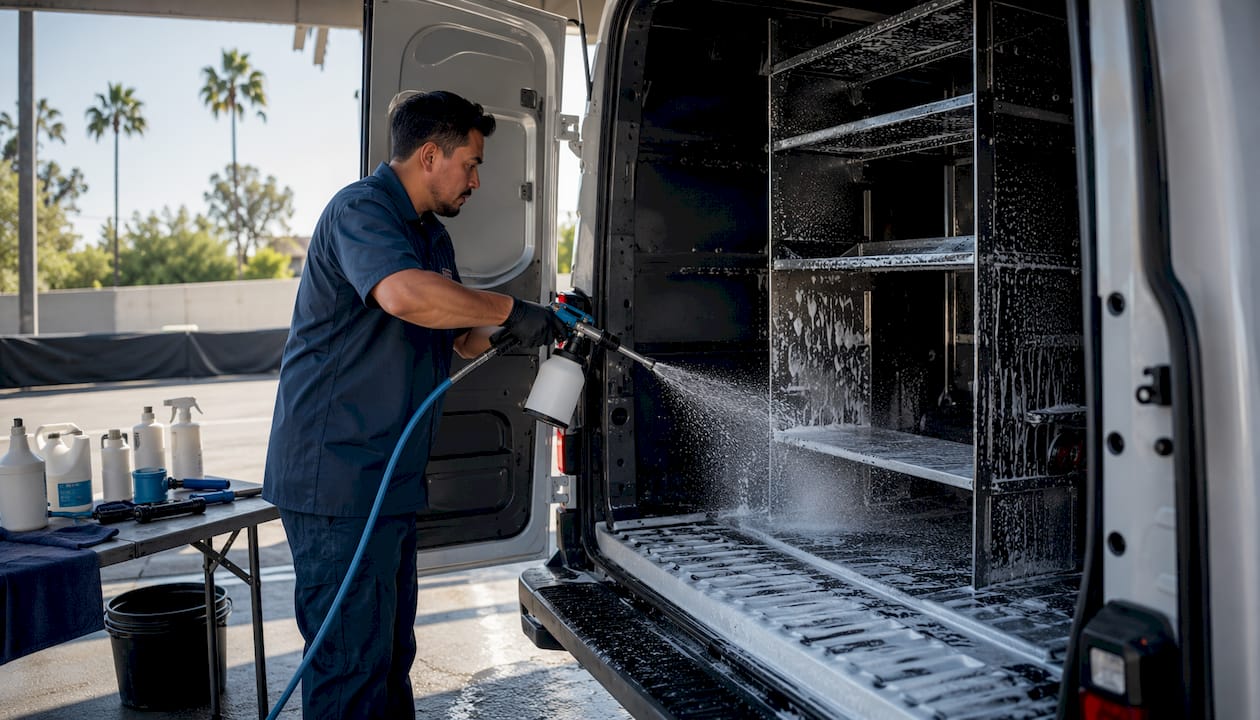
How does a van interior detail actually work?
Understanding the workflow helps you schedule around operations and set realistic expectations for your team.
- Intake and inspection — the technician documents existing damage, stains, and odor sources before touching anything. Get a written sign-off on scope here.
- Pre-vacuuming and debris removal — dry loose material is removed first so wet processes don't push grime deeper into fibers.
- Targeted stain pre-treatment — problem areas (food spills, grease, ink) get a dwell-time application before extraction.
- Upholstery and carpet extraction — hot-water extraction pulls treated soil out of fabric; this is the most time-intensive step.
- Dashboard, console, and hard-surface cleaning — all-purpose cleaner with soft brushes, followed by a UV-protectant application.
- Vent and HVAC cleaning — brushes, compressed air, and a cabin filter check; steam is useful for sanitizing touch points without harsh residue.
- Leather conditioning — applied after cleaning while the leather is still slightly warm for better absorption.
- Odor treatment — ozone or antimicrobial fogging runs after the cabin is otherwise complete.
- Final inspection and documentation — before-and-after photos, a checklist sign-off, and a copy for your maintenance records.
Typical durations by tier:
- Express interior (vacuuming, wipe-down, glass): 45–75 minutes for a standard cargo van.
- Standard deep interior (full extraction, HVAC, odor treatment): 2.5–4 hours for a cargo van; 3.5–5 hours for a larger passenger or service van.
- Full restoration (all of the above plus leather restoration, ozone, antimicrobial coating): 5–8 hours depending on condition.
Mobile detailing eliminates the shop drop-off entirely. Providers like Living Waters Auto Wash LLC operate without municipal water or electric hookups, using generators and low-water systems, so your vans stay at your yard or job site. That means zero transit downtime. Before a scheduled visit, ask drivers to remove sensitive items, report any new damage, and confirm the parking location and a point of contact.
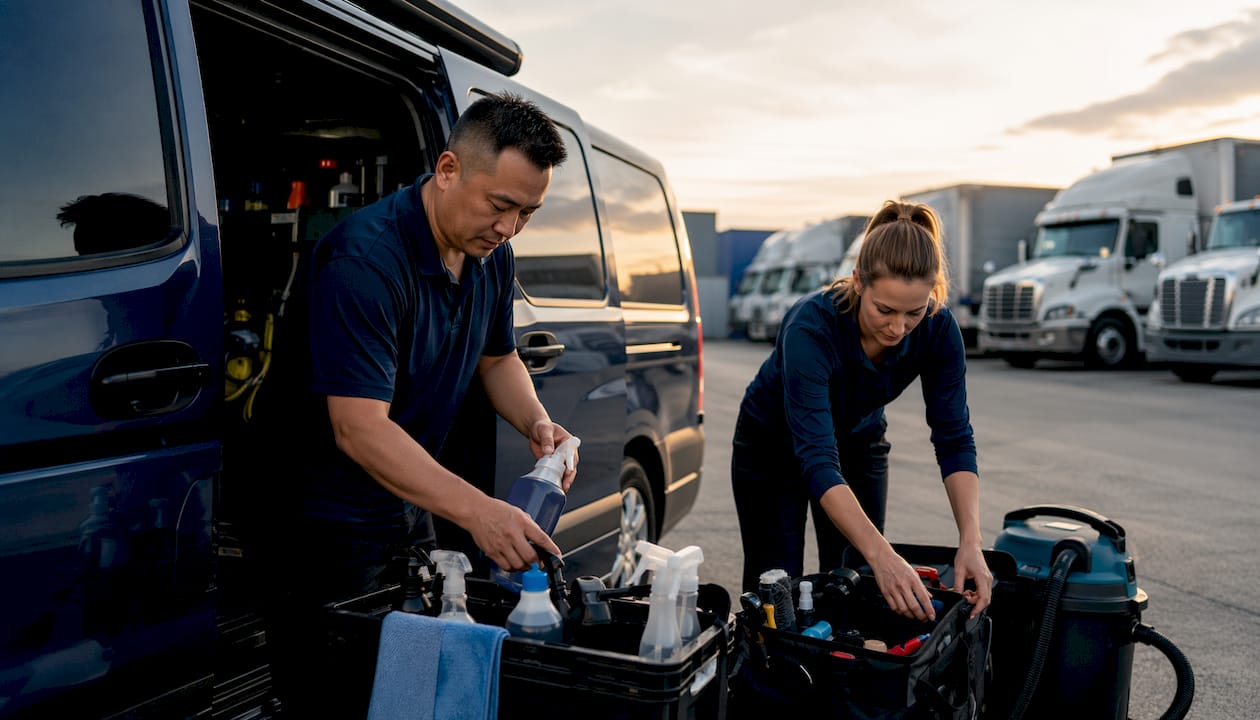
Why professional interior detailing pays off for fleets
The returns show up in several places at once, which is what makes this a budget line worth defending.
- Driver health and reduced sick days — professional interior detailing improves cabin air quality by extracting dust mites, pollen, and bacteria from fibers and cleaning HVAC vents; recommended intervals for health benefits are typically every 3–6 months for daily drivers.
- Stronger brand impression — a consistently clean cabin acts as a rolling advertisement. Every client who steps into a van makes a judgment about your business in the first few seconds.
- Longer interior life — specialized services like odor elimination, leather restoration, and microbial treatment prevent permanent damage and reduce long-term repair or replacement costs.
- Higher resale value — a well-documented detailing history signals to buyers that the vehicle was cared for, which directly affects negotiation leverage when you cycle vans out.
- Driver retention — drivers who spend eight hours a day in a vehicle notice when it's maintained. A clean, odor-free cabin is a low-cost retention signal.
- Compliance and incident response — food-service and medical-transport fleets often face client or regulatory cleanliness standards; documented detailing records support compliance audits and speed up contamination cleanups.
Consider a five-year lifecycle on a cargo van. Neglected upholstery may need full seat replacement by year three. Carpet that never gets extracted holds moisture, which accelerates mold and subfloor damage. Routine detailing, even at the standard-deep tier twice a year, costs a fraction of those repairs and keeps the van presentable for client-facing work throughout its service life.
How often should fleet vans be detailed?
Frequency depends almost entirely on how hard the vehicle works. A recommended schedule from professional fleet detailers: exterior wash every 2–3 weeks, interior sanitation monthly, and a full deep detail once or twice per year.
- Delivery and logistics vans — monthly express sanitation, quarterly standard deep interior, full restoration annually.
- Food-service vans — biweekly interior touchups, monthly extraction, quarterly deep detail with food-safe sanitizers.
- Passenger and shuttle vans — monthly full interior detail; high-touch surfaces (handles, seat belts, armrests) sanitized weekly.
- Administrative or low-mileage vans — monthly express, standard deep every 6 months, restoration as needed.
The simplest implementation: add detailing dates to your existing fleet PM or fleet-management software alongside oil changes and tire rotations. Align visits with off-shift windows so no vehicle misses a revenue-generating run. Keep a log of dates, scope, and before-and-after photos. That record supports warranty claims, resale negotiations, and any compliance audit.
Pro Tip: Check detailing frequency guidance for your specific vehicle types before locking in a schedule — high-use vans often need more frequent service; standard schedules are exterior wash every 2–3 weeks, interior sanitation monthly, paint protection every 3–6 months, and a full deep detail once or twice per year.
What does van fleet interior detailing cost?
Pricing varies by tier, vehicle size, and contamination level. Here is a baseline framework:
| Tier | Typical price range | Core services included | Typical duration |
|---|---|---|---|
| Express | $75 per van | Vacuuming, wipe-down, glass, quick odor spray | 45–75 min |
| Standard deep | $175 per van | Full extraction, HVAC, leather conditioning, odor treatment | 2.5–5 hrs |
| Full restoration | $350 per van | All deep services plus ozone, antimicrobial coating, leather restoration | 5–8 hrs |
Fleet volume discounts are standard practice — providers typically reduce per-vehicle rates for recurring contracts covering five or more vehicles.
Variables that move the price:
- Vehicle size (cargo van vs. full-size passenger van)
- Level of soil or contamination at intake
- Ozone or antimicrobial treatment requirements
- Specialty materials (leather, marine-grade surfaces)
- Mobile or on-site premium vs. shop pricing
- Emergency or same-day service surcharge
Always request an itemized quote that separates labor, product costs, and any PPE or disposal fees. Ask whether pricing is flat-rate per vehicle or hourly, and confirm what triggers an upcharge. For a pilot program, budget the standard-deep tier for your highest-use vehicles first, then compare that monthly spend against the cost of one seat repair or one carpet replacement. The math usually closes the argument quickly.
How do you choose the right fleet detailing provider?
Run through this checklist before signing anything:
- Mobile vs. shop capability (can they come to your yard?)
- Proof of general liability insurance and, for food-service or medical fleets, any required certifications
- Technician training documentation
- MSDS availability for all products used
- Eco-friendly or low-VOC product claims with supporting labels
- Volume and contract pricing structure
- Local references and verifiable reviews
- Written scope of work and SLA for turnaround times
Questions to ask every candidate:
- Can you provide a sample written scope for a fleet of our size?
- What is your turnaround time per vehicle, and how do you handle rescheduling?
- What does your fleet contract cover, and what triggers an additional charge?
- Can you show proof of insurance and a sample certificate?
- Do you have before-and-after documentation from a comparable fleet client?
- How do you handle a complaint or a redo request?
Red flags to walk away from:
- Vague scope ("full detail" with no itemized list)
- Refusal to name the chemicals or provide MSDS
- No proof of insurance
- No fleet references
- Pressure to sign a long contract before running a pilot
The procurement process that works: run a 30–90 day pilot on your highest-use vehicles, collect driver feedback, monitor downtime impact, and then negotiate a volume contract with scheduled visits. You'll know exactly what you're buying before you commit.
Living Waters Auto Wash LLC: a mobile fleet detailing example
Living Waters Auto Wash LLC operates as a fully mobile fleet detailing service across Boca Raton, Pompano Beach, Coral Springs, and Parkland. Their team brings all equipment to your location, with no need for water or electrical hookups at the site, which makes scheduling around active fleet operations genuinely practical.
Their fleet service menu covers express interior detailing for quick turnarounds between shifts and a full interior deep clean priced at $199, which includes extraction, HVAC cleaning, leather conditioning, and odor treatment. For fleet managers running multiple vehicles, they offer fleet contracts with scheduled visits aligned to your PM calendar.
Their eco-conscious approach uses products selected for low environmental impact, and the team is trained to work on mixed-surface interiors — cloth, leather, and specialty coatings — without cross-contamination. For managers who want to verify product safety, ask for MSDS sheets on any chemical used in the cabin.
What to request from any provider, using Living Waters Auto Wash LLC as the benchmark: written scope with product names, proof of general liability insurance, technician training credentials, and a sample before-and-after photo set from a fleet account.
What types of vans and fleet sizes does interior detailing cover?
Interior detailing applies across the full range of commercial van types, and the service scope adjusts to match.
Cargo vans (Ford Transit Cargo, Ram ProMaster, Mercedes-Benz Sprinter) are the most common fleet vehicle. Their interiors take heavy abuse from tools, packages, and daily loading. Detailing focus areas: cargo floor, bulkhead, storage cubbies, and tool rails, treated with appropriate protectants to reduce cleaning time and material replacement over the fleet lifecycle.
Passenger and shuttle vans (Ford Transit Passenger, Chevrolet Express) carry clients or employees, so cabin appearance directly affects brand perception. Full-row seat extraction, armrest cleaning, and high-touch surface sanitizing are non-negotiable at this use level.
Service and utility vans used in HVAC, plumbing, or electrical trades accumulate grease, dust, and chemical residue that standard cleaning products won't touch. These require stronger degreasers and tailored protocols.
Food-service vans need food-safe sanitizers and more frequent service cycles than any other category.
Fleet size doesn't limit access to professional detailing. Solo operators with two or three vans benefit from the same services as a 50-vehicle corporate fleet. The difference is pricing leverage: larger fleets negotiate volume discounts and scheduled-visit contracts, while smaller operators often pay per-visit rates. Either way, the service quality and scope remain consistent.
In-house vs. outsourced van fleet interior detailing
This is a real procurement decision, and the answer depends on fleet size, frequency needs, and internal capacity.
In-house detailing makes sense when you have a large, centralized fleet (typically 30+ vehicles), a dedicated maintenance facility with water and power access, and staff who can be trained and supervised consistently. The upside is control over scheduling and product selection. The downside is equipment cost (extractors, ozone units, HVAC cleaning tools), ongoing product procurement, staff training, and the liability exposure of chemical handling.
Outsourced detailing fits most commercial fleets better. You pay for the service when you need it, with no capital outlay on equipment. A qualified mobile provider brings trained technicians, professional-grade tools, and product liability coverage. The tradeoff is less scheduling flexibility on short notice and dependence on the provider's quality consistency.
A practical middle ground: outsource the deep and restoration tiers to a professional provider, and train an internal staff member to handle express-level maintenance between visits. That keeps cabins presentable daily without the overhead of a full in-house program.
The decision framework is simple. If your fleet is under 20 vehicles or geographically dispersed, outsourcing almost always wins on cost and quality. Above that threshold, a hybrid model or a managed fleet contract with a mobile provider typically delivers the best balance of control and cost.
Key Takeaways
Scheduled professional interior detailing is the single most cost-effective way to protect driver health, preserve interior assets, and maintain brand image across a commercial van fleet.
| Point | Details |
|---|---|
| What it is and why it matters | Van fleet interior detailing is a professional deep-clean and restoration process that protects driver health, brand image, and resale value. |
| Recommended schedule | Exterior wash every 2–3 weeks, interior sanitation monthly, paint protection every 3–6 months, and a full deep detail once or twice per year; frequency depends on usage intensity. |
| Primary pricing factors | Vehicle size, contamination level, service tier, and mobile premium; fleet volume discounts may apply for recurring contracts. |
| Procurement checklist | Always request a written scope, itemized product list, proof of insurance, and fleet references before signing. |
| Living Waters Auto Wash LLC | Offers mobile fleet interior detailing across Boca Raton, Pompano Beach, Coral Springs, and Parkland, including a full interior deep clean at a competitive market price with no on-site hookups required. |
The case for treating detailing as fleet infrastructure
Most fleet managers treat interior cleaning as a reactive task: something gets bad enough, and then it gets cleaned. That framing costs money. The managers who get the most out of their vehicles treat detailing the same way they treat oil changes: scheduled, documented, and non-negotiable.
The argument against professional detailing usually comes down to cost per visit. But that calculation ignores what it costs to replace a set of seats, remediate a mold problem in a cargo floor, or lose a client contract because a driver showed up in a van that smelled like last week's lunch. Those costs are real, and they're preventable.
Start with a quarterly pilot on your three highest-use vans. Track driver feedback, document the before-and-after condition, and compare the cost against any repair or cleaning incident you avoided. That 90-day window gives you the data to make the case internally and negotiate a volume contract from a position of knowledge rather than guesswork.
Living Waters Auto Wash LLC serves fleets across South Florida
Fleet managers in Boca Raton, Pompano Beach, Coral Springs, and Parkland have a mobile option that removes the biggest friction point in fleet detailing: getting vehicles to a shop.
Living Waters Auto Wash LLC brings the full service to your yard, job site, or commercial facility. No hookups needed. Their fleet wash services cover express interior detailing for quick between-shift turnarounds and a full interior deep clean for vehicles that need a complete reset. Fleet contracts include scheduled visits aligned to your PM calendar, volume pricing, and written scopes on every job.
To get a quote, provide your fleet size, vehicle types, and average weekly utilization. Request a written scope, a sample insurance certificate, and references from a comparable fleet account. Then schedule a pilot visit for your highest-use vehicles and see the results before committing to a contract.
Contact Living Waters Auto Wash LLC to request a written quote and schedule your first fleet detail.
Useful sources for fleet managers
These references are worth bookmarking as you build or refine your fleet detailing program:
- Interior detailing benefits and air quality — covers health outcomes from professional cabin cleaning, including allergen and HVAC findings.
- Fleet vehicle detailing and scheduling guidance — practical frequency recommendations and mobile logistics for commercial fleets.
- Interior detailing scope and methods — explains extraction, steam cleaning, and antimicrobial treatment in plain language.
- Fleet detailing first-timer guide — a solid overview of what fleet detailing involves and how it differs from routine cleaning.
- Van detailing guide — covers interior workflow, product selection, and surface-specific protocols relevant to commercial van interiors.
Before signing any provider contract, request MSDS sheets for all chemicals used in your vehicles, verify the provider's general liability insurance, and confirm technician training credentials. For food-service or medical-transport fleets, check whether your client contracts or applicable regulations specify hygiene standards that the detailing scope must meet.