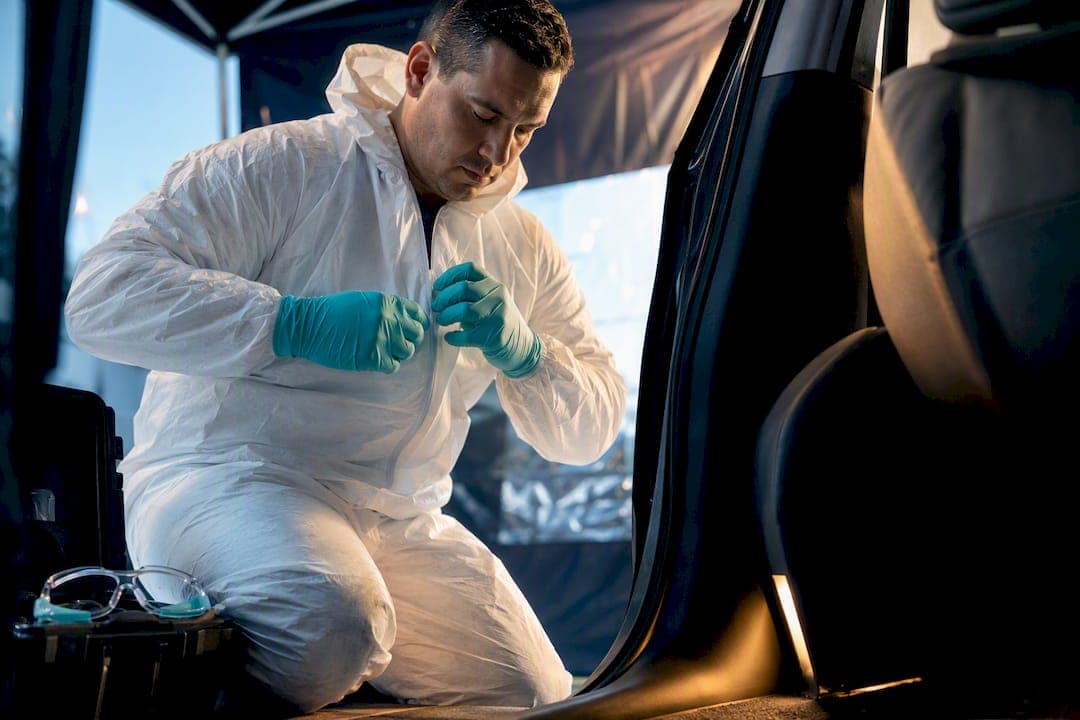
If your vehicle has blood, decomposition fluids, an unknown biological stain, or a discarded needle in it, you need a certified biohazard cleanup provider, not a regular detailer. Isolate the car, avoid touching contaminated surfaces, and call a trained crew or emergency services if there's an active hazard. Most auto policies allow coverage for professional remediation, so contact your insurer as soon as you've secured the vehicle.
TL;DR:
- Biohazard car cleaning is necessary after incidents involving blood, bodily fluids, or decomposition, especially with high infection risk or large contamination volume.
- Certified remediation involves a detailed process with porous material removal, hospital-grade disinfection, HVAC cleaning, and biological verification, often documented for insurance.
- Proper PPE, adherence to OSHA and IICRC standards, and regulated waste disposal are non-negotiable for legal and safety compliance.
- Costs range from around $250 for minor spills to over $5,000 for cases like unattended death, with many insurance policies covering professional cleanup if documented promptly.
- Visual cleanliness does not confirm safety; verified testing and documentation are essential to ensure decontamination success before vehicle resale or insurance claims.
Table of Contents
- What Counts as Biohazard Car Cleaning, and When Do You Need It?
- How Does Professional Vehicle Decontamination Actually Work?
- What Safety Standards and PPE Should a Provider Follow?
- What Does Biohazard Car Cleaning Cost, and Will Insurance Cover It?
- How Do You Choose a Qualified Biohazard Cleanup Provider?
- What Happens After Remediation Is Complete?
- What Living Waters Auto Wash LLC Sees on Mobile Response Calls
- Do You Need a Permit to Clean Biohazard Waste From a Car?
- How Is Biohazardous Waste From Car Cleaning Disposed Of?
- How Do You Know the Biohazard Is Actually Gone?
- The Gap Between Marketing Claims and Real Biohazard Standards
- Get Fast, Mobile Response From Living Waters Auto Wash LLC
- Sources
What Counts as Biohazard Car Cleaning, and When Do You Need It?
Biohazard car cleaning covers the removal and disinfection of blood, vomit from an unidentified source, feces, decomposition fluids, discarded needles, and any bodily fluid contamination that carries an infection risk. This is a distinct category from spilled coffee or muddy floor mats. The distinction matters because bloodborne pathogens like Hepatitis B, Hepatitis C, and HIV can remain infectious on hard and porous surfaces for hours or, in some conditions, days, which is why removal has to be thorough rather than cosmetic.
Certain incidents almost always require a licensed remediation company rather than a standard mobile detailer:
- Traumatic injury or death inside the vehicle, including large-volume bleeding
- Unattended death or any decomposition odor, even if the visible mess looks minor
- A discarded needle or drug paraphernalia found in seats, door pockets, or under carpets
- Vomit, feces, or fluid from an unknown or high-risk source (illness, overdose, injury)
- Vehicles being prepped for resale, rental return, or insurance total-loss inspection after any of the above
Limited do-it-yourself cleanup is reasonable only for low-risk, small-volume situations: a single pet accident, a minor cut with a small blood spot, or a spilled drink. Standard detailing shops typically don't carry the personal protective equipment, training, or legal waste disposal pathways required for bloodborne pathogen work, so anything involving unidentified fluids, volume, or odor belongs to a specialist. If you're unsure which category you're in, treat it as a professional job. Guessing wrong here carries real health consequences.
How Does Professional Vehicle Decontamination Actually Work?
A competent crew doesn't just spray disinfectant and towel it off. The process follows a defined sequence, and skipping steps is exactly how contamination gets missed.
- Assessment and documentation. Technicians photograph the scene, estimate scope, and often notify your insurer before work begins so there's a clear record for claims.
- Containment and PPE setup. The crew seals off the work zone and suits up in respirators, coveralls, and gloves before anyone enters the vehicle.
- Removal of porous materials. Seats, foam padding, carpet, and headliner sections that have absorbed fluids are frequently removed and disposed of, since porous materials can trap pathogens deep enough that surface disinfecting won't reach them.
- Disinfection of hard surfaces. Dashboards, door panels, and trim get treated with hospital-grade disinfectants, applied and left for validated dwell times so the product actually kills what it's meant to kill.
- HVAC and air treatment. Because fluids and odors migrate into vents, the ventilation system gets cleaned and treated, followed by enzymatic odor removal that breaks down organic residue rather than masking it.
- Verification. Reputable providers use ATP testing or comparable methods to confirm biological contamination is at safe levels before signing off, then hand over documentation for insurance or resale purposes.
That last step is the one people skip when they try to shortcut the process, and it's the one that actually proves the job is done. Aftermath Services describes this documentation and removal sequence as standard practice across the trauma cleanup industry, and the IICRC S540 standard codifies much of it as the baseline for trauma and biological remediation work.
Pro Tip: Ask any provider you're considering whether they perform post-cleanup verification testing and whether they'll give you a written report. If they hesitate or say it's "not really necessary," that's a signal to keep calling around.
What Safety Standards and PPE Should a Provider Follow?
Two frameworks govern legitimate biohazard cleanup, and neither is optional for a company doing this work commercially. OSHA's bloodborne pathogens standard, 29 CFR 1910.1030, requires employers whose workers may contact blood or certain bodily fluids to maintain a written exposure control plan, supply PPE, and train employees on safe handling and disposal. This isn't a suggestion. It's a federal requirement with real enforcement teeth.
The IICRC S540 standard sits alongside it as the trade's own best-practice guidance, covering how to handle contaminated porous materials, what containment should look like, and how to verify a space is actually clean when the visible work is finished.
On the ground, that translates into specific gear technicians should be wearing every time:
- N95 or higher-rated respirators to prevent airborne pathogen inhalation
- Full Tyvek or equivalent coveralls to keep contamination off skin and clothing
- Nitrile gloves, often double-layered, changed between contact points
- Eye protection or face shields when there's any splash risk
Research into pathogen survival on surfaces shows that bloodborne agents can remain viable long enough to pose a genuine exposure risk, which is exactly why this gear isn't overkill. A crew that shows up without it is cutting a corner that protects nobody. Ask, too, whether technicians carry Hepatitis B vaccination and documented training. Providers who volunteer that information before you ask are usually the ones actually following the standard.
What Does Biohazard Car Cleaning Cost, and Will Insurance Cover It?
Pricing scales with contamination volume, material damage, and how much has to be removed and replaced. Industry sources put minor fluid or vomit cleanup around $250 to $600, trauma or blood cleanup in the $800 to $2,000-plus range, and unattended death or decomposition cases at $2,000 to $5,000 or more depending on how much of the interior needs replacing.
A handful of factors push the price up or down on any given job:
- Extent of contamination. A small stain costs far less to remediate than an interior soaked through multiple layers.
- Material replacement. Seats, carpet, and foam that can't be salvaged add labor and parts cost.
- Odor remediation. Deep-set odor from decomposition often needs multiple treatment cycles.
- Hazardous waste disposal. Regulated medical waste has to be manifested and transported to a licensed facility, and that service carries its own fee.
- Response and mobility fees. After-hours or emergency dispatch typically costs more than a scheduled appointment.
Here's the part most people miss: many auto insurance policies cover professional biohazard cleanup, particularly when the incident is documented promptly. Call your insurer before or immediately after booking a provider, keep photos of the damage, and hold onto the itemized invoice. Early documentation can be the difference between your insurer approving remediation and deciding the vehicle should be totaled instead.
How Do You Choose a Qualified Biohazard Cleanup Provider?
Vetting a provider takes about ten minutes on the phone if you ask the right things.
- Ask for credentials up front. Confirm OSHA bloodborne pathogens training, IICRC or equivalent certification, and experience billing insurance directly.
- Request a written scope of work. A legitimate company will detail what's being removed, what's being disinfected, and what verification method confirms the job is finished.
- Confirm disposal practices. Ask specifically how regulated waste gets manifested and where it's transported. Vague answers here are a warning sign.
- Check response time and availability. Trauma situations often need same-day or 24/7 response, so ask directly rather than assuming.
- Ask about warranty or guarantee. If odor or contamination returns, what happens next?
Red flags include a company that won't put pricing or scope in writing, can't describe its disposal process, or refuses to provide references or before/after documentation. Also confirm whether they work on-site or require a tow-in, since mobility matters when the vehicle itself is the hazard.
Pro Tip: If a provider quotes a price over the phone without asking a single question about volume, material, or timeline, get a second quote. Accurate pricing requires accurate information.
What Happens After Remediation Is Complete?
A finished job should come with proof, not just a clean smell. Ask what verification method the provider used, since ATP testing gives an objective biological reading while a visual and HVAC inspection confirms nothing was missed in the vents or under trim.
- Request the written report and any before/after photos for your records
- Expect lingering odor to fade over several days to a couple of weeks as enzymatic treatments finish working, not instantly
- Understand that heavily soaked seats or carpet may need full replacement rather than repeated cleaning cycles
- Ask about a written warranty covering odor or contamination recurrence
- If the vehicle is headed for resale or an insurance claim, consider a secondary inspection for buyer or adjuster confidence
If odor persists past a couple of weeks or a provider can't produce documentation, that's a sign the job wasn't finished to standard, not a sign you need to just live with it.
What Living Waters Auto Wash LLC Sees on Mobile Response Calls
Living Waters Auto Wash LLC runs a fully mobile, largely waterless-capable operation across Boca Raton, Pompano Beach, Coral Springs, and Parkland, which shapes how the team approaches urgent cleaning calls. For small, low-risk incidents, a waterless interior approach can handle the job on-site without hookups. The team's advice for anyone waiting on a crew: keep the vehicle parked, don't touch the affected area, crack a window if odor is present, and have keys and access ready so technicians can start immediately.
Scope matters, though. Living Waters Auto Wash LLC handles emergency cleaning and interior sanitization for everyday messes and moderate contamination. For confirmed blood exposure, unattended death, or decomposition, the honest answer is to bring in a dedicated trauma remediation company with the manifesting and disposal infrastructure that scale of job requires.
Do You Need a Permit to Clean Biohazard Waste From a Car?
Individual vehicle owners generally don't need a personal permit to have their own car cleaned, but the company doing the work operates under real regulatory obligations. Any business generating regulated medical waste, blood-soaked materials, needles, or contaminated porous items, has to handle that waste under state and federal rules governing medical waste transport and disposal, and typically works with a licensed medical waste hauler who issues a manifest tracking the waste from pickup to destruction.
OSHA's guidance on regulated waste handling makes clear that employers generating this waste category must follow specific labeling, containment, and disposal procedures, not general trash protocols. This is precisely why a standard detail shop tossing a blood-stained floor mat in a dumpster is a legal problem, not just a hygiene one.
There's a reporting angle too. If the vehicle is connected to a crime, an unattended death, or a reportable incident, law enforcement or a medical examiner may need to clear the scene before any cleanup begins. A reputable provider will ask about this rather than just showing up and starting work. If you're unsure whether a report was required, check with local police before authorizing cleanup, since disturbing evidence, even accidentally, can create complications you don't want.
For the vehicle owner, the practical takeaway is simpler: ask your provider directly how they manifest and dispose of waste, and keep a copy of that documentation. It protects you if questions ever come up later, whether from an insurer, a buyer, or a regulator.
How Is Biohazardous Waste From Car Cleaning Disposed Of?
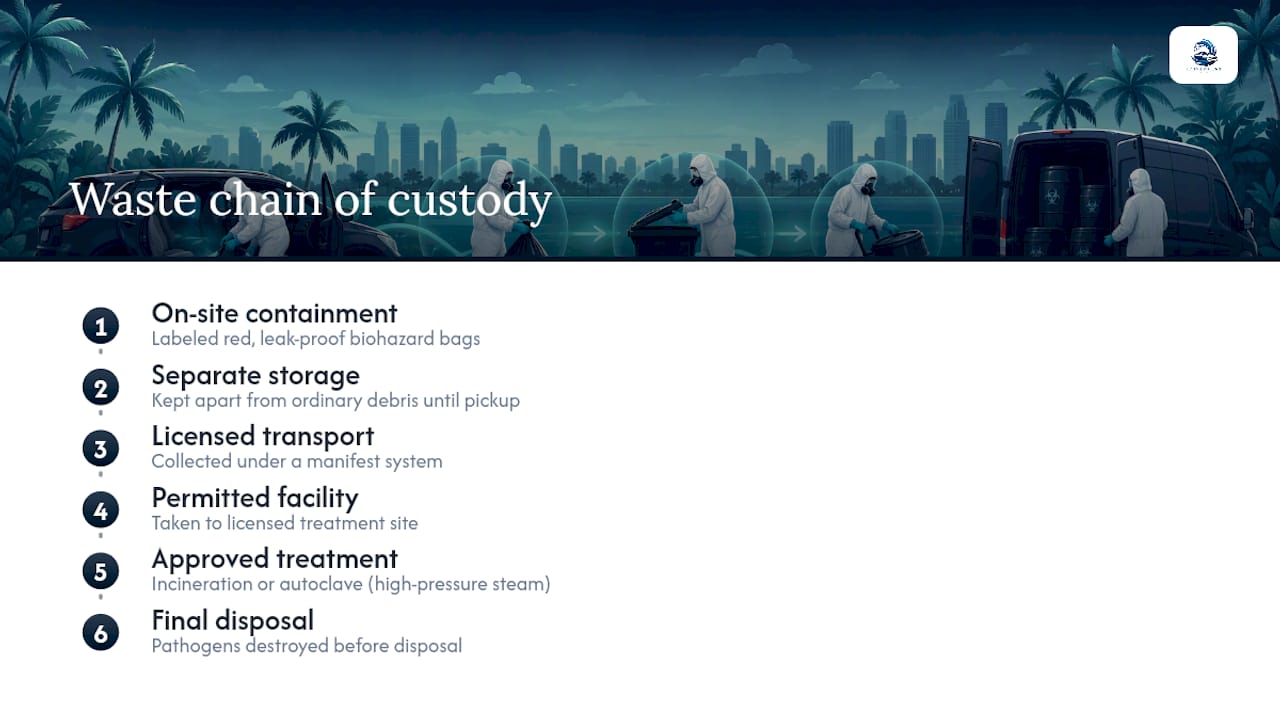
Regulated waste generated during vehicle decontamination doesn't go in a regular trash bag. Blood-soaked carpet, contaminated foam, gloves, and any material saturated with bodily fluids gets bagged in labeled, leak-proof biohazard containers, typically red bags marked with the universal biohazard symbol, and stored separately from ordinary debris until pickup.
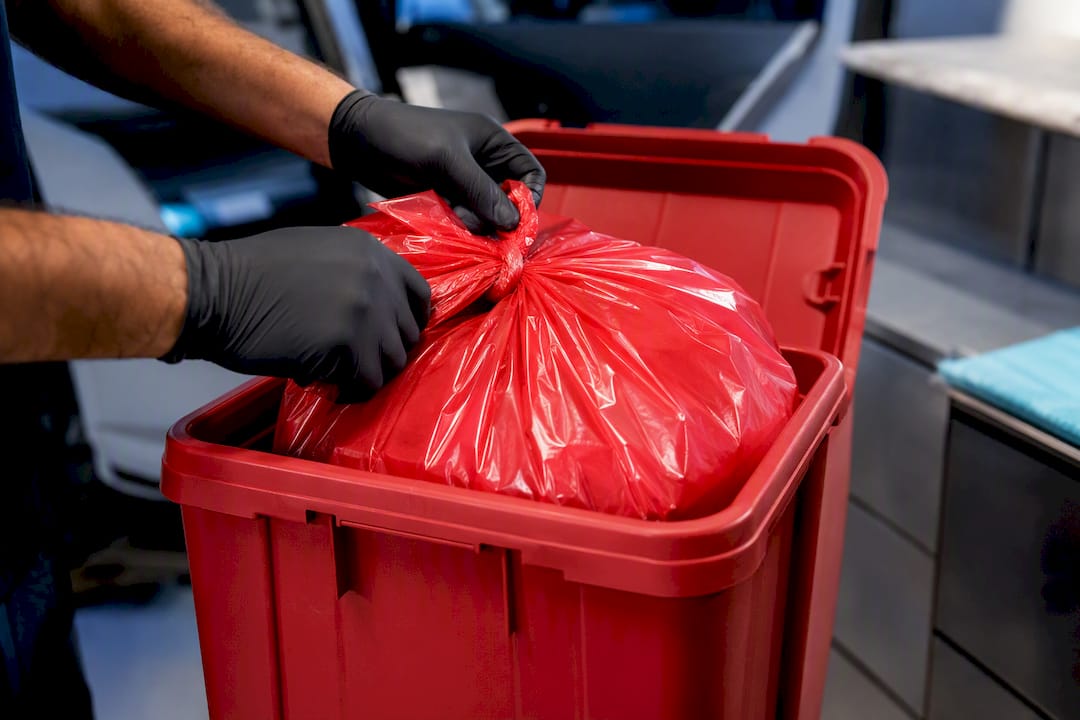
From there, licensed medical waste transporters collect the material under a manifest system that tracks it from the job site to a permitted treatment facility. Most regulated medical waste ends up incinerated or autoclaved (treated with high-pressure steam) at facilities specifically licensed for that purpose, which destroys pathogens before final disposal. This chain of custody is what separates legitimate biohazard remediation from a shop that just hauls a stained seat to the curb.
Sharps, needles found during a cleanup, follow their own protocol: rigid, puncture-resistant containers, never loose bags, transported through the same licensed medical waste stream.
For the vehicle owner, this matters for two reasons. First, it's the law, and a provider skipping it is exposing you to liability if that waste is ever traced back. Second, it's documented: a legitimate manifest gives you a paper trail showing the job was done to standard, which matters if an insurer or future buyer ever asks. If a provider can't describe this process in specific terms, that's a real gap in their operation, not a minor detail.
How Do You Know the Biohazard Is Actually Gone?
Visual cleanliness doesn't confirm biological safety. That gap is exactly why verification testing exists as a separate step from cleaning itself. ATP (adenosine triphosphate) testing measures residual organic material on a surface using a swab and a handheld reader, giving a numeric reading that can be compared against a pass/fail threshold rather than relying on someone's eyes and nose.
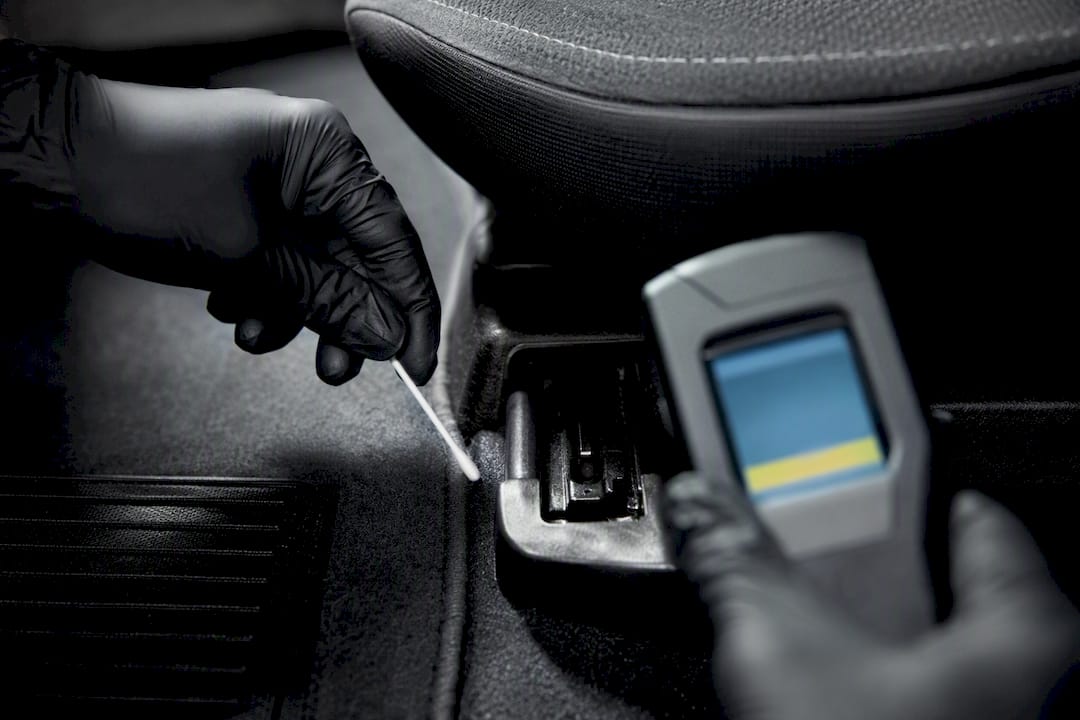
Beyond ATP readings, a thorough provider checks HVAC output for residual odor or particulate, inspects seams, seat tracks, and under-carpet areas where fluid commonly pools unnoticed, and confirms no lingering discoloration or staining on porous surfaces that were treated rather than removed. Air quality inside the cabin should be neutral, not masked by heavy fragrance, which is sometimes used to cover an incomplete job rather than fix it.
Ask for the verification results in writing. A provider following IICRC S540 guidance should have no problem producing a report showing pre- and post-cleaning readings. If a company can't explain how they confirmed the vehicle is safe, or simply says "it's clean" without evidence, treat that as incomplete work rather than a finished job. For resale or insurance purposes, that documentation often matters as much as the cleaning itself.
The Gap Between Marketing Claims and Real Biohazard Standards
Most of the confusion around biohazard car cleaning comes from marketing language borrowed from regular detailing. "Deep sanitization" and "hospital-grade clean" get used by shops that have never handled a bloodborne pathogen exposure control plan in their lives. The real dividing line isn't the language a company uses. It's whether they can show you a written exposure control plan, name their waste hauler, and produce a verification report without stumbling.
The conventional advice tells people to "get a few quotes and pick the best price." That's backwards for this category. Price should be the last filter, applied only after a provider clears the credential and documentation bar. A cheap job that skips porous material removal or waste manifesting isn't a bargain. It's a liability sitting in your car's upholstery and, potentially, in your legal exposure if that waste is ever traced.
What readers should prioritize first is documentation, not dollars: written scope, named disposal pathway, and a verification method you can actually see the results of. Everything else, including how the vehicle is picked up, where the work happens, and how fast it can start, is secondary to confirming the provider follows OSHA and IICRC S540 in practice, not just in their marketing copy.
— Living
Get Fast, Mobile Response From Living Waters Auto Wash LLC
Living Waters Auto Wash LLC gets to your vehicle wherever it's parked across Boca Raton, Pompano Beach, Coral Springs, or Parkland, without you needing a driveway hookup, an outlet, or a trip to a shop. That matters most exactly when you're dealing with a mess you don't want to drive around in.
For emergency cleaning, pet accidents, spills, and moderate interior contamination, the mobile team can typically be on-site the same day with a waterless-capable setup that handles the job right where the car sits. When you call, have the vehicle's location, a description of the contamination, and your insurance information ready. That speeds up dispatch and gives the crew what they need to scope the job accurately before they arrive.
For confirmed blood exposure, unattended death, or decomposition, Living Waters Auto Wash LLC will tell you directly and point you toward a specialized trauma remediation company built for that level of work. That honesty is part of the service. For everything else, from post-incident sanitization to fleet vehicles that need recurring maintenance, book a mobile detailing appointment and get a clean, safe vehicle without leaving your driveway.
This article is general information, not a substitute for advice from a qualified doctor. Consult a qualified healthcare professional about your own circumstances before acting on anything here.
Sources
- OSHA 29 CFR 1910.1030 — Bloodborne pathogens standard
- IICRC S540 standard — Trauma and Crime Scene Cleanup
- The role of insurance in covering biohazard cleanup costs — BioGone blog
- Scientific literature on pathogen survival on surfaces (DOI reference)