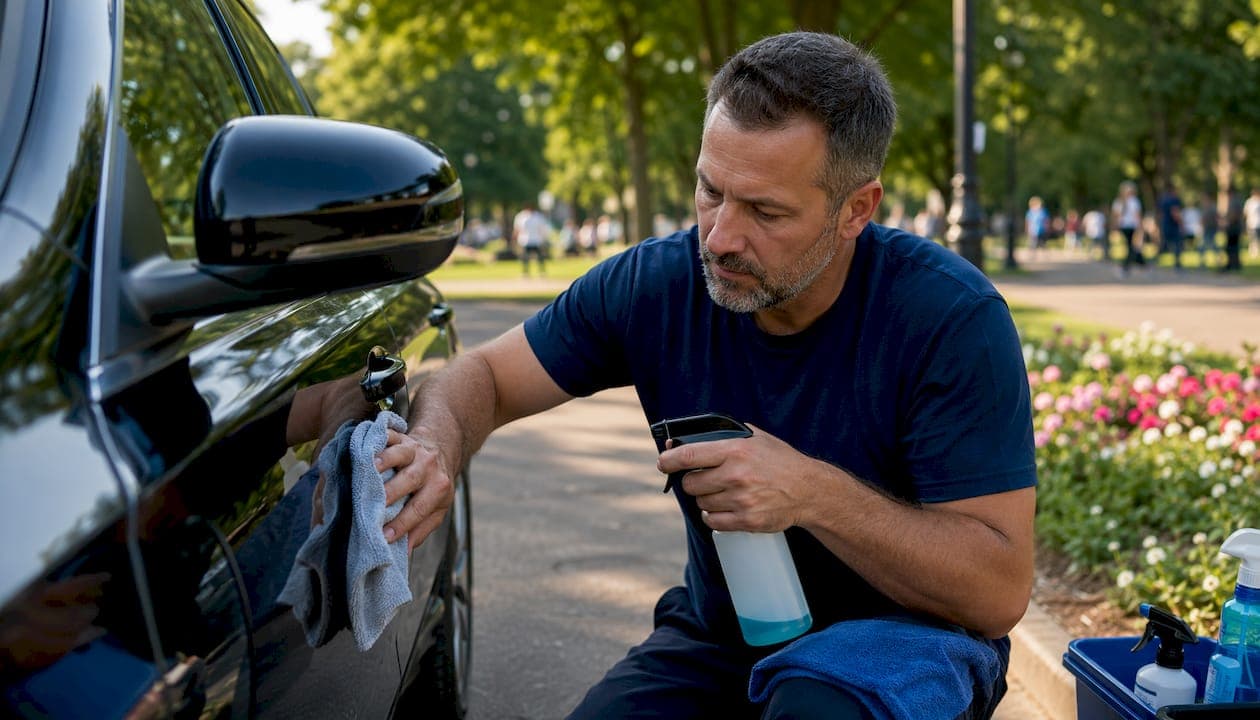
Yes, you can detail a vehicle without external electricity or water hookups. Light-to-moderate detailing is fully achievable using waterless spray products, rinseless wash concentrates, and battery-powered tools. The catch: heavy extraction, powered polishing, and deep odor removal require either a generator-equipped rig or a self-contained professional service. For most apartment dwellers, remote-area drivers, or anyone parked somewhere without outlets, the waterless and rinseless routes handle the bulk of what a car actually needs.
The fastest no-power options are:
- Waterless spray + microfiber towels for light dust and surface grime (30–90 minutes for a sedan exterior)
- Rinseless wash with a small onboard tank and manual pump for moderate dirt without a hose (45–120 minutes)
- Cordless handheld vacuum and dry-clean upholstery sprays for interior work between full details
When the vehicle has heavy soiling, significant pet hair, persistent odors, or needs paint correction, the right call is a self-contained professional. Living Waters Auto Wash LLC operates with onboard water tanks, battery inverters, and cordless extractors, so no customer-provided hookups are needed at all.
Table of Contents
- What supplies do you need for detailing without electricity?
- How do you clean a car exterior without running water or power?
- How do you clean a car interior when you don't have a power outlet?
- What should you not attempt without power, and when is a pro the right call?
- What are the rules for detailing in apartment or condo parking?
- How Living Waters Auto Wash LLC handles no-hookup jobs
- Key Takeaways
- The part most guides skip over
- Living Waters Auto Wash LLC brings the full setup to you
- Useful sources and further reading
What supplies do you need for detailing without electricity?
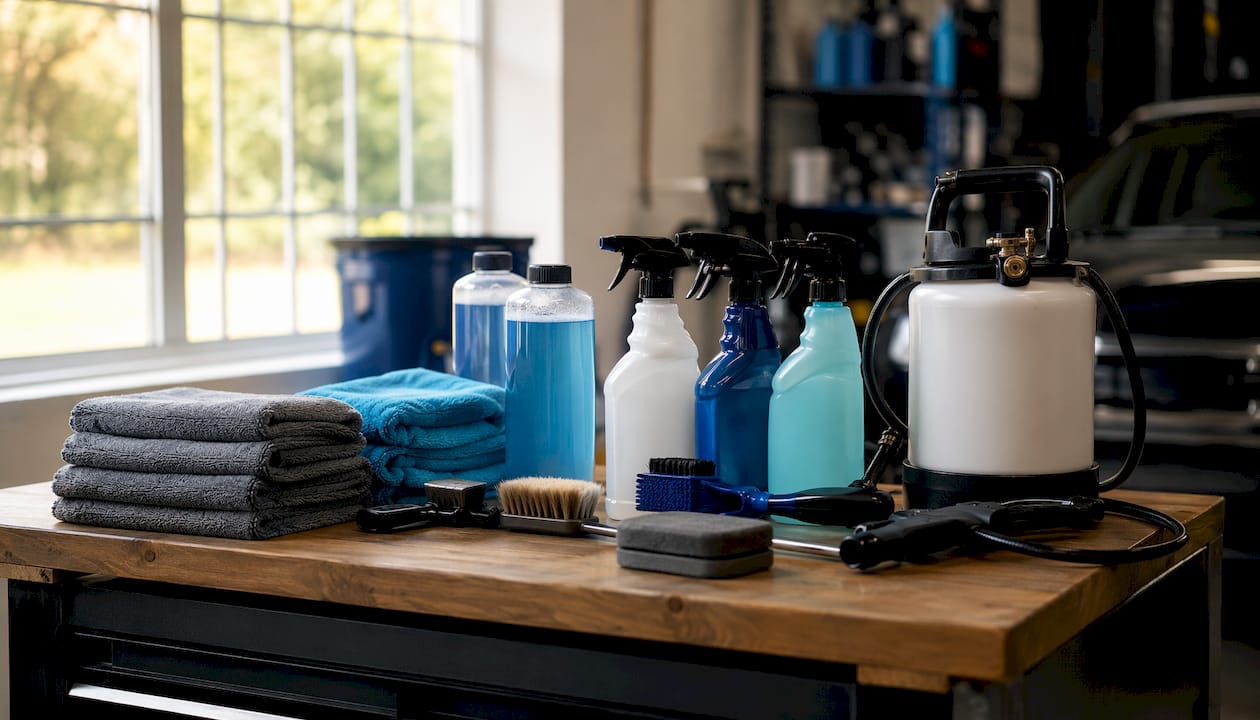
Getting the kit right before you start saves more time than any technique shortcut. Split your supplies into three categories: exterior, interior, and power/water alternatives.
Exterior supplies:
- Waterless wash product (spray-on, wipe-off formula)
- Rinseless wash concentrate for moderate-dirt jobs (diluted into a 5–20 gallon jug)
- At least 6 microfiber towels, pre-folded into quarters and color-coded by surface
- Separate wheel and brake dust towels (never cross these with paint towels)
- Bug and tar remover for targeted pre-treatment
- Clay bar or synthetic clay mitt for decontamination
- Quick detailer or polymer spray for a final protective wipe
Interior supplies:
- Cordless handheld vacuum (with at least one spare battery)
- Detail brushes in multiple sizes for vents, seams, and trim
- Dry-cleaning upholstery spray that activates with agitation, not water extraction
- Microfiber applicator pads for dash and door panels
- Carpet rake and rubber pet-hair brush
- Lint roller for fabric seats
- Odor neutralizer spray
- Segmented towel system: separate cloths for glass, dash, seats, and door jambs
Power and water alternatives:
- 12V inverter or portable power station (for cordless polishers and vacs)
- Portable solar charger for slow recharging between jobs in remote areas
- 5–20 gallon auxiliary water jugs for rinseless wash
- Battery-operated or manual hand pump for dispensing from jugs
- Professional rigs often carry 50–100 gallon tanks and 240V inverters for full-service capability
Pro Tip: Pack two extra microfiber towels beyond the minimum recommended, and keep a dedicated "contaminated" bag for used wheel towels so they never accidentally end up on paint.
How do you clean a car exterior without running water or power?
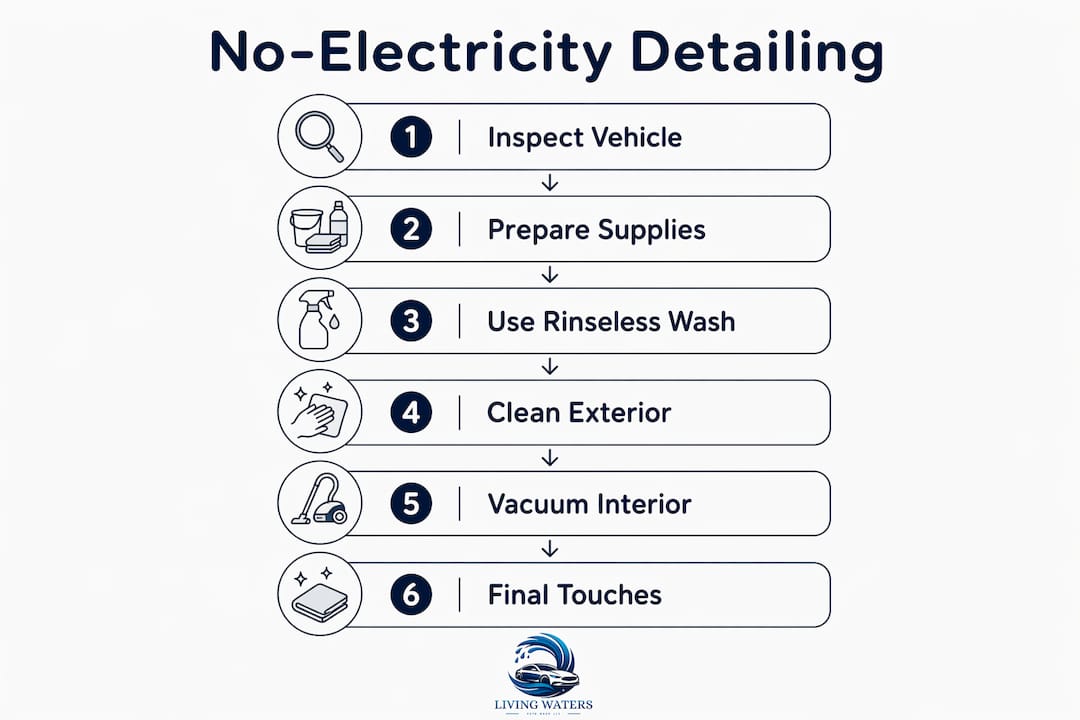
The order of operations matters more than the products you choose. Showroom-level results come from doing things in the right sequence, not from spending more on chemicals.
Start with a visual inspection
Before spraying anything, walk the vehicle. Look for caked mud, heavy sand, or road salt. Waterless wash is safe for light-to-moderate dirt when technique is correct, but it should not be used on heavily contaminated paint. Trying to wipe off thick grime with a waterless product drags abrasive particles across the clear coat and causes micro-scratches. If the vehicle is that dirty, a rinseless wash with a jug system is the safer choice.
The dirty-first rule
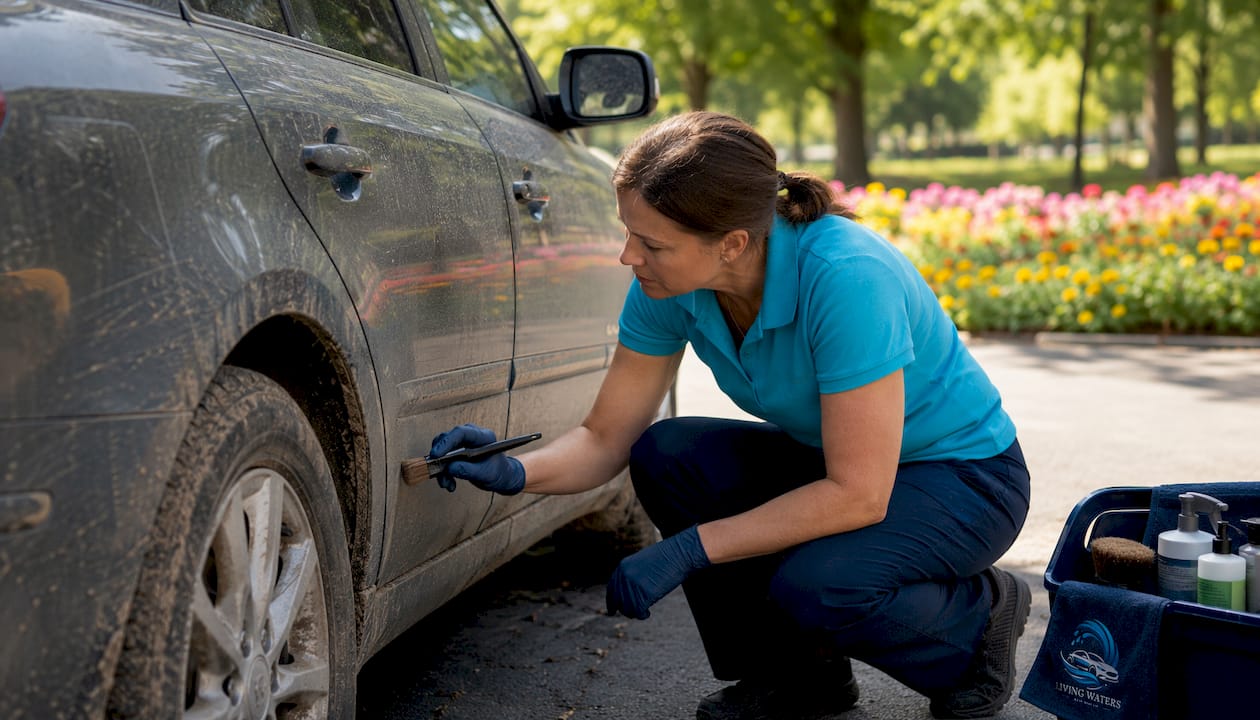
Always start with wheels and wheel wells, then tires, then lower body panels, and work upward to the roof last. Brake dust and road grime from wheels are among the most abrasive contaminants on a vehicle. Cleaning them first, with dedicated towels, keeps that material away from the paint entirely.
Waterless wash workflow
- Pre-treat bug splatter and tar spots with a targeted solvent; let it dwell 30–60 seconds.
- Spray waterless product generously onto one panel at a time (hood, door, quarter panel).
- Use a clean folded microfiber towel in straight, overlapping passes. Never circular.
- Flip the towel to a fresh face after each pass. When all four folds are used, move to a new towel.
- Follow with a light polymer quick detailer on the same panel for streak-free protection. 6 towels is a reasonable minimum for a standard sedan exterior to avoid transferring dirt back onto the paint.
Rinseless wash with a small tank
Dilute rinseless concentrate per the product label into a 5–20 gallon jug. Use a two-jug system: one for the wash solution, one for rinsing your applicator. Wring the applicator into the rinse jug, not the wash jug. Finish each panel with a drying towel and a quick detailer pass to eliminate water spots.
| Method | Typical time (sedan) | Water needed | Power needed |
|---|---|---|---|
| Waterless spray | 30–90 minutes | None | None |
| Rinseless wash (small tank) | 45–120 minutes | 5–20 gallons | None |
| Self-contained pro rig | 4–6 hours (full detail) | Onboard (50–100 gal) | Onboard inverter |
Work in shade whenever possible. Direct sun dries product before you can wipe it, leaving residue that requires a second pass.
How do you clean a car interior when you don't have a power outlet?
Interior work without electricity is more manageable than most people expect, as long as you plan the battery runtime and work top-to-bottom.
Start at the headliner, always. Dust and debris fall. Cleaning seats before the headliner means you'll be brushing headliner debris back onto the seats you just cleaned. Work headliner-first, then the dash, door cards, seats, and carpets last.
Manual techniques that actually work:
- Detail brushes agitate debris from vents, seams, and trim gaps without any power
- A bellows-style manual air blower clears tight spaces where a brush won't fit
- Dry-cleaning upholstery sprays activate with scrubbing agitation, not wet extraction, making them practical for fabric seats and carpet without a machine
- Rubber pet-hair brushes and carpet rakes pull embedded hair that a vacuum would miss anyway
Cordless vacuum planning:
Battery runtime is the limiting factor. A typical cordless handheld vacuum runs 15–25 minutes per charge on high suction. For a full interior, that means at least two battery cycles. Carry a compact power station so you can recharge between the front and rear sections of the vehicle.
| Tool | Best for | Limitation |
|---|---|---|
| Cordless handheld vac | Loose debris, pet hair, carpet | Short runtime; needs spare battery |
| Manual brush + dustpan | Vents, trim, tight gaps | Slower; no suction for embedded dirt |
| Dry-clean upholstery spray | Fabric seats, carpet stains | Not a substitute for wet extraction on deep stains |
| Rubber pet-hair brush | Embedded pet hair | Manual effort; works best before vacuuming |
Pro Tip: Organize interior work into three stages: front cabin, rear cabin, and cargo area. Charge your battery between stages. This prevents the frustrating situation of running out of power halfway through the back seat.
What should you not attempt without power, and when is a pro the right call?
Some detailing tasks genuinely require electricity. Knowing the line saves you time, money, and the risk of damaging your paint or upholstery.
Skip these without a power source:
- Powered polishing and paint correction. Hand-applying compound is possible, but a dual-action polisher running at 3,500–4,500 starting watts distributes product far more effectively and finishes to a true gloss. By hand, you risk uneven correction and residual marring.
- Heavy wet extraction for deep carpet or upholstery stains. Manual agitation handles surface soiling; embedded stains need a machine extractor.
- Large-scale odor removal requiring ozone generators or heated extractors.
- Deep shampooing that needs continuous water flow and a wet-vac to recover moisture.
Decision checklist: DIY or book a pro?
- Heavy mud, road salt, or sand on the paint? Book a pro.
- Significant pet hair embedded in carpet or fabric seats? Book a pro.
- Persistent odors that have not responded to spray neutralizers? Book a pro.
- Light dust, surface grime, and a reasonably clean interior? DIY waterless or rinseless is fine.
- Paint swirls, oxidation, or visible scratches? Book a pro with a generator-powered polisher.
Time and cost context:
A light DIY waterless exterior takes 30–90 minutes. A full manual interior adds another 1–3 hours. A professional full-service detail for a standard sedan runs 4–6 hours; paint correction can extend that to a full weekend. Professional pricing for a self-contained mobile detail varies by region, vehicle size, and service scope, but expect a meaningful premium over a basic wash in exchange for no hookups required and guaranteed results.
What are the rules for detailing in apartment or condo parking?
Shared parking creates constraints that go beyond technique. Before you set up, check three things: permission, space, and runoff.
Permission and access:
- Review your HOA rules or apartment lease. Many explicitly prohibit automotive detailing or water use in parking areas.
- Ask building management in writing. A covered loading area or ground-level lot with management approval is the most workable setup.
- High-rise buildings without driveway access are typically not suitable for mobile detailing; confirm site feasibility before booking.
Runoff and environmental concerns:
Waterless methods dramatically reduce runoff, but wheel cleaners and chemical pre-treatments can still produce contaminated runoff. Use absorbent pads or containment mats under the vehicle when using any liquid product. Choose biodegradable, phosphate-free formulas. Many municipalities regulate automotive wash runoff entering storm drains, so this is not just a courtesy issue.
Logistics checklist before you start:
- Confirm a flat parking space of roughly 12'×20' is available
- Check that the grade is not steeper than about 8–10% (safe staging limit for most mobile setups)
- Avoid working in direct sun above 85°F or in rain
- Reschedule if temperatures drop below 40°F, as waterless products and sprays do not perform reliably in the cold
- Keep doors closed while working panels to prevent airborne dust from resettling
A quick guide to mobile detailing in condo parking lots covers the permission process and site-assessment steps in more detail if you are navigating a specific residential complex.
How Living Waters Auto Wash LLC handles no-hookup jobs
Living Waters Auto Wash LLC operates as a fully self-contained mobile service across Boca Raton, Pompano Beach, Coral Springs, Parkland, and Palm Beach County. The team brings everything: onboard water tanks, battery-powered inverters, cordless extractors, and all chemicals. No customer outlet, no customer hose, no problem.
What the team brings to every job:
- Onboard water supply (no customer hookup required)
- Battery stations and inverters for cordless equipment
- Cordless extractors for upholstery and carpet
- Full chemical kit including clay bar, odor neutralizers, and pet-hair tools
- Trained technicians who follow a dirty-first, top-down order of operations
Pre-job site confirmation checklist:
- Parking access: flat, ground-level space of roughly 12'×20'
- Any HOA or management restrictions on detailing in the lot
- Vehicle condition notes: heavy soiling, pet hair, odor, or stain locations
- Estimated duration for a standard sedan: 4–6 hours for a full detail
Customers booking for the first time should tell the team upfront about any access restrictions, whether the vehicle has been sitting for an extended period, and any specific problem areas (pet odor, biohazard, heavy staining). That information lets the crew arrive with the right equipment and realistic time expectations. For fleet accounts, Living Waters Auto Wash LLC also offers recurring maintenance plans that keep commercial vehicles clean on a schedule without requiring a dedicated wash facility.
Key Takeaways
Detailing without electricity access is fully viable for light-to-moderate jobs using waterless sprays, rinseless systems, and cordless tools, but heavy extraction, polishing, and odor removal require a self-contained professional rig.
| Point | Details |
|---|---|
| Waterless vs. rinseless | Waterless spray handles light dust; rinseless wash with a 5–20 gallon jug is safer for moderate grime. |
| Time expectations | Waterless exterior detailing usually takes less than two hours, while a full professional detail takes several hours for a standard sedan. |
| Interior without power | Work top-to-bottom, use dry-clean sprays with agitation, and plan for two battery cycles on a cordless vac. |
| Know the limits | Skip powered polishing and deep extraction without electricity; these require a generator or professional rig. |
| Living Waters Auto Wash LLC | Fully self-contained service in Boca Raton, Pompano Beach, Coral Springs, Parkland, and Palm Beach County — no hookups needed. |
The part most guides skip over
The biggest mistake in no-power detailing is not the product choice. It is the towel. Specifically, it is the detailer who keeps using the same folded microfiber after it has picked up grit, or who grabs a wheel towel and wipes a door panel without thinking. That is how you put fine scratches in clear coat that were not there before you started.
The fix is not complicated. Fold each towel into quarters. You get eight clean faces per towel. When a face is used, flip to the next one. When all eight are used, the towel goes into the contaminated bag. Separate colors for wheels, paint, glass, and interior. This is not a premium-detailer habit. It is the baseline that prevents you from doing more damage than good.
The other thing worth saying: even if you are not using customer power, confirm outlet availability at booking anyway. Site surprises (a parking garage with no clearance, a lot with a management restriction you did not know about) are the most common reason a job gets delayed or rescheduled. A two-minute phone call before arrival eliminates most of them.
Living Waters Auto Wash LLC brings the full setup to you
Skipping the DIY route entirely is a legitimate choice, especially when the vehicle has pet hair, odors, or staining that manual methods cannot fully address. Living Waters Auto Wash LLC is the no-hookup alternative to dropping your car at a shop or waiting for a service that needs your outlet and your hose.
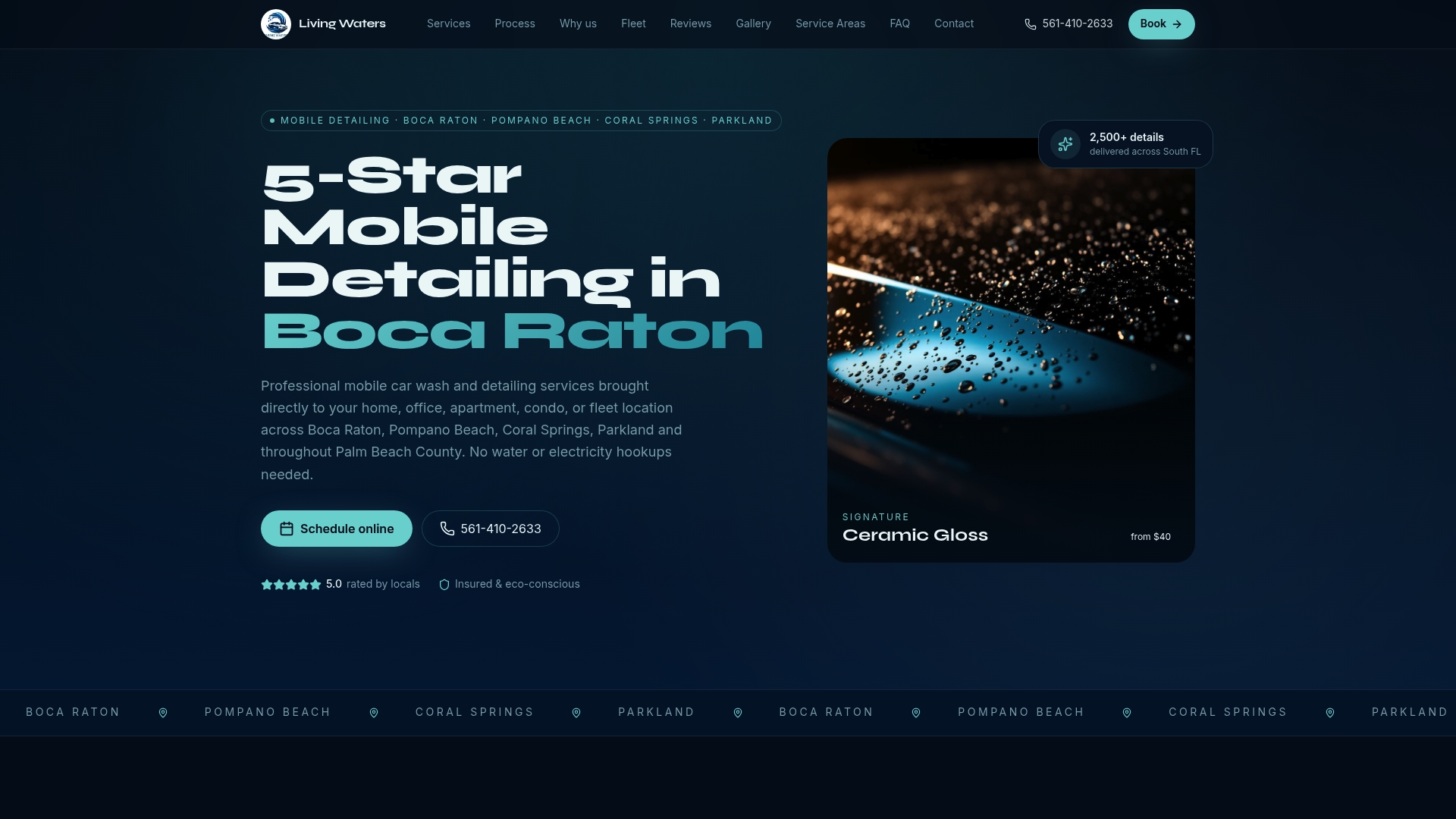
The service is built around a fully self-contained rig: onboard water, battery power, cordless extractors, and a trained crew that handles everything from express interior cleaning to clay bar and wax. Typical add-ons include pet-hair removal, odor extraction, headlight restoration, and biohazard cleaning. Paint correction is available but requires additional scheduling time for heavier work.
Service covers Boca Raton, Pompano Beach, Coral Springs, Parkland, and the broader Palm Beach County area. To book, provide your location, vehicle type, and any specific condition notes (heavy soiling, pet hair, access restrictions). The team confirms site feasibility and arrives with everything needed.
Book a self-contained detail or check availability for your location at lwautowash.com.
Useful sources and further reading
The sources below back the techniques, time estimates, and equipment guidance in this article. Check product pages directly for exact dilution ratios and battery runtime specs before purchasing.
- How to wash your car without water or electricity — Procedure guide covering waterless wash technique and professional rig tank sizes (50–100 gallons).
- How to wash your car without a hose or running water — Step-by-step towel technique, folding method, and surface-separation best practices.
- Step-by-step car detailing: The ultimate pro guide — Time estimates for professional details (4–6 hours for a sedan; paint correction extending to a full weekend).
- Mobile Detailing Setup: What You Need To Get Started — Equipment tradeoffs between generators, inverters, and shore power; tank sizing guidance for self-contained rigs.
- How mobile car detailing actually works — Parking footprint requirements (12'×20'), grade limits, and high-rise access constraints.
- Best Quiet Generator for a Mobile Detailing Business in 2026 — Generator class recommendations (3,500–4,500 starting watts) for running polishers and pressure washers.
- DIY car maintenance and detailing guide — Interior manual-agitation methods, headliner-first sequencing, and low-moisture cleaning techniques.
- DIY car wash guidance — Micro-scratch risk from improper waterless technique and the top-down, towel-rotation approach that prevents it.
Consult product labels for dilution rates and battery manufacturer specs for runtime before assembling your kit. Conditions vary by vehicle size, soil level, and ambient temperature.