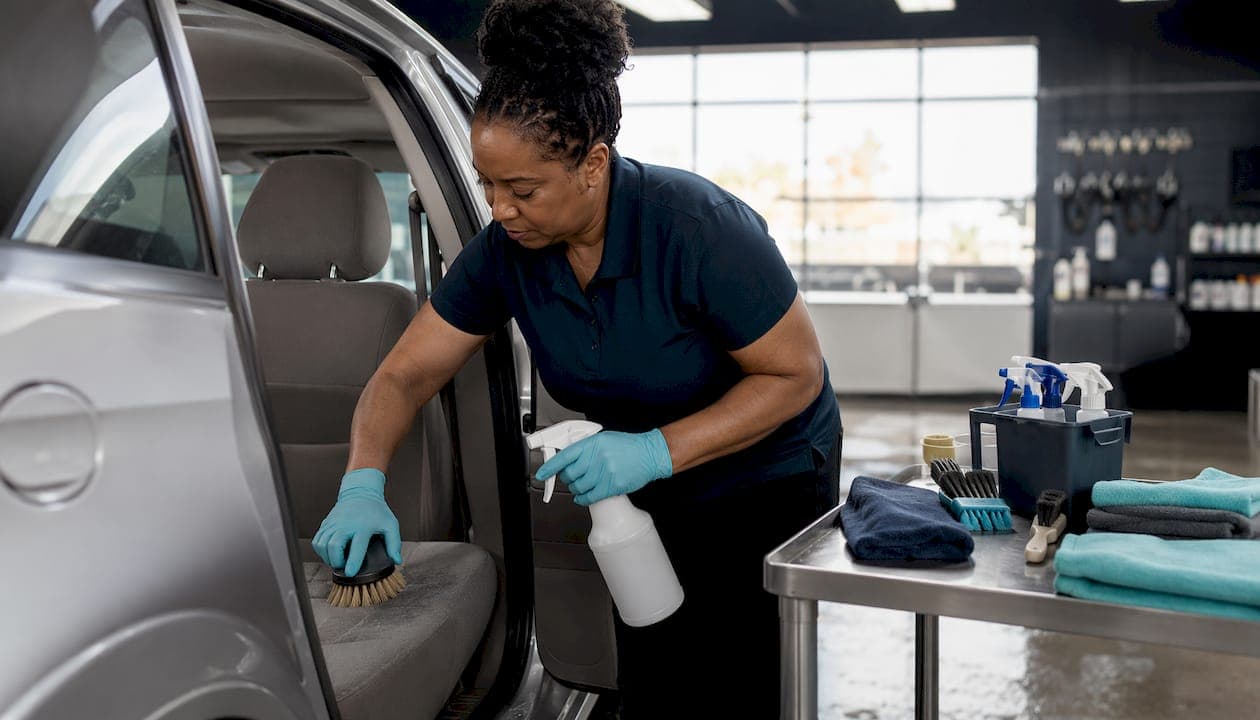
Interior deep cleaning is a top-to-bottom, restorative reset of your car's cabin that removes accumulated grime, allergens, embedded odors, and hidden buildup from areas routine cleaning never reaches — vents, seat seams, under mats, cup-holder crevices, and door tracks.
Quick DIY vs. hire decider: If your car has light-to-moderate soiling and you have several hours free, DIY is realistic. If you're dealing with pet hair throughout, smoke odor, biohazard, or heavy staining, book a professional.
What a full interior deep clean covers:
- Vacuuming every surface, crevice, and under-seat pocket
- Upholstery shampooing or extraction (fabric) or leather cleaning and conditioning
- HVAC vent cleaning (inside the louvers, not just the surface)
- Carpet extraction and mat scrubbing
- Glass cleaning (interior surfaces, including A-pillars)
- Electronics-safe wipe-down of the dash, console, and touchscreen
- Odor neutralization at the source, not just masking
Table of Contents
- What is interior deep cleaning, and how does it differ from routine care?
- When should you schedule an interior deep clean?
- How to deep clean your car interior from top to bottom
- What tools and products do you actually need?
- Should you DIY or hire a professional?
- What a mobile professional does on a full interior deep clean
- How long does it take, and what does it cost?
- How to avoid damaging your car during a deep clean
- Your pre-clean checklist before you start
- Key Takeaways
- What mobile detailing has taught us about interior deep cleaning
- Book a mobile interior deep clean without leaving your driveway
- Useful sources
What is interior deep cleaning, and how does it differ from routine care?
A car interior deep clean is restorative by nature. It targets the buildup that accumulates over months of daily use: grease in vent slats, baked-on spills in cup holders, pet dander pressed into carpet fibers, and grime packed into door-jamb seams. Routine cleaning keeps surfaces looking presentable. Deep cleaning resets them.
The distinction matters because most car owners conflate the two. A quick vacuum and wipe-down is maintenance. Deep cleaning is the baseline you maintain from.
| Category | Routine Cleaning | Interior Deep Cleaning | Full Detailing |
|---|---|---|---|
| Focus | Surface appearance | Restorative reset | Cosmetic perfection |
| Typical tasks | Vacuum, wipe dash, empty trash | Extraction, vent cleaning, seam scrubbing, odor treatment | All deep-clean tasks + paint protection, trim dressing, ceramic coating |
| Frequency | Weekly or bi-weekly | Every 3–6 months | Annually or pre-sale |
| Time required | 20–45 minutes | 3–6+ hours | 6 hours |
Areas that deep cleaning specifically targets but routine cleaning skips:
- Interior vent louvers and the ductwork just behind them
- Seat seams and the gap between seat cushion and backrest
- Under-mat areas where moisture and debris collect
- Window tracks and door-jamb rubber seals
- The underside of seat rails
When should you schedule an interior deep clean?
The most reliable trigger is a smell you can't locate. If your car has an odor that survives air fresheners, something is embedded in the upholstery or carpet, and a surface wipe won't fix it.
Other clear signals:
- Stains that have set and won't lift with a damp cloth
- Visible pet hair woven into fabric seats or carpet
- Post-illness sanitizing (especially after a sick passenger)
- Before selling or trading in the vehicle
- After a long road trip with kids, pets, or food
Suggested frequency by use pattern:
- Daily commuter, no kids or pets: every 4–6 months
- Family vehicle with kids or pets: every 2–3 months
- Infrequent driver: once a year, or before any extended use
Some situations push firmly toward a professional: flood or water intrusion, heavy smoke saturation, biohazard cleanup, or mold. These aren't DIY scenarios — they require controlled chemistries, extraction equipment, and sometimes ozone treatment.
How to deep clean your car interior from top to bottom
Order matters more than most people realize. The Cleaning Institute's top-down guidance is clear: clean high surfaces first so debris falls to lower surfaces you haven't cleaned yet. In a car cabin, that means starting at the headliner and vents before you ever touch the seats or carpet.
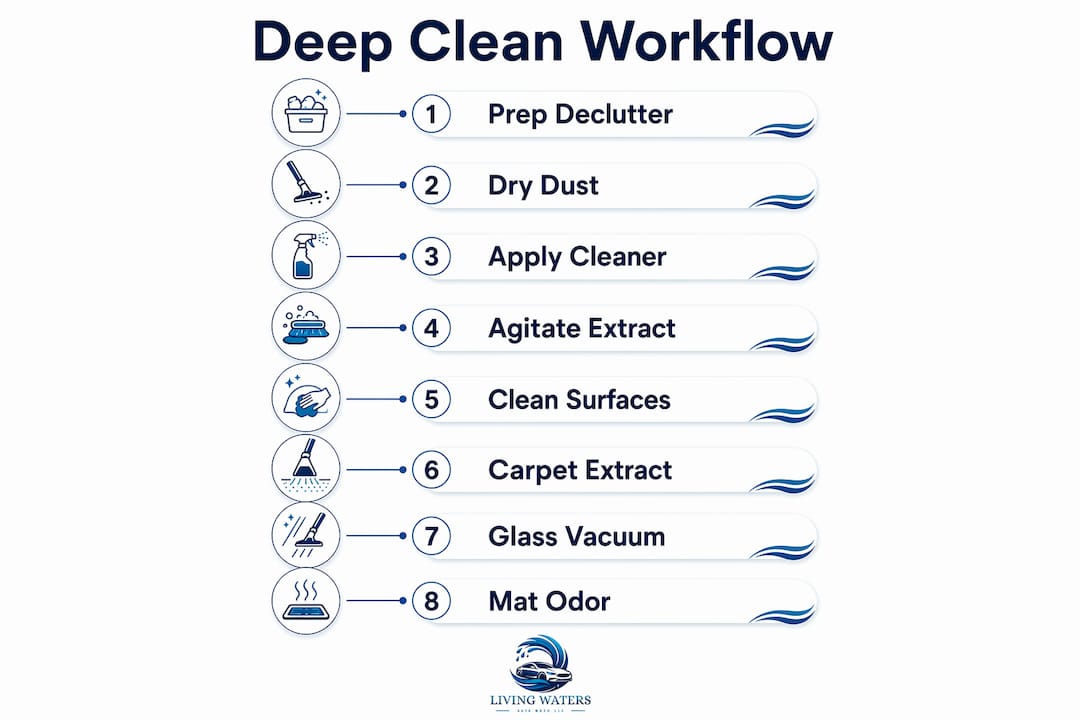
The full workflow
Step 1 — Prep and declutter (15 minutes) Remove everything from the car: floor mats, seat organizers, loose items, trash. Shake mats outside. Stage your tools and products within arm's reach before you start.
Step 2 — Dry dust from the top down (20 minutes) Use a soft detailing brush to loosen dust from vents, the headliner, and upper dash. Follow immediately with a vacuum using a brush attachment. Don't skip the headliner — it traps odors.
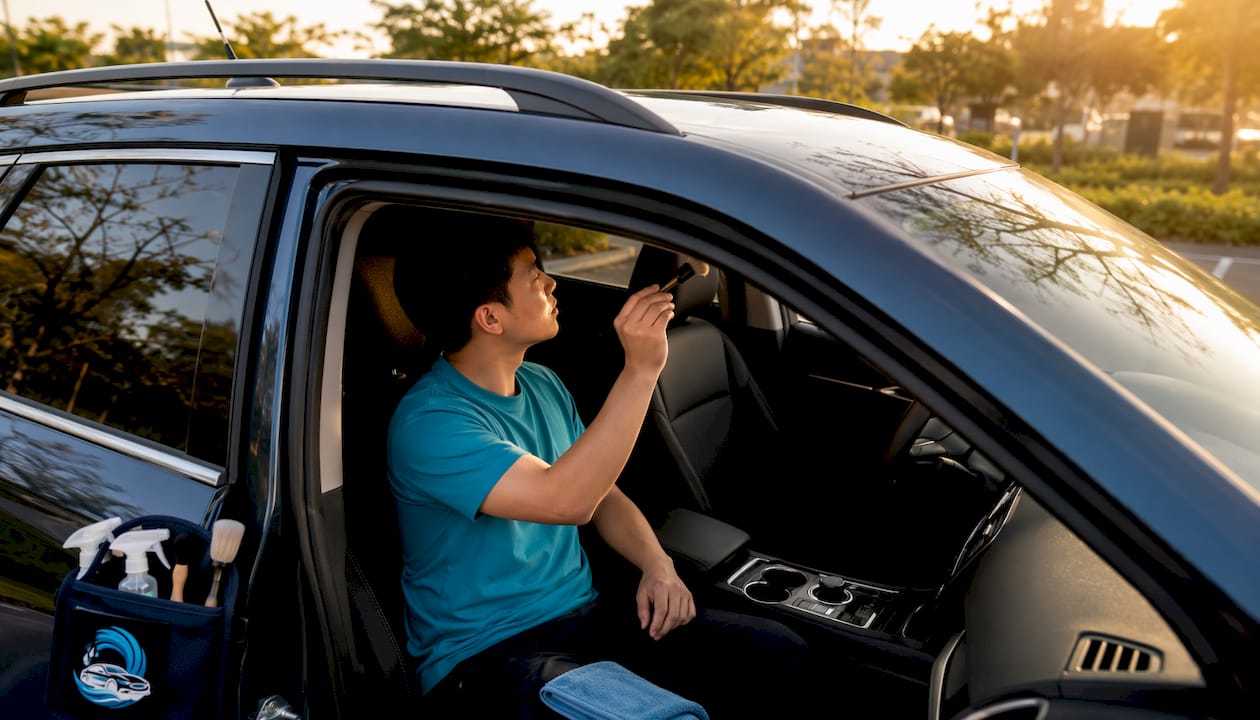
Step 3 — Apply cleaners and let them dwell (10 minutes active, 5–10 minutes dwell) Spray your chosen cleaner on fabric seats, carpet, and any plastic surfaces. Let it sit per the label instructions before agitating. This is where most DIYers rush and get mediocre results.
Pro Tip: Dwell time is the difference between a product that lifts a stain and one that just moves it around. For a degreaser on a greasy console, two minutes of dwell time does more work than two minutes of scrubbing.
Step 4 — Agitate and extract seats (30–45 minutes) Work fabric seats with a stiff-bristle upholstery brush in circular motions, then vacuum or extract. For leather, use a dedicated leather cleaner on a microfiber cloth — no circular scrubbing, which can abrade the surface coating.
Step 5 — Clean the dash, console, and door panels (20–30 minutes) Use a slightly damp microfiber cloth with a plastic/vinyl cleaner. Work into button gaps and vents with a detailing brush. Keep product away from touchscreens — use an electronics-safe wipe instead.
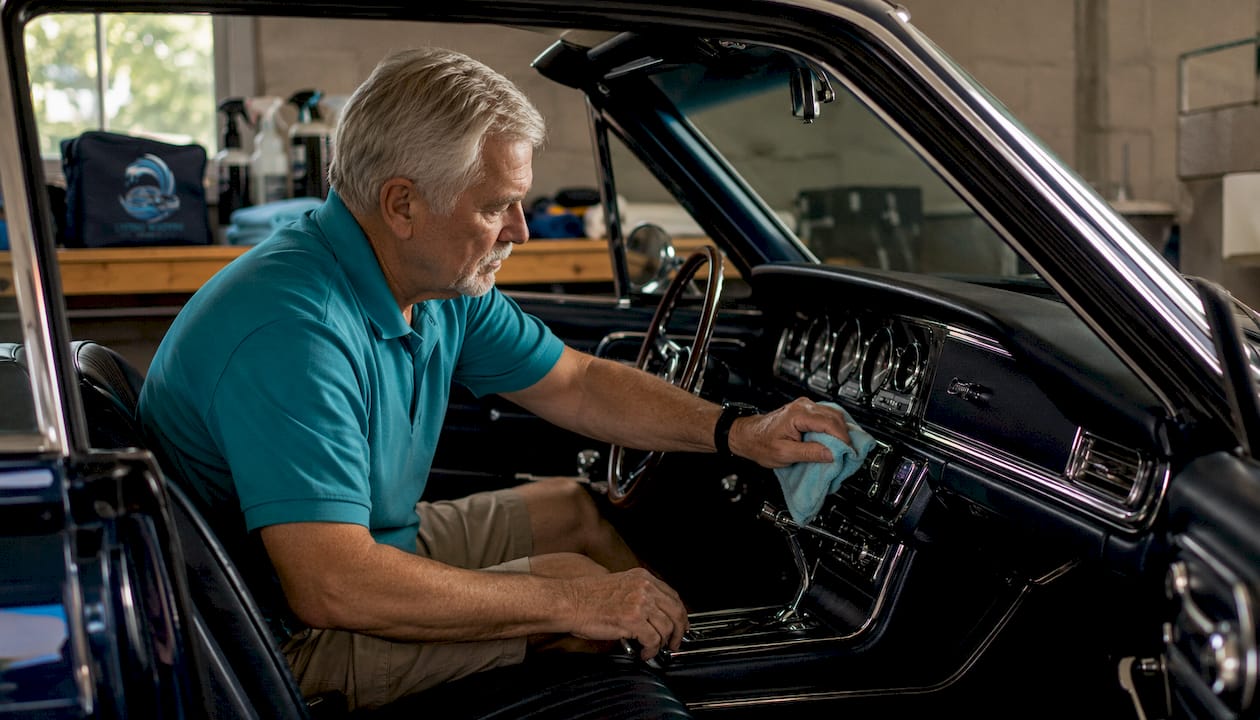
Step 6 — Carpet extraction (30–45 minutes) If you have a wet/dry extractor or rent one, this step makes the biggest visible difference. Work in overlapping passes, don't oversaturate, and allow adequate drying time before closing the car.
Step 7 — Glass and final vacuum (20 minutes) Clean interior glass with an automotive glass cleaner and a clean microfiber. Finish with a final vacuum pass on seats and carpet to pick up anything disturbed during the process.
Step 8 — Mats and odor treatment (15 minutes) Scrub mats separately, rinse if rubber, extract if fabric. Apply an enzymatic odor neutralizer to any problem areas — enzymatic formulas break down odor-causing organic compounds rather than masking them.
Total estimated time: 3–5 hours for a sedan in moderate condition.
Pro Tip: Use a cleaning caddy to carry all your products and tools from zone to zone. It sounds trivial, but walking back to a supply pile 30 times adds 20 minutes to a session and breaks your rhythm.
What tools and products do you actually need?
The right tool for each surface prevents the most common DIY damage. A brush that works perfectly on carpet will scratch leather. A cleaner safe for vinyl can cloud a touchscreen.
Tools by task:
- Vacuum: a shop vac or wet/dry extractor with a crevice tool, brush attachment, and upholstery nozzle
- Brushes: a soft detailing brush for vents and dash, a medium-stiff upholstery brush for fabric, a stiff-bristle brush for carpet and mats
- Microfiber cloths: minimum six, separated by task (glass, dash, seats, leather) to avoid cross-contamination
- Detailing swabs or cotton buds: for button gaps, USB ports, and vent slats
- Steamer (optional): effective for sanitizing fabric and loosening stubborn grime without excess moisture
Products by surface:
- Fabric/upholstery: pH-neutral upholstery cleaner or a dedicated fabric shampoo; enzymatic formula for stains with organic sources
- Leather: a dedicated leather cleaner (pH-balanced, no alcohol) followed by a leather conditioner to prevent cracking
- Plastic and vinyl: an interior detailer or all-purpose cleaner diluted per label; avoid anything with silicone on surfaces you touch
- Glass: automotive glass cleaner (ammonia-free to protect tinted windows)
- Odor: enzymatic neutralizer, not an air freshener
Buying tips: Buy sample or travel sizes of new products before committing to a full bottle. Check that any cleaner is labeled pH-safe for automotive interiors. Never use household bleach or abrasive scrubbers on any interior surface. For guidance on choosing surface-safe chemistries across different materials, interior door cleaning principles offer useful parallels for painted and varnished trim.
Store your kit in a dedicated caddy or bin, and keep glass cloths physically separate from other cloths to prevent streaking.
Should you DIY or hire a professional?
Professionals bring equipment most DIYers don't own: hot-water extraction machines, industrial-grade odor neutralizers, and the experience to know which chemistry is safe on which surface. That gap matters most when the soiling is severe.
DIY makes sense when:
- Soiling is light to moderate (no embedded odors, no set stains)
- You have several hours and the right tools
- You want to maintain a car that was recently professionally cleaned
- Budget is the primary constraint
Hire a pro when:
- Odors are embedded in the headliner or carpet padding
- Pet hair is woven throughout fabric surfaces
- Stains have set and you've already tried a cleaner without success
- You need the job done in under two hours
- The vehicle is going to market and condition affects resale value
For a deeper look at what separates express and full-service options, the types of professional car detailing guide breaks down service tiers clearly.
What a mobile professional does on a full interior deep clean
Living Waters Auto Wash LLC is a fully mobile detailing service covering Boca Raton, Pompano Beach, Coral Springs, and Parkland. Their technicians arrive at your location with all equipment — no water hookup or power outlet required on your end.
A typical full interior deep clean from a mobile pro at this level includes:
- Full vacuum of all surfaces, under seats, and in every crevice
- Hot-water extraction or upholstery shampoo on fabric seats and carpet
- Leather cleaning and conditioning on leather surfaces
- Vent cleaning (louvers and the duct area behind them)
- Enzymatic odor treatment on problem areas
- Electronics-safe wipe-down of the dash, console, and infotainment screen
- Interior glass cleaning
- Mat scrubbing and drying
Living Waters Auto Wash LLC currently offers a $199 Full Interior Deep Clean promotion. That price point covers the full scope above for most passenger vehicles, with turnaround typically within a few hours at your location.
The mobile model removes the biggest friction point in professional detailing: getting your car to a shop and arranging a ride. The service comes to your driveway, office, or apartment complex.
How long does it take, and what does it cost?
Time and cost both scale with vehicle size and soil level. Here's a realistic breakdown:
| Task | Sedan (moderate condition) | SUV/Truck (moderate condition) |
|---|---|---|
| Prep and declutter | 15 min | 20 min |
| Dry dusting and first vacuum | 20 min | 30 min |
| Cleaner application and dwell | 15 min | 20 min |
| Seat cleaning (fabric or leather) | 30–45 min | 45 min |
| Carpet extraction | 30 min | 45 min |
| Dash, console, vents | 20–30 min | 30–40 min |
| Glass and final pass | 20 min | 20 min |
| Mats and odor treatment | 15 min | 20 min |
| Total | ~3–5 hours | ~several hours |
Deep cleaning sessions can run multiple hours depending on condition — plan for a half-day for a sedan and a full day if you're working on a heavily soiled SUV.
Cost expectations:
- DIY: $40–$80 for a basic product kit; add $50–$80 if you rent a carpet extractor for the day
- Professional express interior: typically $80–$150 depending on vehicle size and market
- Full professional deep clean: typically $150–$300+, with Living Waters Auto Wash LLC's current promotion at $199
Factors that push time and cost up: heavy pet hair, smoke odor requiring ozone treatment, set stains needing multiple extraction passes, and extra upholstery work on third-row seating.
How to avoid damaging your car during a deep clean
The most common DIY mistakes are oversaturation, wrong chemistry, and skipping the spot test. Each one is avoidable.
Dos:
- Spot-test every new product on a hidden area (under a seat, inside a door jamb) and wait five minutes before proceeding
- Follow label dwell times — letting a product sit is more effective and gentler than aggressive scrubbing
- Use a damp cloth, not a wet one; wringing out a microfiber until it's barely damp is the right standard for most surfaces
- Wear nitrile gloves when using degreasers or enzymatic cleaners, and work with windows open for ventilation
Don'ts:
- Don't spray cleaner directly onto the dash near airbag covers or into any electronic port
- Don't use heat (a steamer or hair dryer) on microfiber-wrapped surfaces or foam-backed carpet — it degrades the backing
- Don't use abrasive brushes or scouring pads on leather, painted trim, or soft-touch plastics
- Don't use bleach or ammonia-based cleaners on tinted windows or leather
Pro Tip: If you're cleaning near the steering column or center console electronics, spray your cleaner onto the cloth first, never directly onto the surface. One drop in the wrong place can short a sensor.
For a detailed breakdown of how professionals handle sanitization without damaging sensitive surfaces, pro sanitization methods are worth reviewing before you start.
Dispose of dirty extraction water and chemical rinse water properly — don't pour it into a storm drain. Check your municipality's guidelines for disposal of cleaning waste.
Your pre-clean checklist before you start
Run through this before touching a single product:
- Remove all personal belongings, trash, and loose items from the cabin
- Pull out floor mats and shake them outside
- Gather all tools and products into a caddy before you start
- Check that your vacuum has a clean filter and empty canister
- Spot-test any new product on a hidden surface
- Open windows or work with doors open for ventilation
- Take a few photos of problem areas (stains, pet hair zones) for before/after reference
Time-block suggestion: Plan a half-day (3–5 hours) for a sedan in moderate condition. For an SUV or a heavily soiled vehicle, block a full day and build in drying time before you close the car up.
A cleaning caddy with a dedicated waste bag keeps your workspace organized and prevents you from cross-contaminating surfaces with a cloth that just touched the carpet. For a full rundown of how to stage your supplies before a mobile appointment, the mobile detailing prep guide covers logistics in detail.
Quick reminder: document pre-existing damage (scratches, worn leather, existing stains) before you start. If you're booking a professional, those photos protect both parties.
Key Takeaways
Interior deep cleaning is a restorative, top-to-bottom process that resets your car's cabin to a clean baseline — and doing it in the right order, with the right tools, is what separates a real deep clean from a thorough wipe-down.
| Point | Details |
|---|---|
| Definition | A restorative reset targeting vents, seams, carpet, upholstery, and hidden areas routine cleaning skips. |
| Order of operations | Always clean top-to-bottom: vents and headliner first, carpet and mats last, to avoid recontaminating clean surfaces. |
| When to hire a pro | Embedded odors, heavy pet hair, set stains, or a pre-sale condition require professional extraction and chemistry. |
| Safety first | Spot-test every product, never oversaturate foam or carpet, and keep cleaners away from electronics and airbag covers. |
| Living Waters Auto Wash LLC | Offers a $199 Full Interior Deep Clean with mobile service in Boca Raton, Pompano Beach, Coral Springs, and Parkland. |
What mobile detailing has taught us about interior deep cleaning
Most car owners underestimate one area above all others: the HVAC vents. Dust, mold spores, and pet dander accumulate inside the ductwork and get blown directly into the cabin every time the fan runs. Cleaning the vent louvers is visible and satisfying. Cleaning inside them, with a detailing brush and a vacuum nozzle, is what actually improves the air you breathe. That single step is what most DIY guides skip and what detailing's impact on air quality consistently highlights as the highest-impact move for health.
The professional priority order exists for a reason: air quality first — vents, headliner, odor sources — then upholstery, then deep carpet extraction. That sequence produces results that last because it removes the sources of recontamination before you clean the surfaces below them.
One thing worth communicating when you book a mobile deep clean: be specific about problem areas. "It smells" is less useful than "there's a pet odor concentrated in the rear seats and cargo area." Specificity lets a technician bring the right chemistry and allocate time where it matters most.
Book a mobile interior deep clean without leaving your driveway
Skipping the shop trip is the real advantage Living Waters Auto Wash LLC offers. Their fully mobile team comes to your home, office, or parking lot in Boca Raton, Pompano Beach, Coral Springs, and Parkland — no electricity or water hookup needed on your end.
The $199 Full Interior Deep Clean covers full vacuum and extraction, upholstery shampoo, leather conditioning, vent cleaning, odor treatment, and an electronics-safe wipe-down. Trained technicians handle the entire job on-site, typically within a few hours. If you need a lighter touch first, express interior detailing is also available for faster turnaround. To book or request a quote, visit the promo page and pick a time that works for you.
Useful sources
- The American Cleaning Institute — Room by Room Cleaning Guide: authoritative top-down cleaning methodology applied to vehicle workflow
- Angi — What Is Deep Cleaning?: scope definition covering vents, seams, tracks, and hidden areas
- Capital Clean Care — What Is Included in a Deep Cleaning?: time-duration benchmarks for deep-clean sessions
- The Final Touch Auto Detailing — Everything You Need to Know About Deep Interior Car Cleaning: vehicle-specific task list covering core deep-clean components
- Chemical Guys — How Much Does a Car Detail Cost?: professional vs. DIY cost and equipment comparison
- Otesse — What Is Deep Cleaning?: maintenance vs. deep-clean distinction and baseline concept
- Living Waters Auto Wash LLC — How Detailing Improves Air Quality in Cars: brand-sourced explanation of vent cleaning and allergen reduction